When you visit our website, information may be stored or recovered on your device, mainly in the form of cookies. We use essential cookies to ensure the website works as it should, and statistical and marketing cookies for audience measurement and content customisation purposes. We rely on Google for statistical and marketing cookies in order to measure website performance and display relevant advertising. For more information on this, please also refer to the Google policy on Business Data Responsibility.
From the Cookie Management Centre, you can set your preferences with respect to the use of cookies: accept or reject certain categories, accept all, or reject all. For detailed information on all cookies used across these three categories, please refer to our Cookie Policy.
Please note that blocking certain cookies may affect your experience and the services offered.
Essential cookies Always active
Essential cookies help the website to work as it should by enabling necessary functionalities, such as navigating between pages and accessing secure areas. These cannot be disabled in our systems.
Statistical cookies
Statistical cookies help us understand how visitors interact with our site by collecting and communicating browsing information. They make it possible to identify the most and least visited pages and to improve the overall performance of the site.
Marketing cookies
Marketing cookies are used to display relevant advertising and measure the performance of campaigns. If you choose not to allow these cookies, you will continue to see ads, but they will be less relevant to your interests.
Choose the purposes for which we may use Google products to collect and use your data:
User storage: to technically permit advertising functionality.
User data for advertising: to optimise our advertising campaigns.
Ad customisation: to tailor advertising to your interests.
The Democratic sweep of Congress creates legislative gridlock, while leaving the broad path of US economic policy largely unchanged
Fiscal, trade and industrial policies are unlikely to shift materially before 2028, with most major initiatives already in place and many measures implemented through executive orders
Political friction may generate volatility, but history suggests divided government can support government bonds, corporate credit and equities as policy visibility improves
We retain our pro-risk stance, with overweights in US and global equities. We remain neutral on government bonds and positive on the US dollar.
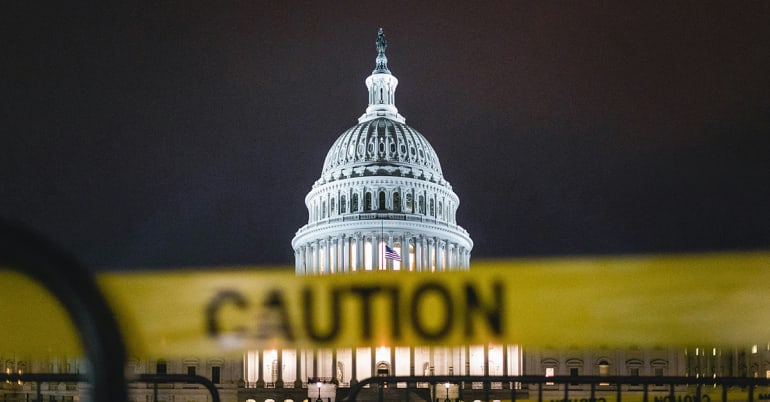
The US midterm elections saw control of both chambers of Congress shift to the Democratic Party, limiting the likelihood of major new legislation over the next two years and leaving the broad direction of US economic policy unchanged. The investment backdrop remains one of resilient US domestic growth, unprecedented capital expenditure, a more constrained fiscal outlook, and continued strategic competition with China.
Democrats won a decisive ‘blue sweep’ of the key seats in both the House of Representatives and Senate, handing them majorities in both chambers. Since 2006, every US president has lost control of at least one chamber of Congress in midterm elections.
Given this historical pattern, an unpopular war in Iran, voters’ concerns about prices at home and President Trump’s low approval ratings, the Republicans’ defeat is no surprise. The scale of the Democrat sweep also matters for both parties. For the Republicans it raises questions about the president’s electoral appeal heading into the 2028 election, and for Democrats reduces the leverage of the Party’s more radical factions.
A divided government is a recipe for gridlock on many subjects, with the Congress in a position to stonewall presidential legislation, and the president able to veto Democrat proposals. Congress is unlikely to agree bipartisan measures to slow US spending growth over the next two years and may act only on issues such as government funding or the debt ceiling, with defence spending and immigration potentially sensitive clash points.
Congress is unlikely to agree bipartisan measures to slow US spending
With a Democrat majority in both chambers, new policy will likely come through the president’s executive authority, limiting Congress’ ability to alter measures. Many of the second Trump administration’s most consequential measures until now have been implemented through executive orders or existing statutory authority, rather than new legislation, despite Republicans controlling both chambers of Congress. Democrats may now launch investigations into actions by the president and key figures in his administration. However, the chances of a successful impeachment of the president are low; removing a president from office still requires a two-thirds majority in the Senate, which the Democrats lack. Yet even if an impeachment process failed, it may set the tone for the 2028 presidential campaign.
This ‘lame-duck’ period in the weeks before the new Congress takes office in January 2027, may offer President Trump a window to resume strikes against Iran. We would expect any resumption of the campaign to be limited in both time and effectiveness, partly because of the constraints imposed by munitions rather than a lack of funding. Iran’s response to such attacks would be equally important. Iranian attacks on US allies in the region would escalate the political costs for the Trump administration.
Sign up for our newsletter
A narrower mandate, not a new direction
The broad direction of US fiscal policy was largely established during the administration’s first year in office through the ‘One Big Beautiful Bill’ in 2025. Any major change to tax or spending would need Congressional approval, meaning that a major fiscal policy shift is unlikely before 2028. Tax measures and investment incentives still offer support, but we expect already-approved spending reductions to start to weigh on US economic activity over the coming quarters.
Our core assumption remains that fiscal policy stays on autopilot
Approaching deadlines may give the Democrats some leverage to push for their own fiscal demands, perhaps on healthcare, tariffs, or AI. Funding for most US government agencies ends on 11 December, and the debt ceiling will likely be reached by the end of the first quarter of 2027. Extending funding and raising or suspending the debt ceiling requires a Congressional majority. However, with the deficit already wide, scope for compromise is small, and our core assumption remains that fiscal policy stays on autopilot.
Trade policy is likely to see some continuity because the administration has relied on executive authority rather than Congressional approval to implement measures including punitive tariffs. Trade restrictions will therefore remain available policy tools, unless challenged again.
At the institutional level, the election also has implications. With a Democratic majority in the Senate, the White House will be unable to impose politically controversial candidates as judges, cabinet officials and Fed appointments. Concretely, that means that any vacancy on the Supreme Court or Fed may stay empty until a new administration is in place in 2029.
Strategically, we do not see the midterms impacting US priorities around its competition with China, industrial resilience, supply-chain security and domestic manufacturing. These will remain bipartisan priorities, while geopolitical tensions in the Middle East and efforts to secure critical technologies are also likely to remain important themes. In foreign policy, Congress may increase scrutiny of executive decisions but is unlikely to fundamentally alter the president’s broad discretion over sanctions, diplomacy and military action.
A positive outlook for risk assets
Despite recent volatility, our focus remains on the core drivers of the economic and market outlook. The US economy continues to show resilience despite tighter financial conditions in October. Private-sector demand, corporate earnings and investment remain the main growth drivers, while a gradual path towards disinflation and Federal Reserve policy shape market expectations.
Markets prefer visibility over uncertainty, even when that comes with constraints and political friction
Markets typically prefer visibility over uncertainty, even when that visibility comes with institutional constraints and political friction. Investors will now focus again on fundamentals rather than political developments.
We maintain our pro-risk stance, with overweights in global and US equities. If past midterms are any guide, US stock markets have often been volatile before the vote and strengthened after, as we wrote last month. In today’s environment, market opportunities will ultimately depend on fundamentals. We expect equity markets to continue to depend predominantly on robust private-sector demand, investment, and earnings, all of which can offset higher financing costs and static or slowing fiscal spending. Selectivity remains key, and we favour firms with strong balance sheets, substantial free cash flow, durable margins, and visible earnings growth. Lower Treasury yields would also support growth-oriented stocks including technology, communication services, consumer discretionary and small capitalisations.
These businesses should retain a valuation premium and outperform sectors that depend on government spending. We are nonetheless monitoring policy debates that could influence technology-sector investment. At the state level, changes in the political environment may affect the AI sector’s ability to build new data centres, which are an increasingly sensitive issue among voters. Specifically, Democrats may push to scale back tax incentives, shift more grid costs onto developers, and try to introduce safety regulations. We see little risk of stringent or impactful measures, such as a federal moratorium on data centres, which would likely face an immediate presidential veto. Some self-supervised regulation remains the most likely path. We maintain an overweight in global stocks, including in the US where we think the technology sector will continue to help drive broader performance.
The dollar is still undervalued
Historically, periods of divided government following the midterm elections, all else being equal, have often coincided with a more favourable environment for government bonds, high-quality corporate bonds and equity markets. In the three months following a midterm vote, 10‑year Treasury yields have fallen by about 20-25 basis points (bps) on average. Falling government bond yields may support total returns, and with some political uncertainty behind them, investors may be more willing to use cash to build risk exposure. A divided US government and the fiscal path should also reduce upward pressure on longer-dated yields and allow part of the risk premium embedded in longer maturities to unwind. We continue to favour 5-to-7-year maturities in US Treasuries. In the past, corporate bonds have also performed well after midterms. Investment-grade spreads – or the additional yields on offer over government bonds – have typically tightened progressively, while high-yield spreads have compressed more sharply. While both investment grade and high yield bonds would benefit from tighter spreads, we see current levels as historically tight and therefore remain neutral on both segments.
We maintain a positive outlook for the US dollar against other developed market currencies. The dollar is still undervalued compared with real yields and supported by expectations for lower policy rates outside the US next year. Also, confidence in Federal Reserve independence would be reinforced since board appointments require a Democrat-led Senate confirmation.
This is a marketing communication issued by Bank Lombard Odier & Co Ltd (hereinafter “Lombard Odier”).
It is not intended for distribution, publication, or use in any jurisdiction where such distribution, publication, or use would be unlawful, nor is it aimed at any person or entity to whom it would be unlawful to address such a marketing communication.






share.