When you visit our website, information may be stored or recovered on your device, mainly in the form of cookies. We use essential cookies to ensure the website works as it should, and statistical and marketing cookies for audience measurement and content customisation purposes. We rely on Google for statistical and marketing cookies in order to measure website performance and display relevant advertising. For more information on this, please also refer to the Google policy on Business Data Responsibility.
From the Cookie Management Centre, you can set your preferences with respect to the use of cookies: accept or reject certain categories, accept all, or reject all. For detailed information on all cookies used across these three categories, please refer to our Cookie Policy.
Please note that blocking certain cookies may affect your experience and the services offered.
Essential cookies Always active
Essential cookies help the website to work as it should by enabling necessary functionalities, such as navigating between pages and accessing secure areas. These cannot be disabled in our systems.
Statistical cookies
Statistical cookies help us understand how visitors interact with our site by collecting and communicating browsing information. They make it possible to identify the most and least visited pages and to improve the overall performance of the site.
Marketing cookies
Marketing cookies are used to display relevant advertising and measure the performance of campaigns. If you choose not to allow these cookies, you will continue to see ads, but they will be less relevant to your interests.
Choose the purposes for which we may use Google products to collect and use your data:
User storage: to technically permit advertising functionality.
User data for advertising: to optimise our advertising campaigns.
Ad customisation: to tailor advertising to your interests.
The November 2026 US midterm elections are likely to deliver a divided government, with Democrats expected to take the House, and a Democratic Senate majority looking increasingly probable
Midterm losses for the president's party are a feature of US politics rather than a historical anomaly. Trade and foreign policy will remain in the president’s hands, regardless of the election results
A divided government will however create legislative gridlock, and leave core economic policy unchanged: fiscal policy would be effectively on 'autopilot', and become a mild headwind to growth over the coming quarters
Investors should expect more political friction and some market volatility around the 3 November vote, but little change to the fundamental path of US policy and economic conditions.
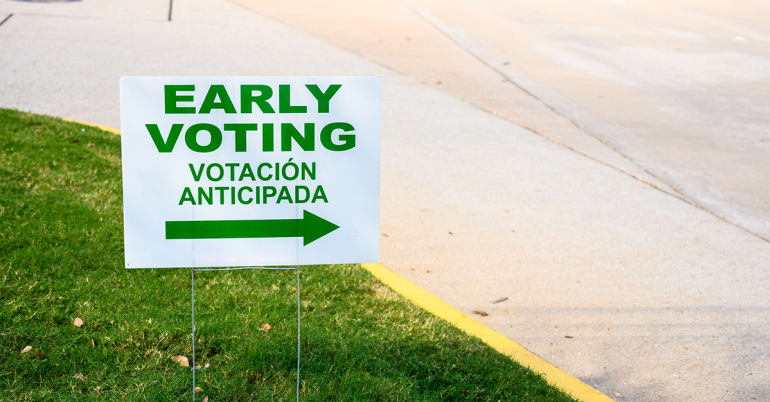
The race for control of the two branches of the US Congress clearly indicates a divided government. The 3 November midterm elections are expected to see Democrat candidates win a majority in the House of Representatives. The fight over the Senate, where Republicans had been expected to retain a majority, has become competitive. For investors, this would leave President Trump with a narrower governing mandate rather than implying major policy changes.
Our base case is that the Democrats gain control of the House of Representatives, where prediction markets suggest they have the upper hand, while Republican prospects to retain a Senate majority have narrowed. A shift in Texas, a state that has only elected Republicans to the Senate since 1993, is notable. There, the party’s candidate for the contested seat, endorsed by President Trump, has been described as “ethically challenged” by fellow Republican Senators. Texas is important because it illustrates a decline in support for Republicans nationally, and the close race forces the party to divert resources to a previously safe seat. Mr Trump remains the dominant figure in American politics and his falling approval ratings have created headwinds for Republican candidates, especially those most closely associated with the administration.
Sign up for our newsletter
A divided Congress would leave many policy tools firmly in the hands of the administration, but it would remove the White House’s ability to pass major legislation. Over the past two decades, every US president has lost control of at least one chamber of Congress following midterm elections. A weaker congressional position for the current White House would therefore follow a familiar pattern of checks and balances.
Such a result would allow a Democrat-controlled House to block legislation, reducing the administration’s ability to bring in new tax cuts, broad spending programmes or make significant structural reforms. Still, not all policy momentum would disappear. Several policy areas that fall under executive powers and are important for markets would remain largely unaffected by the outcome.
Trade policy is the clearest example of continuity and an area in which the Trump administration has not sought Congressional backing
Trade policy and political friction
Trade policy is the clearest example of continuity and an area in which the Trump administration has not sought Congressional backing. Whatever the election outcome, the administration will retain authority to use tariffs and other trade measures through existing executive powers, leaving the path of US trade policy intact, unless challenged by the Supreme Court. Similarly, minor regulations within federal agencies would still be driven by the White House, and we would expect to see the president issue more executive orders.
Foreign policy, including sanctions, will also remain within the president’s powers. However, after the strikes to topple Venezuela’s president at the start of the year, and the continuing conflict with Iran, we would expect any further US interventions to generate domestic political friction and further erode the president’s support.
The Trump administration continues to question the integrity of the US electoral system and is advocating tighter voting rules in a number of states. The president also still refuses to accept his loss in the 2020 presidential election and has so far stopped short of committing to accept the results of the 2026 midterm vote. While the US’s decentralised voting system prevents a president from overturning the outcome at the national level, we should not underestimate the risk of disruptions before and after the vote. Efforts to challenge voting procedures, cast doubt on the legitimacy of the process, or challenge unfavourable results could create political uncertainty, and market volatility, even if the results are eventually certified.
We should not underestimate the risk of disruptions before and after the vote
A divided Congress may lead to more intense policy oversight and raises the likelihood of periodic government shutdowns over recurring funding disputes. Such episodes can generate significant news flow and short-term market volatility, even if their lasting economic impact is usually limited. Markets would therefore need to contend with even more political noise.
At the same time, the chances of a successful impeachment process against the president are rather low. A Democrat-majority House could initiate investigations and potentially pursue proceedings. However, removing a US president from office requires a two-thirds majority in the Senate, a threshold that remains improbable with no more than a narrow Democrat majority. As a result, an impeachment attempt may generate headlines but not alter the political equilibrium.
Fiscal policy is another area where divided government is significant. Much of the US’s fiscal outlook was determined by the ‘One Big Beautiful Bill’ in 2025, deliberately passed in the administration’s first year to leverage its Congressional majority. This fiscal baseline will not be substantially altered because any major change would need approval by both chambers of Congress, with at least one under Democratic control. Fiscal policy would therefore effectively be on autopilot through to 2028.
Fiscal policy would therefore effectively be on autopilot through to 2028
We therefore see fiscal policy shifting from a sizeable tailwind towards a modest headwind over the coming quarters. Tax-related measures and investment incentives will continue to provide some support, but cuts to Medicaid and other social spending will act as a drag on growth starting in the second half of this year. This was a deliberate policy by the White House to shore up voter support and minimise the impact on the midterm vote, by frontloading tax cuts and postponing benefit cuts. A divided Congress would make it difficult either to meaningfully expand or reverse these policies through new legislation.
Another area where divided government could be meaningful is political appointments. If Democrats were to win a Senate majority as well as the House, the confirmation of judges, cabinet officials and Federal Reserve appointments would all require Democratic support, making it impossible to for the White House to nominate politically controversial figures. This may impact the Fed, where it is possible that former Chair Jerome Powell decides whether to stay on the central bank’s board depending on the post-election balance of power. Specifically, if Democrats were to win a majority in both chambers, Mr Powell may conclude that the White House would have little scope to propose a candidate on the basis of their political agenda, and therefore feel able to step down.
…any election-driven market weakness would be more about sentiment than a signal that the underlying economic outlook is deteriorating
Equity market implications
Any midterm-related equity market volatility would create tactical opportunities rather than a lasting shift in the market environment. Historical experience suggests that periods of weakness ahead of midterm elections have often been followed by stronger equity returns once political uncertainty fades. Given our expectation that divided government would lead to policy continuity rather than a policy reset, any election-driven market weakness would be more about sentiment than a signal that the underlying economic outlook is deteriorating.
Broadly, for investors, a divided government would reduce the administration’s ability to reshape the legislative landscape, but tariffs and foreign policy will remain tools under the president’s control through executive orders. Fiscal policy would therefore continue along a largely predetermined path. The election can increase political friction in the legislative system, creating paralysis and increasing the risk of government shutdowns. The most likely outcome of the 2026 midterms is therefore not political transformation, but a narrower political mandate within the constraints of a divided US government, as has happened to every presential mandate over the past two decades.
This is a marketing communication issued by Bank Lombard Odier & Co Ltd (hereinafter “Lombard Odier”).
It is not intended for distribution, publication, or use in any jurisdiction where such distribution, publication, or use would be unlawful, nor is it aimed at any person or entity to whom it would be unlawful to address such a marketing communication.






share.