corporate sustainability.

corporate sustainability.

We have a longstanding tradition of thinking and acting in line with the principles of corporate responsibility, sustainability and philanthropy. We also have a deep conviction that sustainability is a fundamental driver of economic change and that sustainable investing is essential for preserving and growing our clients’ wealth over the long term. 

get in touch

introduction.

Our long-term interests as a business and those of our clients, society, and planet are deeply intertwined. Historically, our world has been repeatedly transformed by far-reaching, systemic changes across the economy. Successive industrial, agricultural, financial, and energy revolutions have repeatedly transformed our daily lives. Change is a constant, and we dedicate our energy to understanding its nature – and the investment opportunities it unlocks. 

Growing challenges – including pain points around climate change, environmental waste and pollution, and the geopolitical rollercoaster created by our fossil-fuel economy – are putting pressure on existing models. At the same time, new and scalable solutions are emerging. From renewables and electrified transport to advanced compute solutions and breakthrough medical treatments, we see innovation disrupting the entire economy. 

The breadth of these challenges – and their solutions – is driving change at extraordinary speed and scale. These system changes will force us to rethink everything, from how we think about our economy to the positioning of our portfolios.

download our sustainability reports.

Dive into our latest sustainability report and browse our library of previous editions. Each report offers insight into our ongoing efforts in corporate social responsibility, sustainable investing, and environmental stewardship. 

download the 2025 sustainability report

download our latest report


lombard odier’s net-zero commitment.

The transition to a net-zero economy is no longer a distant ambition – it is an urgent global priority. Through the 2015 Paris Agreement, world governments committed to limiting global warming to well below 2 °C above pre-industrial levels while pursuing efforts to cap the increase at 1.5 °C. Meeting this challenging goal will require global greenhouse gas (GHG) emissions to halve by 2030 and reach net zero by 2050. 

Against this backdrop, we are committed to reducing our operational emissions to net zero by 2030. Achieving this ambition requires sustainability to be embedded throughout our operations, governance, and decision-making processes. From the way we manage our buildings and resources to the partnerships and frameworks that guide our approach, we continually strive to strengthen the resilience, accountability, and long-term sustainability of our business.

economic responsibility.

The environmental and social challenges facing the world are also economic challenges impacting industries, infrastructure, supply chains, and consumption patterns worldwide. As asset managers, how we allocate capital can directly support our collective global response to these challenges as well as accelerate the transition to a more sustainable global economy. 

We believe this transition is already underway, creating unrivalled opportunities for sustainable investors. Advances in technology, changing regulation, evolving consumer expectations, and increasing resource constraints are driving the shift towards new economic models. In many sectors, sustainable new technologies and business models are being rapidly adopted wherever they deliver better environmental and social outcomes at a competitive cost.

Understanding these system changes helps us identify both the risks and the opportunities associated with building a net-zero, nature-positive, socially constructive, digitally enabled economy

At Lombard Odier, we analyse the transition through the lens of long-term system changes. We see such shifts emerging around decarbonisation and electrification, the bioeconomy and resource efficiency, affordable and accessible products and services, and data productivity and add-on services. Understanding these system changes helps us identify both the risks and the opportunities associated with building a net-zero, nature-positive, socially constructive, digitally enabled economy, so we can invest responsibly by directing capital in ways that move the transition forward.

B Corp™

Lombard Odier has been a Certified B Corporation™ since March 2019. B Lab™ renewed our certification in May 2023, with our B Impact™ Assessment score increasing to 111.2 from 98.8. In line with our recertification cycle, we are currently in the process of recertification under the new B Lab standards, which were launched during 2025. 

B Corp is one of the most widely recognised sustainability certifications granted to companies striving to practise corporate sustainability at the highest level. B Corp Certification indicates that the recipient meets the highest standards of verified sustainability performance, accountability, and transparency, and we are proud to be part of this global entrepreneurial movement.
 

corporate environmental responsibility.

We operate our business with a long-term focus, so we can continue offering our clients market-leading services and a world-class working environment for our employees while supporting the transition to a more sustainable economy.


our community.

Commitment to our colleagues

Lombard Odier strives to provide an ethical and inclusive workplace for all employees, as outlined in our Code of Conduct and Shared Values and other internal policies. We continually develop and adopt initiatives designed to improve the quality of their working lives. The Bank Gender Committee, for instance, works to improve gender representation and participation throughout Lombard Odier. LO University, alongside our partnerships with leading external training providers, offers colleagues opportunities to enhance their professional expertise and personal growth through a range of high-quality courses. And our three Emerging Talent programmes nurture future leaders and foster sustainability from the ground up.


Philanthropy and community outreach

Lombard Odier has a long history of supporting social improvement through philanthropy. This can take the form of creating new financing solutions or bringing together new partnerships to catalyse action. Our corporate foundation, Fondation Lombard Odier, carries out the Group’s philanthropic efforts by funding innovative solutions to pressing issues, with a particular emphasis on humanitarian work and our local community. For instance, in 2025, the Foundation’s work included collaborations with The Zoological Society of London to combat the illegal timber and rubber trade, and the World Meteorological Organization to research impact-based weather forecasts and warning services that can support humanitarian responses in sub-Saharan Africa. As part of our philanthropic advisory offering, we also provide access to Fondation Philanthropia, an umbrella foundation that enables our clients to establish their own donor-advised funds.

our framework.

Sustainable supply chains

We seek suppliers that have adopted meaningful corporate responsibility policies and programmes that cover and actively support ethical conduct, diversity, and social and environmental sustainability. In our Supplier Code of Conduct, we outline our expectation that all our suppliers will align their business practices with the Ten Principles of the UN Global Compact over time. In this context, we use sustainability criteria in our sourcing and supplier selection.


Risk and governance

We are committed to conducting our business activities in line with high governance and risk standards, as well as any applicable laws. We have built accountability into our risk management culture and implemented it throughout the Group. We have clear sustainability governance, and we base our risk framework on the “three lines of defence” model. In owning and manage their day-to-day risks, Business, Operations, and IT are our 1st line of defence. Our 2nd line of defence is Risk, Compliance, and Legal, who provide oversight and monitoring, define the risk management framework, and drive implementation of appropriate rules and frameworks. Internal Audit forms our 3rd line of defence, independently verifying the completeness, efficiency, and effectiveness of our overall internal control system.

memberships, partnerships and external engagements.

We are part of a broader social and environmental ecosystem, and are signatories to several frameworks and certifications.  We align ourselves with those who are encouraging the transition to a more sustainable economic model. Our commitment to these frameworks, and related reporting requirements, help us to further integrate sustainability in a transparent manner in all our areas of business and operations. 

Collaborative engagement initiatives

CDP Non-Disclosure Campaign
ChemScore
Climate Action 100+
FAIRR
Institutional Investors Group on Climate Change (IIGCC) Finance Sector Deforestation Action (FSDA) initiative
IIGCC Net Zero Engagement Initiative (NZEI) (deforestation, regulation, and banking workstream)
Investor Alliance for Human Rights
Investor Initiative on Human Rights Data
Investor Initiative – FTSE100 companies to include a climate transition shareholder vote 
Nature Action 100
UN PRI Advance
Votes Against Slavery

Partnerships 

Alliance to End Plastic Waste
B Corp™
Building Bridges
Business Coalition for Plastic Treaty
The Circular Bioeconomy Alliance
Enterprise for Society Center (E4S)
EDGE
Energy Transitions Commission
France Digitale
Forest Investor Club
Glasgow Financial Alliance for Net Zero (GFANZ)
NZAM initiative
Regenerative Society Foundation
Sustainable Finance Geneva
Swiss Sustainable Finance
Swiss Secretariat for International Finance (Climate Scoring Initiative)
UN Global Compact
UN PRI
University of Oxford
World Economic Forum
 

frequently asked questions about our 2025 Sustainability Report.

Lombard Odier has committed to achieving net zero for its operations by 2030. We are reducing our environmental impact through responsible resource management, energy efficiency, waste reduction, and the promotion of sustainable practices throughout our operations.

  • In 2025, Lombard Odier’s global carbon footprint was 7,028 tCO2e , down 4.5% from 2024 and 23% from our 2019 base year
  • Scope 1 emissions decreased by 6.5% compared to 2024 and by 41% compared to 2019
  • Scope 2 emissions decreased by 15% compared to 2024 and by 63% compared to 2019
  • Scope 3 emissions decreased by34% compared to 2024 and by 8% compared to 2019

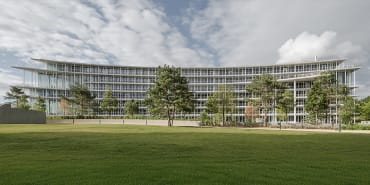
1Roof is designed to minimise energy and water consumption. It is connected to Geneva’s GeniLac network, which uses water from Lake Geneva to heat and cool the building. The roof is equipped with 750 m² of solar panels and 85% of its surface is covered with vegetation, which helps cool the air beneath the panels, reducing heat absorption and increasing efficiency. Rainwater is collected in a 444 m2 tank and used in the building’s operations. 

Building automation features monitor electricity and water usage, as well as heating, cooling, ventilation, and lighting. This system allows for precise adjustment of conditions according to occupancy, reducing energy consumption.
Our BREEAM Outstanding certification and other sustainable construction accreditations have provided a framework for optimising 1Roof’s climate resilience, resource efficiency, material use, energy provision, circularity, and use of green technologies.

With spectacular views of Lake Geneva and the Alps, 1Roof offers an exceptional working environment for our employees. The lake-facing areas are dedicated to clients and staff, allowing everyone to benefit from the extraordinary natural surroundings. 1Roof also features two 1,000 m² collaborative spaces facing the lake, available to all employees for interaction and teamwork. 

Lombard Odier promoted social impact through multiple initiatives, such as:

The Bank Gender Committee
In 2025, the Bank relaunched its Gender Committee with a clear ambition: to refocus efforts on high‑impact actions that benefit both our people and our business.
Recognising that further progress is needed to strengthen the representation of women – particularly in senior management roles – the Bank is working closely with our partner Economic Dividends for Gender Equality (EDGE) to align our initiatives with industry‑leading standards and best practices.

Supply chain responsibility
We aim to ensure responsible sourcing, fair labour practices, and sustainability across our supply chain while advocating for fair wages and safe working conditions. We approach the subject of responsible sourcing in our overall business through our Supplier Code of Conduct. We require our suppliers to, among other things, respect human rights as defined in the UN Universal Declaration of Human Rights, implement a policy commitment to meet their responsibility to respect human rights, implement a related due diligence process, and provide a safe working environment. We have a preference for local suppliers and/or certified B Corporations. In addition, we work, when possible, with social enterprises focusing on labour reintegration of persons outside the ordinary job market. 

Corporate volunteering
All employees have one paid day off for volunteering per year, with two days for LOIM employees. The Corporate Sustainability and Philanthropy teams, as well as our global offices, organise volunteering opportunities with social or environmental impact. Social impact initiatives include, among others, helping to prepare meals for people in need with Le CARE, hiking with people with disabilities with Différences Solidaires, and speed-coaching migrant women to facilitate their reintegration into the job market with Association Découvrir.

Humanitarian relief
Our Foundation has long supported the International Committee of the Red Cross (ICRC) through a substantial annual contribution. In 2025, the Foundation’s support was allocated to the ICRC’s operations in the Democratic Republic of the Congo, one of many “forgotten conflicts”. At the end of 2024, widespread violence in the country left many people killed, injured, or subject to abuse, and forced two million people to flee their homes and livelihoods. In response to the resurgence in fighting, the ICRC expanded its activities in the country, delivering essential emergency aid such as food distribution, access to clean water, health facilities and services, and cash assistance.
 

Lombard Odier Investment Managers (LOIM), our asset management business, aims to support companies on their transition journey through ongoing investment stewardship. Specifically, we aim to deliver on two overarching objectives:

1.    promotion of companies’ alignment to the transition and sustainable value creation, and 
2.    promotion of resilient corporate sustainability and governance

LOIM takes an integrated approach to stewardship by engaging with companies and using our proxy votes to guide them towards more sustainable operating models. In 2025, we carried out 70 engagements. Most of these engagements continued to focus on the themes of net zero and nature.

Our engagements enhance our understanding of companies’ sustainability, providing more data points for our investment analyses and decisions and ensuring a circular stewardship approach. Our scope of engagement aims to include corporations, sovereigns, policymakers, and industry associations.

We also continued to emphasise our key sustainability priorities in our 2025 proxy voting activities, which saw LOIM vote in over 1,300 shareholder meetings on over 29,500 items across more than 50 different markets. 

get in touch.

get in touch.

Please select a category

Please enter your firstname.

Please enter your lastname.

Please enter a valid email adress.

Please enter a valid phone number.

Please select a country

Please select a banker

Please enter a message.


Something happened, message not sent.
let's talk.
share.
newsletter.