When you visit our website, information may be stored or recovered on your device, mainly in the form of cookies. We use essential cookies to ensure the website works as it should, and statistical and marketing cookies for audience measurement and content customisation purposes. We rely on Google for statistical and marketing cookies in order to measure website performance and display relevant advertising. For more information on this, please also refer to the Google policy on Business Data Responsibility.
From the Cookie Management Centre, you can set your preferences with respect to the use of cookies: accept or reject certain categories, accept all, or reject all. For detailed information on all cookies used across these three categories, please refer to our Cookie Policy.
Please note that blocking certain cookies may affect your experience and the services offered.
Essential cookies Always active
Essential cookies help the website to work as it should by enabling necessary functionalities, such as navigating between pages and accessing secure areas. These cannot be disabled in our systems.
Statistical cookies
Statistical cookies help us understand how visitors interact with our site by collecting and communicating browsing information. They make it possible to identify the most and least visited pages and to improve the overall performance of the site.
Marketing cookies
Marketing cookies are used to display relevant advertising and measure the performance of campaigns. If you choose not to allow these cookies, you will continue to see ads, but they will be less relevant to your interests.
Choose the purposes for which we may use Google products to collect and use your data:
User storage: to technically permit advertising functionality.
User data for advertising: to optimise our advertising campaigns.
Ad customisation: to tailor advertising to your interests.
Lula’s surprise election victory defied expectations, including polls and market positioning
Financial markets had priced for a Bolsonaro victory. The result triggered volatility across equities, the Brazilian real and interest-rate expectations
A more conservative Brazilian Congress, elected at the start of October, should constrain major policy changes, limiting Lula’s room for manoeuvre on fiscal and regulatory initiatives
After the initial selloff, we expect markets to look for more concrete clues about Lula’s policies in his fourth term.
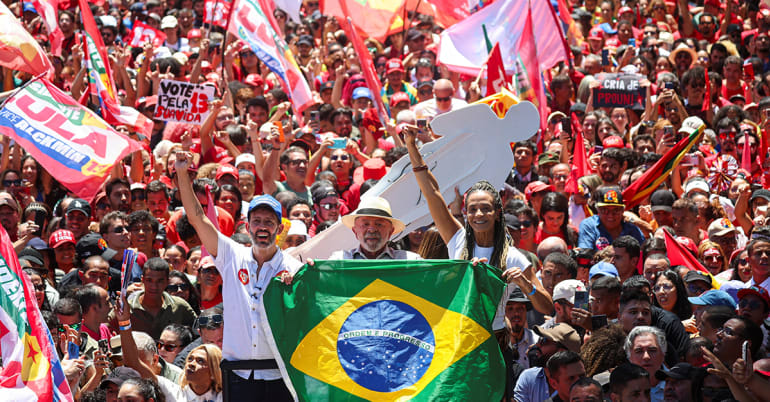
Luiz Inácio Lula da Silva’s victory in Brazil’s presidential run-off surprised investors and pollsters alike. Markets had positioned for a Flávio Bolsonaro victory following the first round of voting and stronger conservative representation in Congress. Instead, 81-year-old Lula secured a historic fourth presidential term, prompting markets to reassess the fiscal and monetary expectations for Latin America’s largest economy.
The selloff in Brazil’s assets following Lula’s re-election shows that many investors were positioned for a change of president. Still, the outlook for Brazil’s economy is more stable than swings in Brazilian assets imply, even if some market volatility is understandable given the country’s complex policy history.
Despite Lula’s dramatic political comeback, the composition of Brazil’s Congress matters at least as much as the presidential result. In the legislative elections held alongside the first round of the presidential contest on 5 October, conservative parties strengthened their presence in both chambers of Congress, with Bolsonaro’s Liberal Party securing the best single party representation under the 1988 Constitution, especially in the Senate. Its increased influence, together with other conservative representatives, will add complexity to Lula’s relations with the legislature.
Legislative realities will hinder major departures from the existing policy framework
The costly pledges of Lula’s re-election campaign depend on congressional approval. Congress’ more conservative composition is likely to limit fiscal expansion and may dictate a pragmatic approach to economic policy. The progressive voices behind Lula’s victory may gain influence, but legislative realities will hinder major departures from the existing policy framework. Markets will re-calibrate Brazil’s medium-term fundamentals, recognising that Lula is likely to accept some constraints and pursue his agenda through a legislature that neither his own party nor its allies have ever dominated.
Sign up for our newsletter
Fiscal credibility
For now, we assume that Brazil will see modest economic deceleration due to the delayed impact of Banco Central do Brazil’s (BCB) high real interest rates, which outweighs the targeted support packages that Lula has passed through the outgoing Congress. We see Brazil posting real gross domestic product (GDP) growth of 1.8% in 2026, slowing to 1.6% next year. Post-election fragility in the Brazilian real could prompt a slightly more elevated trajectory for headline inflation on top of energy product prices, but a jump in inflation is unlikely if BCB is able to anchor the real’s performance and private sector inflation expectation with relatively restrictive policy setting.
Fiscal credibility is likely to be the defining theme of Lula’s fourth term. During the election campaign, his populist commitments were estimated at roughly 0.3%-0.5% of GDP. While modest in isolation, these pledges come as Brazil struggles to maintain the small primary surplus goals proposed by Fernando Haddad, Lula’s former finance minister. While too early to predict Lula’s spending priorities in 2027, the current fiscal framework would be difficult, given the volatile implications for capital market. Funding new spending through higher taxation would also be challenging, given the complexity of Brazil’s tax system, while cuts elsewhere would be politically difficult. Markets will pay close attention to who Lula picks to navigate these policy issues in December, which will be the first major opportunity for the re-elected president to calm investor nerves.
Fiscal credibility is likely to be the defining theme of Lula’s fourth term
On monetary policy, investors will reassess expectations for rapid interest-rate cuts. Optimism over further easing had partly reflected expectations of a Bolsonaro victory and hopes for stronger fiscal reform momentum. Recent economic data suggest monetary tightening is working through the economy, with some moderation in activity and consumption. Central bank officials continue to characterise policy as restrictive, implying further easing is possible. However, policymakers are likely to wait for more certainty over fiscal policy before resuming the rate-cutting cycle. We expect the BCB to stay cautious, keeping policy rates on hold over the next six months, while the new administration clarifies its fiscal priorities. Our central scenario is therefore for gradual easing from today’s policy rate of 13.75% through mid-2027 to take rates to around 12.25% by the end of 2027. This said, risks are tilted towards fewer cuts should fiscal concerns intensify.
The election also has international implications. Relations between the Lula and Trump administrations have proven complex and further trade disputes may re-emerge. Bolsonaro had campaigned promising warmer relations with the White House, support for friend-shoring initiatives and alternative supplies of strategic rare earths, a market that China dominates. China remains by far Brazil’s largest trading partner, accounting for 29% of shipments by value in 2025. That means the country exports almost three times more to China than to the US, making Chinese demand for Brazil’s products a vital source of earnings. Lula’s victory means that congenial relations with China will be maintained.
Investment implications
For investors, the immediate implication is continued volatility. The election outcome requires markets to recalibrate expectations around fiscal and monetary policy, and reforms. Brazil faces economic headwinds, including low productivity growth, infrastructure gaps, a complex tax system, and weak long-term investment rates. However, the country is still constrained and supported by the same institutional framework that existed before the vote: an independent central bank, fiscal rules and a fragmented Congress. Together, these forces should limit the scope for dramatic policy shifts in either direction.
Brazilian equities also offer diversification benefits
We see the sharp post-election selloff, which erased all of Brazil’s gains since early July, as excessive given the likelihood of broad policy continuity, and maintain our preference for Brazilian equities. In our view, election-related uncertainties were already priced, alongside attractive valuations, compelling dividend yields, and cyclical earnings tailwinds. The recent selloff returned valuations to attractive levels and we expect a recovery over the coming weeks as political uncertainty recedes.
In a global equity market heavily exposed to artificial intelligence, Brazilian equities also offer diversification benefits. Brazil’s earnings drivers are largely domestic and commodity-linked, providing a source of returns that is relatively independent of the AI investment cycle. Moreover, the country’s abundant natural resources contrast with the energy and infrastructure constraints faced by some of the developed world. This not only supports Brazil’s competitive advantages but may also enhance its strategic importance in an increasingly resource-constrained and fragmented global economy.
Since Lula ended his second term in 2011, the composition of emerging market indices has continued to shift with the performance of the technology sector in South Korea and Taiwan. These two markets now account for half the MSCI EM index by capital. Brazil’s share of the index has consequently fallen from 15% 15 years ago, to 5% today. The emerging IT sector remains one of our equity preferences, along with Taiwan and Korea, supported by the continuing AI investment cycle.
The real’s valuation appears fair, even accounting for Brazil’s rising debt profile
For fixed income markets, the focus on fiscal credibility leaves Brazilian local bond yields exposed to a sharp upward adjustment, despite already high real interest rates. Longer maturities may face pressures if concerns over debt sustainability increase the premium that investors demand. Any currency weakness could also limit interest-rate cuts anticipated by markets. An initial rise of around 150 basis points (bps) is plausible, with 5-year yields potentially reaching 15% by the end of 2026. Dollar-denominated sovereign debt is also vulnerable to around 50-60 bps of spread widening versus US Treasuries, bringing valuations closer to sovereign bonds rated one notch lower. Higher domestic financing costs would increase the debt burden and could encourage greater international issuance expectation. Stabilisation will depend on the credibility of the government’s fiscal commitments.
We expect the Brazilian real to rise towards 5.50 against the US dollar in the coming months, reflecting fiscal policy uncertainties. The currency will likely then trade in a range around 5.20 over the longer term. The real’s valuation appears fair, even accounting for Brazil’s rising debt profile. Elevated commodity prices and historically high real yields are likely to provide a cushion. The appointment of a finance minister, likely around December, may be another currency move catalyst.
This is a marketing communication issued by Bank Lombard Odier & Co Ltd (hereinafter “Lombard Odier”).
It is not intended for distribution, publication, or use in any jurisdiction where such distribution, publication, or use would be unlawful, nor is it aimed at any person or entity to whom it would be unlawful to address such a marketing communication.






share.