When you visit our website, information may be stored or recovered on your device, mainly in the form of cookies. We use essential cookies to ensure the website works as it should, and statistical and marketing cookies for audience measurement and content customisation purposes. We rely on Google for statistical and marketing cookies in order to measure website performance and display relevant advertising. For more information on this, please also refer to the Google policy on Business Data Responsibility.
From the Cookie Management Centre, you can set your preferences with respect to the use of cookies: accept or reject certain categories, accept all, or reject all. For detailed information on all cookies used across these three categories, please refer to our Cookie Policy.
Please note that blocking certain cookies may affect your experience and the services offered.
Essential cookies Always active
Essential cookies help the website to work as it should by enabling necessary functionalities, such as navigating between pages and accessing secure areas. These cannot be disabled in our systems.
Statistical cookies
Statistical cookies help us understand how visitors interact with our site by collecting and communicating browsing information. They make it possible to identify the most and least visited pages and to improve the overall performance of the site.
Marketing cookies
Marketing cookies are used to display relevant advertising and measure the performance of campaigns. If you choose not to allow these cookies, you will continue to see ads, but they will be less relevant to your interests.
Choose the purposes for which we may use Google products to collect and use your data:
User storage: to technically permit advertising functionality.
User data for advertising: to optimise our advertising campaigns.
Ad customisation: to tailor advertising to your interests.
Building Bridges 2026: how can regenerative agriculture strengthen food systems?
key takeaways.
The seventh annual Building Bridges event in Geneva this month brought together investors, policymakers, industry and development experts to focus on investable solutions to sustainability challenges
A key topic was restoring the productivity of agricultural soils, which have been severely degraded by industrial farming practices and are vulnerable to extreme weather events driven by climate change
Experts explored regenerative agriculture – which harnesses nature to sustain healthy soil structure, nutrient cycling and water-absorption capacity – as a viable solution to restore resilience in food systems.
Is modern agriculture sowing the seeds of its own failure, and if so, how can food systems cope?
This topic was tackled by farming, investment and food company experts at the 2026 edition of Building Bridges this month. After a summer of severe heatwaves in the US and Europe, and with forecasts for a super El Niño bringing floods in the coming winter, adapting agricultural landscapes to ensure food security was the basis of solutions-focused sessions at the annual Geneva summit.
Extreme weather caused by climate change has exposed a critical weakness at the foundation of food systems. Nature depletion driven by repeated tilling, monocultures, and the systematic use of chemical fertilisers and pesticides, has severely reduced the ability of agricultural soils to absorb water, cycle nutrients and naturally resist pests and erosion.
Amid intensifying weather shocks, the impacts of this lost reliance are being felt along the value chain, from farm gates to supermarket aisles.
Sign up for our newsletter
But there is a proven solution. Regenerative agriculture seeks to transition monocultures by restoring soil structure and harnessing natural processes to replace synthetic inputs. Successful regenerative farms can generate similar yields to conventional fields at a lower cost per hectare – and with the additional long-term benefit of this superior productivity being sustained by soil and ecosystem health.
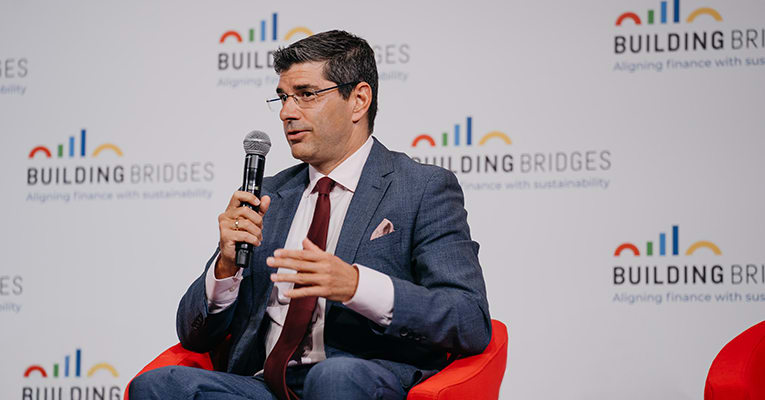
“There is a strong case to invest in restoring these assets so they can again deliver their full potential,” Huber Keller, Senior Managing Partner at Lombard Odier, said at Building Bridges. “And if they do, their value will start to increase again because they will become much more resilient.”
Regenerative farming for better food-system resilience
Modern food systems are “both a miracle and a disaster”1. The post-war Green Revolution has delivered more than enough calories to feed decades of global population growth but has incurred a heavy environmental toll that is now due.
Food systems account for 90% of deforestation2, 70% of freshwater use3 and 34% of greenhouse gas emissions4. These extractive processes persist despite the sector’s high dependency on climatic and ecosystem stability. But it is precisely this reliance on nature that offers a clear opportunity to change course towards regeneration.
“We have the evidence to know that moving from conventional agriculture, which uses extractive practices and chemicals, to a new paradigm that relies on restoring soil health, nature and its biodiversity can sustain productive agricultural landscapes,” said Marc Palahí, Chief Nature Officer at Lombard Odier Investment Managers.
Regenerative agriculture describes farming approaches focused on restoring soil health, strengthening biodiversity and improving ecosystem functions while safeguarding productive farmlands. Key objectives include: better soil structure for storing water, strong earthworms and beneficial bacteria populations for nutrient cycling, and mycorrhizal fungi to boost plant roots’ water and nutrient intake. Together, these improvements help create productive and resilient farming systems.
“The new normal is going to be characterised by extreme weather events like floods, droughts and heat waves,” Palahí said. “Soils that have been operated in a conventional way have lost the capacity to store water and nutrients. By regenerating nature and biodiversity, you are building resilience into the system.”
By regenerating nature and biodiversity, you are building resilience into the system
Economic incentives for regenerative agriculture
More resilient agricultural production would ease climate-driven price shocks across the food value chain.
“Price volatility in the food sector is also increasing, and by building resilience in the system, you are also decreasing this volatility,” Palahí said. “You are also ensuring that you will have long-term value creation within those productive landscapes.”
Major food company Nestlé5 has made decisive investments in expanding its offtake of regenerative produce. At the end of 2025, the firm had acquired 20.7% of its inputs from regenerative farmers – including cereals, grains, cocoa, dairy, meat, poultry, eggs, vegetables and vegetable oils. It aims to increase this share to 50% by 2030.
Katja Seidenschnur, Global Head of Sustainability for Nutrition and Health at Nestlé, said the food giant is increasingly focused on sourcing from growers that can deliver long-term ingredient supply, restore soil and ecosystem health, and enhance profitability to ensure they remain in business.
Beyond offtake contracts, the firm aims to assist farmers making the regenerative transition through measures that include technical training with agronomists, targeted funding and incentive programmes or partnerships linked to regenerative produce.
Corporate interest in regenerative approaches is growing noticeably. Five years ago, Palahí primarily met sustainability specialists at food companies to discuss the need for adoption. Now, he also speaks with professionals at senior levels of corporate finance and strategy.
“Businesses are now aware of the importance of nature for growth and resilience. My interlocutors at companies are no longer always chief sustainability officers, but CFOs too,” he said.
Businesses are now aware of the importance of nature for growth and resilience. My interlocutors at companies are no longer chief sustainability officers, but CFOs
Restoring nature: an investment, not a cost
Palahí, a forestry scientist who is also CEO of the Circular Bioeconomy Alliance, joined the investment industry in 2023 to fulfil a clear purpose: “to make nature financially visible and systemically investable.”
With 55% of economic activity moderately or highly dependent on nature, restoring this critical and irreplaceable resource must feature in value chains across sectors.
“Nature underpins our economy, but our economy doesn’t recognise this. It understands nature either as an externality or as a resource to extract rather than as infrastructure to regenerate,” Palahí said. “When we fail to value nature for what it is, sooner rather than later we will start paying for the costs of its destruction.”
Andre Hoffmann, Vice Chairman of Roche Holdings and a founder of cross-sector sustainability solutions platform InTent, agreed. Traditionally focused on deploying priced resources – talent, capital and resources – to achieve commercial growth and profit, capitalist theory had neglected to include nature.
“Nature is not unlimited and nature is not without cost,” Hoffman said.
The economic and environmental costs of nature depletion – including soil degradation and lost output due to extreme weather – can no longer be accounted for as ‘externalities’ beyond the remit of business. Unresolved, they continue to impact company operations, affect material inputs, supply chains and, ultimately, financial performance in a negative feedback loop.
But as regenerative approaches to agriculture show, restoring nature can reverse the situation.
“We have to completely shift the paradigm,” Hoffman said. “Nature is no longer a cost. It is an opportunity.”
Nature is no longer a cost. It is an opportunity
Building bridges to deliver solutions
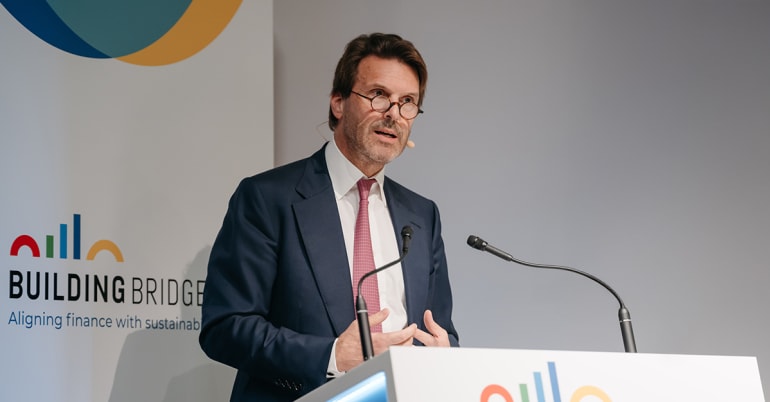
Addressing delegates, Patrick Odier, Chair of Building Bridges and a former Senior Managing Partner of Lombard Odier, delivered a clear call to action:
“The challenge is not a lack of awareness. It is not a lack of pledges, targets or announcements,” Odier said. “The challenge is leadership. And whether decision-makers can convert risks, technological innovations and policy ambitions into investment propositions that meet the requirements and adapt to a warming world.”
Investment plays a central role, but must be deployed effectively with input from experts across policy, industry, development and finance disciplines.
“Capital is the engine or the lever, but credible policy, innovation and implementation determine where that capital moves and whether it can move at scale and speed.”
How these stakeholders collaborate to deliver solutions like regenerative agriculture will shape outcomes across value chains – and beyond.
“This is about what kind of economy we want to build,” Odier said. “The capital is here. The expertise is here. The enabling connections can be built.”
This is a marketing communication issued by Bank Lombard Odier & Co Ltd (hereinafter “Lombard Odier”).
It is not intended for distribution, publication, or use in any jurisdiction where such distribution, publication, or use would be unlawful, nor is it aimed at any person or entity to whom it would be unlawful to address such a marketing communication.





share.