When you visit our website, information may be stored or recovered on your device, mainly in the form of cookies. We use essential cookies to ensure the website works as it should, and statistical and marketing cookies for audience measurement and content customisation purposes. We rely on Google for statistical and marketing cookies in order to measure website performance and display relevant advertising. For more information on this, please also refer to the Google policy on Business Data Responsibility.
From the Cookie Management Centre, you can set your preferences with respect to the use of cookies: accept or reject certain categories, accept all, or reject all. For detailed information on all cookies used across these three categories, please refer to our Cookie Policy.
Please note that blocking certain cookies may affect your experience and the services offered.
Essential cookies Always active
Essential cookies help the website to work as it should by enabling necessary functionalities, such as navigating between pages and accessing secure areas. These cannot be disabled in our systems.
Statistical cookies
Statistical cookies help us understand how visitors interact with our site by collecting and communicating browsing information. They make it possible to identify the most and least visited pages and to improve the overall performance of the site.
Marketing cookies
Marketing cookies are used to display relevant advertising and measure the performance of campaigns. If you choose not to allow these cookies, you will continue to see ads, but they will be less relevant to your interests.
Choose the purposes for which we may use Google products to collect and use your data:
User storage: to technically permit advertising functionality.
User data for advertising: to optimise our advertising campaigns.
Ad customisation: to tailor advertising to your interests.
In a hotter, riskier world, nature is critical economic infrastructure
key takeaways.
Healthy ecosystems now function as economic infrastructure, regulating water and storing carbon, while degraded landscapes are becoming financial liabilities for investors and insurers
Nature loss is now a measurable financial risk. Global insured losses from natural catastrophes and wildfires reached USD 107 billion in 2025, exposing the cost of degraded ecosystems
Wildfire risk builds long before ignition. Degraded soils, forests, and biodiversity make landscapes more flammable, turning ecosystem health into a core investment and insurance issue
Closing the USD 7 trillion nature finance gap needs private capital. Regenerative agriculture, forestry, and natural capital markets offer resilience-focussed investment opportunities.
For much of the past century, the global economy has treated nature as an inexhaustible input: something to extract, convert, consume, and monetise. Value appeared on balance sheets when forests became timber, soils became harvests, and land became real estate. The cost of degradation – depleted soils, biodiversity loss, and weakened ecosystems – was largely treated as an externality.
That era is ending.
In a world of record temperatures, extreme wildfires, and mounting insurance losses, those externalities are becoming financial risks. The investment question is no longer whether nature has value; it is whether economies and portfolios can afford to ignore it. Climate volatility is exposing the economic consequences of degraded landscapes: fragile food systems, exposed infrastructure, repriced insurance, costlier disaster recovery, and supply chains under strain.
PwC estimates that 55% of global GDP – around USD 58 trillion – depends to some degree on nature, underlining how deeply economic activity relies on ecosystem services. As those services degrade, so does the economy’s ability to absorb shocks.1
The investment question is no longer whether nature has value; it is whether economies and portfolios can afford to ignore it
When nature risk becomes financial risk
Climate and nature risks are present-day realities. After the hottest June on record in Western Europe, summer 2026 has already seen record-breaking heatwaves and some of the largest wildfires ever recorded.2 Extreme heat is affecting health, productivity, and agriculture. Droughts and floods are disrupting commodity markets. Wildfires are damaging infrastructure, homes, businesses, and balance sheets.
Sign up for our newsletter
This is not simply a climate story. It is also a nature story – and, increasingly, a financial one.
The International Monetary Fund now treats climate change as a macroeconomic and financial-stability risk. Its work on nature-related financial risks highlights that economies are embedded in and dependent on natural systems. When those systems weaken, climate shocks spread through landscapes, supply chains, and infrastructure, making ecosystem degradation a powerful risk multiplier.3
A hotter world dries out soils and vegetation. Drier soils retain less water, weakened forests become more susceptible to pests, disease, and fire, and biodiversity loss erodes ecosystems’ capacity to recover. The result is a landscape that absorbs less shock and transmits more risk. For investors, this changes the way nature should be understood. Healthy ecosystems are productive assets. They regulate water, store carbon, support food systems, protect infrastructure, and reduce disaster vulnerability – and their decline shows up directly on the loss side of the ledger.
insights for you.
In the newsNatural Capital
In the newsNatural Capitalcircular economysustainability
The cost of inaction is plainly visible. Natural catastrophe losses have become a recurring feature of the global economy, with weather-related events accounting for most insured losses in recent years. Estimates from Swiss Re Institute underline the escalating financial impact of natural catastrophes and wildfire-related events, with global insured losses reaching around USD 107 billion in 2025.4
The protection gap also remains significant, leaving households, businesses, governments, and investors to absorb much of the economic cost. Against the rising expense of fires, floods, droughts, crop failures, and shrinking insurance availability, investing in healthier soils, forests, and watersheds increasingly looks less like environmental spending and more like resilience infrastructure.
Why wildfire risk begins long before the first spark
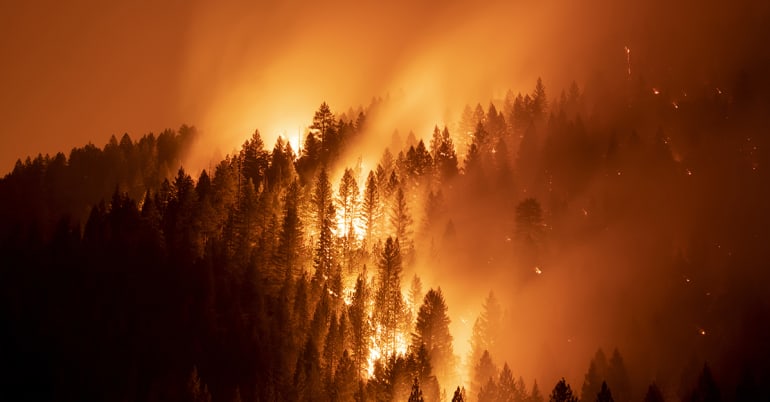
The record-breaking wildfires that have swept through France and Spain this summer are a reminder that wildfire risk begins long before the first spark. Months of exceptional heat, prolonged drought, and parched vegetation created the conditions for fires to spread rapidly across landscapes, forcing mass evacuations and causing widespread economic disruption.5
Wildfires are often discussed as emergency events: a spark, a heatwave, a wind shift, a firefighting response. But the next wildfire season starts much earlier – beneath our feet, in the condition of the soils, forests, and ecosystems. Heat and drought create the conditions for fire, but degraded landscapes determine how easily it spreads, how intensely it burns, and how quickly the land recovers. Forests weakened by drought or poor management become more combustible, degraded soil holds less water, and biodiversity loss weakens natural recovery systems.
The economic consequences were evident in January 2025, when the Los Angeles wildfires generated an estimated USD 40 billion in insured losses, the single largest wildfire loss in Swiss Re’s sigma records6, driven in part by fire spreading through one of the world’s most valuable wildland-urban interfaces.7
related content.
rethink sustainabilityNatural Capital
rethink sustainabilityNatural Capitalnet zerosustainable business
Beyond destroyed homes and disrupted infrastructure, rising fire risk is reshaping insurance itself. As insurers reprice physical climate risks, premiums rise, coverage narrows, and some providers withdraw from high-risk regions altogether. Fire prevention is no longer only an emergency services issue; it is also a land management, infrastructure, and investment issue. A poorly managed, water-stressed landscape is a balance-sheet risk waiting to be ignited.
Wildfires also carry significant long-term health costs. The World Health Organization identifies heat stress as a leading cause of weather-related deaths and notes that it can worsen cardiovascular and respiratory conditions. Wildfire smoke can travel far beyond the fire zone, prompting air quality warnings hundreds of kilometres away, as seen during the Canadian wildfires last July. The impacts therefore extend well beyond the immediate burn area.8
Nature as economic infrastructure
In a warmer, more volatile world, natural systems perform functions that are essential to economic resilience. Forests help regulate temperatures, store carbon, and, when properly managed, reduce wildfire intensity. Watersheds support agriculture, industry, and cities by improving water availability and reducing drought and flood risk. Healthy soils improve productivity, retain water, and reduce erosion. Biodiversity supports pest control, ecosystem stability, and recovery after disturbance.
A degraded landscape is a liability. A regenerative landscape is an asset. This shift has significant implications for private capital
These ecosystem services function as infrastructure. They safeguard assets, support production, and reduce volatility. A degraded landscape is a liability. A regenerative landscape is an asset. This shift has significant implications for private capital. Land, forestry, agriculture, water, and biodiversity are increasingly connected to risk management and long-term value creation. For families with operating businesses, real estate, agricultural assets, or diversified investment portfolios, nature is becoming relevant not only as a philanthropic concern but also as a strategic financial theme.
Investors are having to ask different questions than in the past: where are our assets exposed to heat, drought, fire, or water stress? Which supply chains depend on vulnerable ecosystems? Where could restoration reduce risk? Which natural systems, if strengthened, could protect long-term value? The answers will increasingly shape how investors manage risk and allocate capital.
Resilience as an investment theme
Decarbonisation remains essential, but it is no longer sufficient. Even under optimistic climate scenarios, physical climate risks will continue to intensify for decades. Adaptation and resilience are therefore becoming defining investment themes.
Nature-based solutions are a key part of this opportunity. Five areas stand out:
Regenerative agriculture can improve soil health, water retention, drought resilience, and productivity
Agroforestry can diversify income, improve biodiversity, and stabilise landscapes.
Climate-smart forestry can combine restoration, sustainable timber production, and lower wildfire risk
Watershed restoration can improve water security for agriculture, industry, and cities
Biodiversity and natural capital markets may create new mechanisms for valuing ecosystem services, provided they are approached with discipline, transparency, and robust measurement.
For every US dollar invested in protecting nature, around USD 30 is spent on activities that damage it
According to the United Nations Environment Programme’s (UNEP) State of Finance for Nature 2026, nature-negative finance reached USD 7.3 trillion in 2023, compared with USD 220 billion invested in nature-based solutions. For every US dollar invested in protecting nature, around USD 30 is spent on activities that damage it. UNEP estimates annual investment must reach USD 571 billion by 2030 to meet global biodiversity, climate, and land restoration targets.9
At COP30 in Belém, governments agreed to triple adaptation finance by 2035 and advanced initiatives to mobilise capital for forests and restoration.10 But public finance alone cannot close the gap. Private capital will remain essential across restoration, sustainable forestry, regenerative agriculture, biodiversity data, and ecosystem services.
For investors, this is where the opportunity becomes concrete. Investment opportunities span real assets, private markets, sustainable land use, and blended finance. The most compelling approaches are likely to combine different forms of capital – from philanthropy that proves new models to patient and commercial capital that scales them.
Technology and nature, not technology versus nature
Technology has an important role to play. Artificial intelligence (AI), satellite monitoring, drones, sensors, and advanced analytics are improving the ability to map risks, detect fires, monitor forest health, and prioritise interventions. An example is FireSat, the Earth Fire Alliance-led programme supported by Google Research.11 In July 2026, it launched three new operational satellites using high-resolution infrared data and AI to detect early-stage wildfires before they spread.
AI can help predict the next fire; nature can help prevent it
For investors and landowners, better data provides a more granular view of exposure – from stressed forests and drying soils to increasingly combustible landscapes – helping identify where intervention is most needed. But technology alone cannot solve ecological fragility. AI can help predict the next fire; nature can help prevent it.
The value lies in integrating technology with nature. Remote sensing and AI can identify vulnerable landscapes, strengthen forecasting, and support early intervention. Yet long-term resilience still depends on the condition of the ecosystem itself. A model can predict how a fire may spread, but it cannot replace a healthy forest, a restored watershed, or soil that can hold water.
An economic paradigm is emerging: one that recognises nature not as an unlimited resource, but as foundational infrastructure. This shift lies at the heart of the move from an extractive economy to a regenerative one, and from linear production models to a circular bioeconomy.
The circular bioeconomy aims to create value from renewable biological resources while restoring the natural systems on which production depends. It spans sustainable forestry, regenerative food systems, biomaterials, and ecosystem restoration.
The solutions already exist. The challenge now is scaling the capital needed to deliver them
Nature-positive investing extends beyond conservation to food systems, land use, water security, and infrastructure protection.
The solutions already exist. The challenge now is scaling the capital needed to deliver them.
The investment case for regeneration
The debate around nature is changing. For decades, economic value was created by extracting from natural systems, while the cost of degradation was treated as an externality. That model is becoming untenable. As climate risks intensify, weakened ecosystems create financial risks, economic disruption, and greater vulnerability to future shocks.
This is why nature is now being recognised as a critical form of infrastructure: a system that supports economic stability, protects value, and builds resilience as physical risks intensify. The opportunity lies in financing the regeneration of natural systems and the circular bioeconomy that depends on them.
In a hotter and more volatile world, nature is no longer just something we protect. It is increasingly the infrastructure that protects us. The capital now required is the capital needed to protect future growth.
This is a marketing communication issued by Bank Lombard Odier & Co Ltd (hereinafter “Lombard Odier”).
It is not intended for distribution, publication, or use in any jurisdiction where such distribution, publication, or use would be unlawful, nor is it aimed at any person or entity to whom it would be unlawful to address such a marketing communication.




share.