When you visit our website, information may be stored or recovered on your device, mainly in the form of cookies. We use essential cookies to ensure the website works as it should, and statistical and marketing cookies for audience measurement and content customisation purposes. We rely on Google for statistical and marketing cookies in order to measure website performance and display relevant advertising. For more information on this, please also refer to the Google policy on Business Data Responsibility.
From the Cookie Management Centre, you can set your preferences with respect to the use of cookies: accept or reject certain categories, accept all, or reject all. For detailed information on all cookies used across these three categories, please refer to our Cookie Policy.
Please note that blocking certain cookies may affect your experience and the services offered.
Essential cookies Always active
Essential cookies help the website to work as it should by enabling necessary functionalities, such as navigating between pages and accessing secure areas. These cannot be disabled in our systems.
Statistical cookies
Statistical cookies help us understand how visitors interact with our site by collecting and communicating browsing information. They make it possible to identify the most and least visited pages and to improve the overall performance of the site.
Marketing cookies
Marketing cookies are used to display relevant advertising and measure the performance of campaigns. If you choose not to allow these cookies, you will continue to see ads, but they will be less relevant to your interests.
Choose the purposes for which we may use Google products to collect and use your data:
User storage: to technically permit advertising functionality.
User data for advertising: to optimise our advertising campaigns.
Ad customisation: to tailor advertising to your interests.
Facing a changing reality at LO Gen 2026: what time teaches us about leadership, investing, and legacy
key takeaways.
From geopolitics and economic security to intergenerational responsibility, the 2026 LO Generations Summit explored how different time horizons are shaping the decisions we make today and the world we pass on tomorrow
Rising geopolitical anxiety hasn’t triggered economic crisis – it’s driving a wave of investment in security and resilience, rewarding conviction over reaction
From bio-based materials to healthy ageing, the bioeconomy’s real test is narrative: making long-term benefits feel personal and tangible today, before their effects become visible
Long-term conviction depends on knowing which values to preserve and where to adapt.
The fourth LO Generations Summit brought together founders, entrepreneurs, and next-generation leaders from around the world to explore how today’s decisions can shape the future, with this year’s discussions centred on time, leadership, and responsibility across generations.
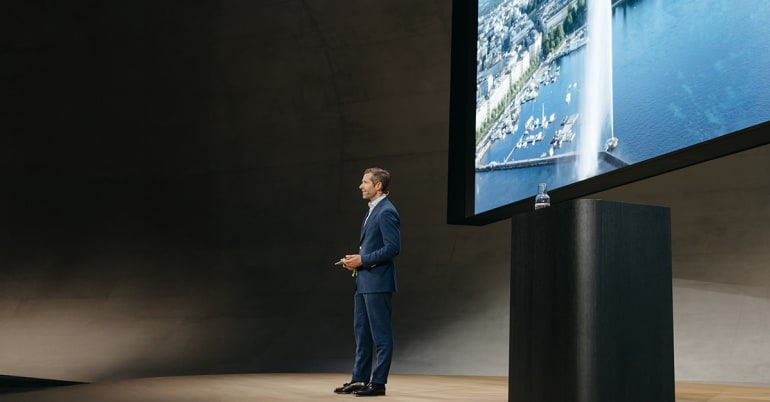
Seven years after Lombard Odier first presented plans for its headquarters at the inaugural summit in Venice, guests gathered this year at 1Roof – the Maison’s new headquarters in Geneva. “Today you are no longer looking at the future on a screen. You are sitting inside it,” Xavier Bonna, Managing Partner at Lombard Odier, said. The question behind 1Roof, he added, reaches beyond architecture: “How do we build today for a future we cannot fully predict?”
Watch the wrap-up video of our LO Gen 2026 edition
Much has changed since the last summit in Tuscany. Geopolitical relationships have fractured, artificial intelligence has accelerated innovation, climate and nature pressures have intensified, and a new generation is taking on greater responsibility for business, investment, and family legacies. Yet the central challenge remains remarkably constant – and personal. How do we prepare for what comes next without losing sight of what we should preserve?
Across the discussions, one message emerged clearly. Change does not happen at a single speed. Markets can move in seconds, political decisions can shift assumptions overnight, industrial transitions take years or decades, while family values and institutional legacies are built across generations.
“Time shapes everything we build: our decisions, our investments, but also our relationships, trust and, of course, legacy,” reflected Édouard de Saint Pierre, Managing Director, Lombard Odier France. “While families share the same history, each generation experiences time differently. The challenge is to bring those timelines into alignment.”
Time as history: permanence through change
Lombard Odier’s more-than 230-year history offers an important lesson in navigating uncertainty, according to Hubert Keller, Senior Managing Partner. Throughout that history, clear values, a willingness to rethink accepted assumptions, and a multi-generational approach to its business and clients have provided direction. “The compass needle will tremble, but the true north is not redrawn at every stop,” he stated. The image captures a challenge familiar to families stewarding capital over decades: remaining anchored in purpose while reassessing the decisions needed to serve it.
The compass needle will tremble, but the true north is not redrawn at every stop
That philosophy shaped the creation of 1Roof. “The story of 1Roof is ultimately much bigger than the story of a building. It’s about our relationship with time,” Xavier Bonna explained. Santiago Espitia Berndt, Partner at Herzog & de Meuron, the architects behind 1Roof, saw that balance reflected in Venice. Its streets and buildings appear to have endured unchanged for centuries, yet the city has continually accommodated new uses, technologies, and ways of living. “How can something remain itself by changing?” he asked. “The things that survive are not those that resist change, but somehow those that are able to absorb change.” The same principle informs his view of sustainability. Energy efficiency matters, but a building that becomes obsolete after a few decades cannot fulfil its long-term promise. “Perhaps the most sustainable thing that a building can do is simply remain useful for a long time.” That analogy reaches beyond architecture. A family business or wealth management strategy also needs a durable purpose and enough flexibility to remain relevant to future generations.
Sign up for our newsletter
In times of tension: conviction over reaction
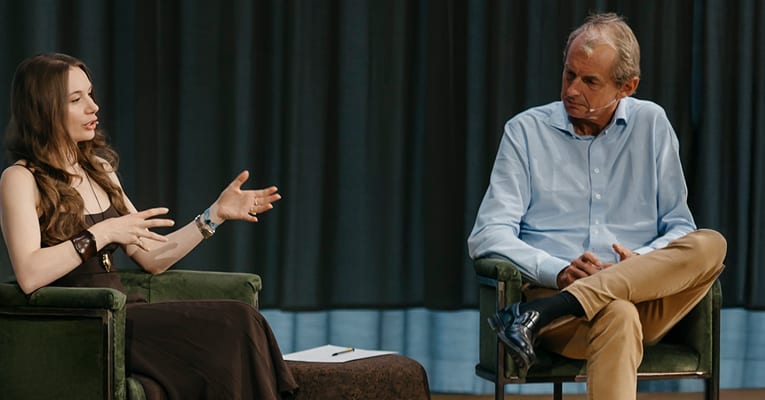
The discussion turned to geopolitics, where shifting alliances and a redistribution of power are challenging established assumptions. Sylvie Bermann, former French Ambassador to China, Russia, and the United Kingdom, characterised the present moment as one of “polycrisis,” in which geopolitical, energy, financial, and environmental pressures increasingly overlap. “The old world is dead,” she said. “We are living in an era of unpredictability,” she noted, adding that the emergence of new powers and a more influential Global South calls for engagement with an evolving world.
China provided one of the clearest illustrations of what long-term thinking can achieve. Sylvie Bermann traced its transformation over three decades from a developing economy to a leader in areas including electric vehicles, artificial intelligence, robotics, and advanced technology. Central to that transformation, she suggested, has been an ability to think simultaneously across multiple horizons, setting very long-term ambitions while using five-year plans to turn them into action.
You negotiate with your enemies, not your friends
For Europe, she argued, adaptation will demand both investment and diplomacy. A more multipolar world requires relationships with a broader range of countries, including those whose values and interests may differ. “Diplomacy is not talking to yourself. It’s talking to others, even if you disagree,” she affirmed. That principle becomes particularly important in periods of conflict. Sylvie Bermann argued that diplomacy ultimately requires engagement with adversaries precisely because agreement cannot be assumed. “You negotiate with your enemies, not your friends,” she observed.
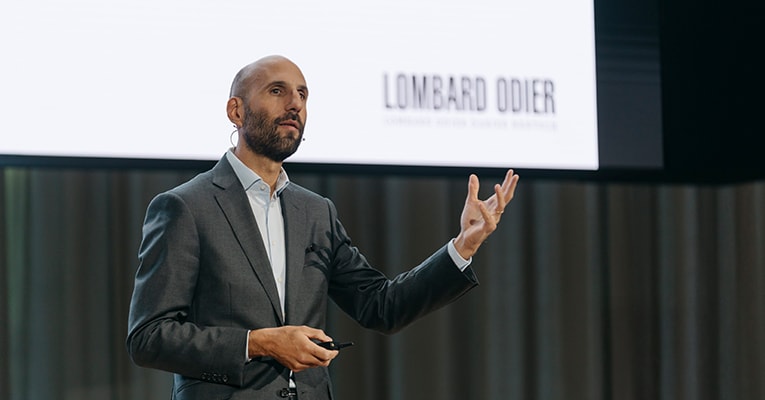
Samy Chaar, Chief Economist and CIO Switzerland at Lombard Odier, explored what this changing geopolitical landscape means for the economy. For decades, the global economy has allowed countries to rely on others for critical needs: the United States for security, China for low-cost manufactured goods, Russia and the Middle East for energy. That model is changing, he said: “The new world is now about adjusting to a world that is fragmented.”
That adjustment is driving investment in defence, energy, technology, and supply chains as countries seek greater economic security. The result is counterintuitive: anxiety is high, yet the rise in capex is driving economic activity. “We’re in a geopolitical crisis,” Samy Chaar observed. “Funnily enough, it hasn’t transformed into an economic crisis. We’re rather in an economic revolution.”
In other words, the political narrative and the economic reality do not necessarily move in parallel. Spending in response to geopolitical uncertainty can transform an economy, shifting the debate about public debt. For Samy Chaar, the question is not simply how much debt a country holds,but what that borrowing enables. “Debt is all about what you do with it… There is good debt, and there is bad debt,” he explained. Investment in defence, energy security, technology, or productive infrastructure can build future capacity.
For investors, the implication is that heightened uncertainty does not automatically demand retreat. It requires the ability to separate structural change from short-term noise, and to distinguish anxiety from lasting economic shifts. Samy Chaar’s message to investors was one of disciplined conviction rather than complacency.
Time as responsibility: turning urgency into opportunity
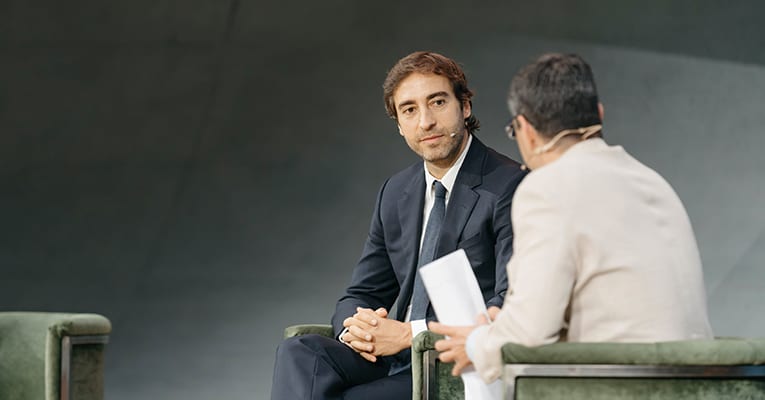
Mathieu Flamini, former international footballer and co-founder of GF Biochemicals, joined Marc Palahí, Lombard Odier’s Chief Nature Officer and CEO of the Circular Bioeconomy Alliance, in a session exploring the transition from fossil-based chemistry towards a bio-based economy. Bio-based industries are those capable of using biological resources – including plants, microorganisms, and organic waste – to create materials and chemicals that can replace petroleum-derived products. For investors assessing the energy transition, this links potential environmental gains with supply-chain resilience. “Developing the bio-based industry is very strategic to become independent from other parts of the world in that respect,” Marc Palahí argued.
The good player is the one who thinks after he receives the ball. The great player is the one who thinks before he receives the ball
For Mathieu Flamini, the transition is simultaneously environmental, industrial, and deeply personal. “From a very young age I was very much aware of the negative impact of humankind on our nature.” His journey from elite football to chemistry might appear unconventional, but he sees strong parallels between the two. Both require anticipation, resilience, and the ability to perform under pressure. “The good player is the one who thinks after he receives the ball. The great player is the one who thinks before he receives the ball,” he said. In his view, the same principles apply to leadership. An entrepreneur must anticipate where the market is going rather than waiting for change to arrive.
Sustainability can feel distant when framed only as an environmental problem, Mathieu Flamini noted, and scientific innovation alone will not persuade people to embrace more sustainable products. “We have to change the narrative,” he said. “We need to make it personal and we need to make it relevant.” Connecting it to products people use every day, and to their desire to live better, live longer, and perform at their best, makes the benefits more tangible, he pointed out.
Ageing is not something we need to wait until we’re 60 to start addressing. We need to start acting on it now while we’re young
That same ambition raises a familiar question: how early you start matters more than most people realise. Chris Rinsch, co-founder and President of Swiss life sciences company Timeline, presented research suggesting that ageing is not a linear process, but one in which significant biological changes can begin decades before their effects become apparent. Timeline’s focus on “healthspan” – the period of life spent in good health – therefore rests on a similar principle to long-term investing: understanding the forces already at work, identifying where intervention can make a difference, and acting before change becomes difficult to reverse. “Ageing is not something we need to wait until we’re 60 to start addressing,” Chris Rinsch highlighted. “We need to start acting on it now while we’re young.”
Its research into mitochondrial health and urolithin A offers one example of how advances in life sciences can turn that long-term perspective into action. As populations live longer, investing in healthier ageing can help shift the emphasis from treating the consequences of age-related decline towards maintaining health for longer – creating opportunities for innovation while supporting more resilient health systems and better outcomes for people.
In a discussion moderated by Édouard de Saint Pierre, Alexandra Martel and Matthieu Leclercq explored three connected questions: what do we receive, what do we build from it, and what do we choose to pass on?
For Alexandra Martel, founder and CEO of Martel Paris, inheritance began with her grandfather’s relationship with nature and the way he saw the world. “What he gave me was really this original seed of identity,” she said. It was hers, however, to develop: “I’m growing [it] in my own way.”
Matthieu Leclercq, founder and chairman of For Talents, reflected on the entrepreneurial spirit he inherited from his family’s business, Decathlon, where he served as chairman of the board for several years, and on the importance of staying close to employees, products, and customers. He now works with family businesses through a transition that can be difficult to address in governance plans: the founder must decide when to hand over the vision and give a successor the authority to develop it. “We are not speaking about someone to run the business; we are looking for someone to carry the flame, the vision, and the next strategy,” he said.
Respecting what came before us, preserving what matters, while having the courage to change what needs to be changed
The long view: making room for the future
The summit’s discussions pointed to a shared test of leadership. Will today’s decisions leave those who follow better equipped to make their own? For investors, that means distinguishing immediate anxiety from long-term economic shifts. For families and entrepreneurs, the same discipline means giving the next generation room to interpret an inherited purpose. Alexandra Martel sees that freedom reflected in craftsmanship where skills and traditions pass between generations, while each brings a new creative vision. “A life mission is really something that other people can join and can appropriate for themselves,” she said. The younger generations “are always going to reinvent it in a different way, just as I am reinventing it in a specific way, and just as our ancestors did it another way.”
Just like 1Roof, businesses and family legacies must remain rooted in their purpose while making room for futures their founders cannot yet imagine. As Xavier Bonna concluded, that means “respecting what came before us, preserving what matters, while having the courage to change what needs to be changed.”
Any reference to a specific company or security does not constitute a recommendation to buy, sell, hold, or directly invest in the company or securities.




share.