When you visit our website, information may be stored or recovered on your device, mainly in the form of cookies. We use essential cookies to ensure the website works as it should, and statistical and marketing cookies for audience measurement and content customisation purposes. We rely on Google for statistical and marketing cookies in order to measure website performance and display relevant advertising. For more information on this, please also refer to the Google policy on Business Data Responsibility.
From the Cookie Management Centre, you can set your preferences with respect to the use of cookies: accept or reject certain categories, accept all, or reject all. For detailed information on all cookies used across these three categories, please refer to our Cookie Policy.
Please note that blocking certain cookies may affect your experience and the services offered.
Essential cookies Always active
Essential cookies help the website to work as it should by enabling necessary functionalities, such as navigating between pages and accessing secure areas. These cannot be disabled in our systems.
Statistical cookies
Statistical cookies help us understand how visitors interact with our site by collecting and communicating browsing information. They make it possible to identify the most and least visited pages and to improve the overall performance of the site.
Marketing cookies
Marketing cookies are used to display relevant advertising and measure the performance of campaigns. If you choose not to allow these cookies, you will continue to see ads, but they will be less relevant to your interests.
Choose the purposes for which we may use Google products to collect and use your data:
User storage: to technically permit advertising functionality.
User data for advertising: to optimise our advertising campaigns.
Ad customisation: to tailor advertising to your interests.
AI, innovation, and investment: what will drive tomorrow’s growth?
key takeaways.
Creative destruction is a key driver of growth, provided competition allows new entrants to innovate and expand
AI-driven automation could add 0.68 percentage points to annual total factor productivity growth over ten years
Europe has world-class scientific research capabilities, but still struggles to turn its discoveries into globally competitive technology companies
Strong corporate fundamentals and continued technology investment support the case for staying invested, with a preference for the markets and sectors where growth and earnings are concentrated.
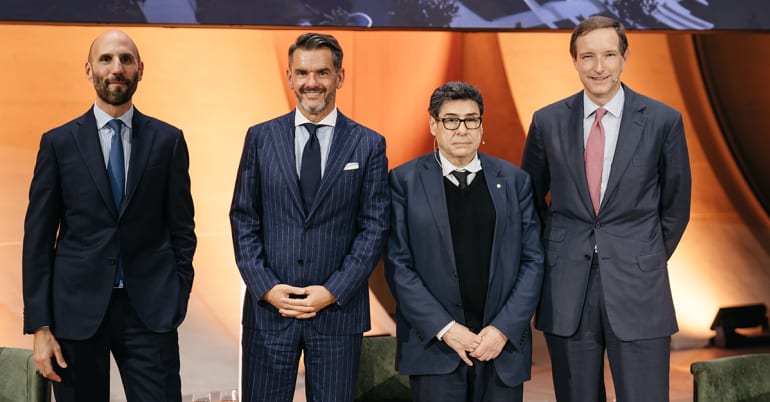
How can economies sustain growth in the face of geopolitical tensions, Europe’s technological lag, and the rise of artificial intelligence (AI)? And what are the implications for financial markets and investment strategies as 2027 approaches? These questions were at the heart of our latest flagship Rethink Perspectives event, “Rethinking growth in a world in transition”, held recently at 1Roof.
Opening the event, Frédéric Rochat, Managing Partner at Lombard Odier, highlighted the paradoxes of an era rich in innovation and investment opportunities, yet also marked by mounting trade, energy, and geopolitical tensions. As the Firm celebrates its 230th anniversary and ten years of its rethink everything® campaigns, he emphasised the importance of continually questioning assumptions and reinventing ourselves, while remaining true to our convictions and identity. A philosophy summed up in a few words: “We are stable, but never still.”
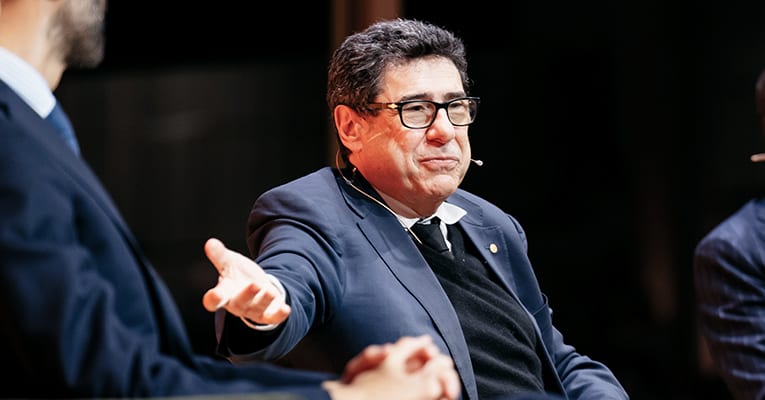
Building on this perspective, Philippe Aghion, French economist and 2025 Nobel laureate in economics, examined the drivers of long-term growth, the critical role of innovation, and the competitiveness challenges facing Europe. Samy Chaar, Partner, Chief Economist, and CIO Switzerland at Lombard Odier, then offered his insights into the resilience of the global economic cycle, the outlook for financial markets, and the implications for portfolio positioning in 2027.
Innovation gradually renders existing technologies or business models obsolete. While this process of renewal drives growth, it cannot be taken for granted
Creative destruction: fostering innovation without restricting competition
Why do some economies continually renew their sources of growth while others lose momentum? For Philippe Aghion, the answer lies in “creative destruction”, a concept originating with Joseph Schumpeter, and central to the research Philippe Aghion developed with Peter Howitt. The underlying principle is that innovation gradually renders existing technologies or business models obsolete. While this process of renewal drives growth, it cannot be taken for granted.
Sign up for our newsletter
“Innovation does not fall from the sky,” Philippe Aghion reminded the audience. It depends on entrepreneurs willing to invest, take risks, and finance research in anticipation of future profits. Yet this creates an inherent contradiction: companies that have succeeded through innovation may subsequently use their dominant position to protect their competitive advantages, hinder the emergence of new competitors, and ultimately stifle innovation itself.
Companies that have succeeded through innovation may subsequently use their dominant position to protect their competitive advantages, hinder the emergence of new competitors, and ultimately stifle innovation itself
This is one of the lessons Philippe Aghion draws from the US digital revolution. Major technology platforms contributed to productivity gains in the 1990s and 2000s, but their increasing concentration and control over data can make it more difficult for new players to emerge. To sustain growth, a competitive environment must therefore facilitate market entry for new businesses while encouraging established companies to continue innovating.
Europe must turn its research excellence into leading companies
This analysis helps explain Europe’s growing technological lag across many sectors. Following the Second World War, Europe benefited from catch-up growth, rebuilding its productive capacity and adopting technologies already developed elsewhere. However, the transition to an economy driven by breakthrough innovation has proved more difficult. According to Philippe Aghion, Europe has “largely missed the transition from intermediate technologies to high-tech sectors,” unlike the United States and, more recently, China1.
Yet the main issue is not the quality of European research. Europe boasts world-class scientists, universities, and laboratories, particularly in artificial intelligence. Instead, it struggles to translate this academic excellence into commercial innovations and companies capable of scaling up. According to Philippe Aghion, “Regulatory fragmentation, the absence of a genuine single market in many sectors, insufficient growth financing, and a limited culture of risk-taking are all barriers.”2
“Europe needs to wake up,” he stressed. Proposed solutions include mobilising European savings more effectively, developing venture capital, creating more integrated markets, and establishing investment programmes that bring together public and private sector participants. Philippe Aghion particularly advocates initiatives inspired by the US Defense Advanced Research Projects Agency (DARPA), supporting ambitious, competing technology projects, including through coalitions involving Switzerland and other like-minded countries.
Europe boasts world-class scientists, universities, and laboratories, particularly in artificial intelligence. Instead, it struggles to translate this academic excellence into commercial innovations and companies capable of scaling up
AI: significant productivity potential, subject to conditions
AI could offer a fresh opportunity to stimulate growth. Philippe Aghion distinguishes between two effects: automating tasks involved in producing goods and services, and accelerating the discovery of new ideas. A 2023 study by economists Erik Brynjolfsson, Danielle Li, and Lindsey Raymond, conducted among customer support staff at a US software company, found that using a generative AI assistant increased productivity by 14% in the first month, rising to approximately 25% after three months.3
At the macroeconomic level, research by Aghion and Bunel4 estimates that automation could add 0.68 percentage points per year to total factor productivity growth over a ten-year period5. Although this would represent only a temporary boost to growth, it would leave the level of economic output permanently higher. Philippe Aghion also referred to ongoing research suggesting an additional increase in growth of at least 0.4 percentage points, potentially permanent, through the generation of new ideas. However, these estimates represent potential gains rather than guaranteed outcomes that can be taken for granted.
Successful realisation of this potential will depend on the policies adopted. In a value chain where cloud services and computing capacity are concentrated among a handful of major players, Philippe Aghion advocates promoting open technologies and access to data and shared infrastructure. The 2025 Nobel laureate in economics notably called for the creation of a “CERN for AI” in Europe, giving researchers and new entrants the resources they need to innovate.
Philippe Aghion also cited Veolia as an example of potential efficiency gains: in wastewater treatment, AI could help reduce electricity consumption by 5.4% and CO₂ emissions by 6%.6
Employment is another major consideration. While productivity gains can strengthen competitiveness and create new activities, certain roles, particularly administrative and support functions, remain highly exposed to automation.
To support these transitions, Philippe Aghion emphasises the importance of high-quality education, lifelong learning, “flexicurity” policies (which combine flexibility for employers with security for workers), and greater recognition of technical professions, highlighting the strengths of Switzerland’s vocational training system. The challenge is clear: technological progress must deliver stronger, more inclusive growth for all.
Both the United States and China are seeking to strengthen their strategic autonomy, whether in semiconductors, computing capacity, industrial production, or energy. This rivalry is encouraging long-term investment
Technology: is the investment cycle near its end?
For investors, one question stands out: should they remain invested in financial markets? During his presentation, Samy Chaar addressed this by examining the forces driving demand for technology. The first is geopolitical. Both the United States and China are seeking to strengthen their strategic autonomy, whether in semiconductors, computing capacity, industrial production, or energy. This rivalry is encouraging long-term investment.
The second force is demographic. As working populations age, particularly across a number of Asian and European economies, companies will need to boost productivity to offset labour shortages. Robotics and AI are therefore becoming tools for competitiveness as well as drivers of growth.
Against this backdrop, AI adoption may still be in its early stages. Samy Chaar noted that approximately 25% of US companies are already using these technologies, suggesting significant scope for broader adoption over the medium term7. In his view, this demand should continue to support investment and profitability among technology companies. Unlike the late 1990s, when stock prices rose much faster than corporate earnings, today’s rally in technology stocks has been accompanied by growth in earnings per share. For Samy Chaar, this distinction puts the risk of a bubble comparable to the dot-com era into perspective.
Europe, however, continues to lag behind the United States and China. Echoing Philippe Aghion’s diagnosis, Samy Chaar illustrated this decline with a striking figure: over the past 25 years, European equities’ share of the MSCI World Index has fallen from approximately 40% to just 13%8. This reflects, in particular, Europe’s weaker presence in the sectors driving innovation and value creation. While not discounting opportunities in Europe, at Lombard Odier we therefore favour the United States and Asia to gain exposure to the companies and markets best positioned to benefit from these trends.
Strong corporate fundamentals and a solid outlook support the case for staying invested
Beyond the technology sector, Samy Chaar highlighted the resilience of economic fundamentals. While public debt and fiscal deficits raise legitimate concerns, they should not overshadow improvements in the financial position of households, banks, and companies over the past 15 years. The private sector’s financing capacity offers a complementary perspective on public-sector imbalances, without eliminating them.
Corporate profitability remains another key source of support. While annual corporate earnings growth has historically averaged around 7%9, forecasts point to growth approaching double digits in several regions10. Resilient employment and consumer spending are also helping to prolong the economic expansion. Finally, at this stage, under our base-case scenario, we do not anticipate monetary tightening as severe as in previous cycles, particularly if energy price pressures ease in 2027.
Tomorrow’s growth will depend on economies’ ability to finance, disseminate, and govern innovation
This environment leads us to maintain our exposure to risk assets, with a preference for equities over sovereign debt, while remaining attentive to risks. “It is too early to step aside,” Samy Chaar summarised. Geopolitical tensions, inflation, and the financing of AI investments warrant vigilance, but at this stage they are not sufficient to undermine the growth momentum.
From creative destruction to investment strategies, the presentations by Philippe Aghion and Samy Chaar highlighted a common reality: tomorrow’s growth will depend on economies’ ability to finance, disseminate, and govern innovation. For Europe, the challenge is to create the conditions for its technological renewal; for investors, it is to distinguish short-term risks from more enduring drivers of value creation. As Samy Chaar put it, highlighting the stamina needed to stay the course in today’s investment cycle, “The marathon is not over.”
This is a marketing communication issued by Bank Lombard Odier & Co Ltd (hereinafter “Lombard Odier”).
It is not intended for distribution, publication, or use in any jurisdiction where such distribution, publication, or use would be unlawful, nor is it aimed at any person or entity to whom it would be unlawful to address such a marketing communication.





share.