When you visit our website, information may be stored or recovered on your device, mainly in the form of cookies. We use essential cookies to ensure the website works as it should, and statistical and marketing cookies for audience measurement and content customisation purposes. We rely on Google for statistical and marketing cookies in order to measure website performance and display relevant advertising. For more information on this, please also refer to the Google policy on Business Data Responsibility.
From the Cookie Management Centre, you can set your preferences with respect to the use of cookies: accept or reject certain categories, accept all, or reject all. For detailed information on all cookies used across these three categories, please refer to our Cookie Policy.
Please note that blocking certain cookies may affect your experience and the services offered.
Essential cookies Always active
Essential cookies help the website to work as it should by enabling necessary functionalities, such as navigating between pages and accessing secure areas. These cannot be disabled in our systems.
Statistical cookies
Statistical cookies help us understand how visitors interact with our site by collecting and communicating browsing information. They make it possible to identify the most and least visited pages and to improve the overall performance of the site.
Marketing cookies
Marketing cookies are used to display relevant advertising and measure the performance of campaigns. If you choose not to allow these cookies, you will continue to see ads, but they will be less relevant to your interests.
Choose the purposes for which we may use Google products to collect and use your data:
User storage: to technically permit advertising functionality.
User data for advertising: to optimise our advertising campaigns.
Ad customisation: to tailor advertising to your interests.
Succession is a top concern for Swiss family businesses. At Finanz und Wirtschaft 2026’s GenerationSummit the answer was as much about people as planning: start early, build trust, and give the next generation room to contribute
Geopolitical fragmentation is pushing families to diversify markets and suppliers, and to anticipate the next disruption rather than react to it
Continuity rests on trust and custodianship: owners who see themselves as stewards, preparing the next generation to take the business in new directions.
Succession remains a leading concern for Swiss family businesses. In the 2026 Entrepreneurs Study, conducted by Lombard Odier with Bilan and Finanz und Wirtschaft among 282 family-owned businesses, 45% of respondents identified business succession and ownership transfer as their primary concern. By comparison, 25% cited preparing the next generation. The findings suggest that succession is no longer seen through the lens of family continuity alone: third parties and the extended family are playing a growing role.
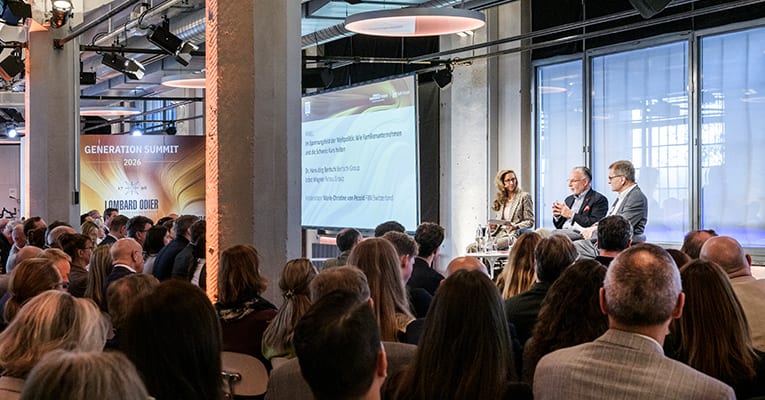
These themes were at the heart of the second GenerationSummit, recently organised by Finanz und Wirtschaft in Zurich. Bringing together several generations of entrepreneurs and business leaders from across Switzerland, the event explored how family businesses can navigate geopolitical uncertainty, remain competitive, and prepare the next generation to take responsibility. Around 90% of Swiss companies are family businesses1, noted Damien Martin, editor at Finanz und Wirtschaft and event moderator. Their ability to adapt therefore matters not only to the families themselves, but also to the wider economy.
Sign up for our newsletter
Family businesses in a fragmented world: resilience through diversification
In his keynote, H.S.H. Prince Michael of Liechtenstein described a multipolar world in which major powers increasingly put their own interests first. For companies, he warned, this turns supply-chain dependencies into a growing vulnerability, from semiconductors in Taiwan to rare earth refining in China. His advice: keep fixed costs under control, but pay closer attention to dependencies, and stay adaptable. As he put it, “the worst thing for an economy in the long term is stagnation.”
The panel that followed, moderated by Marie-Christine von Pezold, Independent Family Governance consultant at Lombard Odier and Director of the Family Business Network Switzerland, looked at these challenges from the perspective of family businesses and Switzerland's position in a changing world. Hans-Jörg Bertschi, Chairman of the Board of the Bertschi Group, a chemical logistics provider with more than 3,000 employees in 34 countries, has seen it first-hand. The war in Ukraine, shifting trade relations, and disruption to shipping through the Strait of Hormuz forced his teams to build new supply chains through Saudi Arabia towards the Red Sea. His lesson: diversify markets and suppliers, and anticipate the next disruption rather than react to it.
Jobst Wagner, Vice-Chairman of the REHAU Group, a polymer solutions company with more than 13,000 employees at over 160 locations, saw the bigger risk in the erosion of the rules-based international order. “I still believe in rules,” he said. He also warned Switzerland against complacency on competitiveness. The two differed on Europe, with Jobst Wagner favouring pragmatic cooperation and Hans-Jörg Bertschi stressing autonomy and federalism, but both saw trust in Switzerland’s institutions and its stability as assets that should not be taken for granted, a view echoed by H.S.H. Prince Michael, who called stability one of Switzerland’s greatest assets.
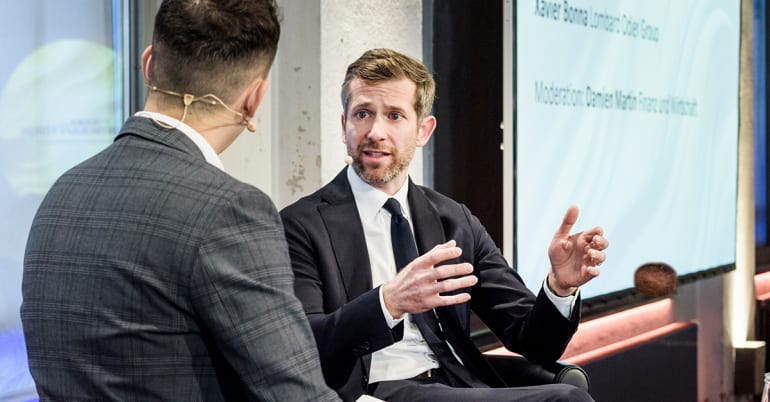
For Xavier Bonna, the sixth generation of his family to serve as Managing Partner at Lombard Odier, adapting to change is also central to the Bank’s own longevity. Founded in 1796, Lombard Odier has navigated successive economic, political, and technological transformations. “The recipe for one generation is not necessarily the recipe for the next generation,” he reflected. The firm’s rethink everything® philosophy embodies this willingness to question established assumptions and embrace change, while remaining true to its purpose.
One of the clearest signs that this trust has been established is when clients introduce the next generation of their family to the Bank
Asked what has enabled Lombard Odier to endure across 230 years, Xavier Bonna returned to the importance of relationships. “Ultimately, it’s a question of trust, values, and how we serve our clients,” he said. One of the clearest signs that this trust has been established, he explained, is when clients introduce the next generation of their family to the Bank.
Other speakers arrived at the same place from different directions. “Nothing works without it,” said Jobst Wagner, adding that trust is needed within the company, within the family, and within the country as a whole.
Making room: five ways to bring in the next generation
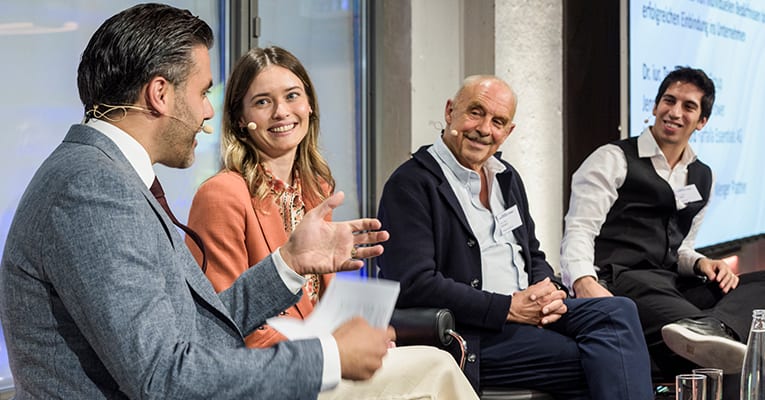
A second panel, moderated by Daniel Gabrieli of Swiss business law firm Wenger Plattner, focussed on how young family members can find their place in a business. The experiences of Tano Barth, Member of the Board of Directors at the Rivella Group, Jennifer Caspar-Pötz, Head of Strategy and President of the Board at the Traco Power Group and Jean-Claude Richard, Co-founder of farfalla showed that there is no single route into family leadership.
1. Start outside. Jean-Claude Richard’s son gained experience at Philip Morris and PwC, and even founded his own start-up, before joining farfalla. Jennifer Caspar-Pötz also built her career beyond Traco Power, studying hospitality management and working across Europe and Asia. Both developed their own perspective before committing to the family business.
2. Own without operating. Tano Barth is a Member, and soon Chairman2, of the Board of Rivella, which has been led by external CEOs since his grandfather’s time. Recognising that his strengths lie in legal matters rather than operations, he contributes at board level: family can steer a business without running it day to day, as several other families on stage had also chosen.
3. Change something early. Jennifer Caspar-Pötz joined her family’s board at just 23. One of her first questions to her father was how the company could attract young talent without a LinkedIn profile. So they set one up. She went on to run workshops with employees to define the company’s values together, rather than impose them. Her father gradually gave her more responsibility and now supports her as a coach and mentor, their roles effectively reversed.
4. Make it a joint project. At farfalla, Jean-Claude Richard and his wife spent almost seven years preparing the handover to their son, including a joint project to renew almost 400 products. The founders were initially taken aback by some of the changes, Jean-Claude Richard admitted, but working through them together helped the family embrace the new direction. His advice to the older generation: “You need trust, and you need to offer support when it is asked for, without imposing yourself.”
5. Allow time. Both Hans-Jörg Bertschi and Jobst Wagner stressed starting succession planning well in advance. Hans-Jörg Bertschi began planning at 48, after being advised to allow 20 years, and now brings the family, board, and executive management together every year for a retreat on the business and its future. Jobst Wagner similarly recommended planning for ten years when you think five will suffice. At REHAU, the next generation also helped revise the family charter, removing the principle that “the company comes before the family”.
You need trust, and you need to offer support when it is asked for, without imposing yourself
Asked what advice he would give the families in the room to help their businesses thrive for generations, Xavier Bonna echoed these experiences: communication, openness, and taking the time to listen to the next generation are essential. Younger family members should be involved early, given clear responsibilities, and allowed to contribute their own ideas. “They are not always right, but they can bring some good ideas to the table.”
The Summit's final conversation, with Mujinga Kambundji, a two-time indoor world champion and holder of multiple Swiss sprint records, offered a different perspective on the role of family in supporting ambition. She spoke about how her parents encouraged her and her sisters to set ambitious goals, while remaining a constant source of support regardless of sporting results. Within her family, she said, she is not the athlete but simply a daughter and sister. Like Jennifer Caspar-Pötz, who hopes one day to give her own son the freedom her father gave her, Mujinga Kambundji wants her young son to grow up without limits on his ambitions: the same combination of confidence and support that the next generation of a family business needs.
We see ourselves a little as owners, but more as trustees or custodians. Our ultimate goal is to pass the company on to the next generation in better shape
The long view: preserving purpose while embracing change
Across the Summit's discussions, a common message emerged: longevity is not about preserving a business exactly as it is. It depends on maintaining a clear sense of purpose while rethinking how it is carried forward. For family businesses, that means preparing succession early, building trust, and giving those who follow the freedom to take the business in new directions.
For Xavier Bonna, this balance has been central to Lombard Odier's history. “We constantly rethink the environment in which we live. We are not afraid to embrace change,” he said. “We are owners of Lombard Odier for a certain period of time, but not forever. We see ourselves a little as owners, but more as trustees or custodians. Our ultimate goal is to pass the company on to the next generation in better shape.”
That is perhaps the defining challenge for any business that hopes to endure: to preserve what gives it its identity, while ensuring that each generation has the trust, time, and freedom to shape what comes next.
Any reference to a specific company or security does not constitute a recommendation to buy, sell, hold, or directly invest in the company or securities.
This is a marketing communication issued by Bank Lombard Odier & Co Ltd (hereinafter “Lombard Odier”).
It is not intended for distribution, publication, or use in any jurisdiction where such distribution, publication, or use would be unlawful, nor is it aimed at any person or entity to whom it would be unlawful to address such a marketing communication.



share.