When you visit our website, information may be stored or recovered on your device, mainly in the form of cookies. We use essential cookies to ensure the website works as it should, and statistical and marketing cookies for audience measurement and content customisation purposes. We rely on Google for statistical and marketing cookies in order to measure website performance and display relevant advertising. For more information on this, please also refer to the Google policy on Business Data Responsibility.
From the Cookie Management Centre, you can set your preferences with respect to the use of cookies: accept or reject certain categories, accept all, or reject all. For detailed information on all cookies used across these three categories, please refer to our Cookie Policy.
Please note that blocking certain cookies may affect your experience and the services offered.
Essential cookies Always active
Essential cookies help the website to work as it should by enabling necessary functionalities, such as navigating between pages and accessing secure areas. These cannot be disabled in our systems.
Statistical cookies
Statistical cookies help us understand how visitors interact with our site by collecting and communicating browsing information. They make it possible to identify the most and least visited pages and to improve the overall performance of the site.
Marketing cookies
Marketing cookies are used to display relevant advertising and measure the performance of campaigns. If you choose not to allow these cookies, you will continue to see ads, but they will be less relevant to your interests.
Choose the purposes for which we may use Google products to collect and use your data:
User storage: to technically permit advertising functionality.
User data for advertising: to optimise our advertising campaigns.
Ad customisation: to tailor advertising to your interests.
Family business succession: preparing the people behind the legacy
key takeaways.
Succession has an emotional dimension. Preparing the next generation requires open dialogue about expectations, establishing legitimacy, and allowing individual ambitions to grow alongside family responsibilities
External experience strengthens professional credibility. For Javier Prado Benítez, working independently before joining his father’s business provided the skills and confidence to contribute. Clear recruitment criteria and reporting lines help maintain professional standards
Trust develops through responsibility. Borja Prado Eulate emphasised the importance of allowing younger family members to make decisions, learn from mistakes and resolve difficulties themselves
Family governance provides a framework for continuity. Lombard Odier helps entrepreneurial families clarify expectations, organise collective decisions and prepare for succession, working alongside their existing advisers.
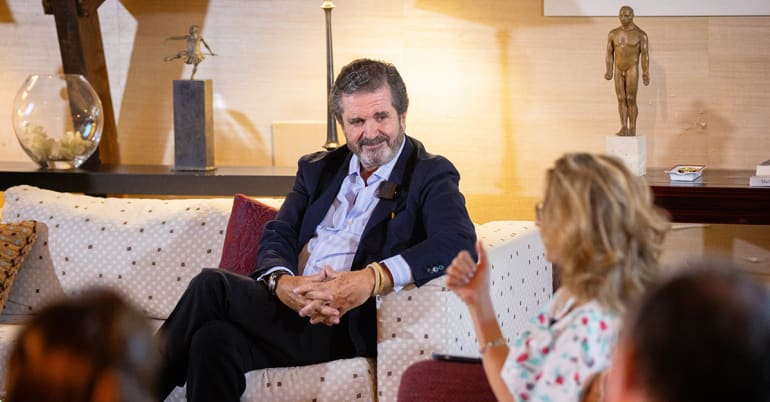
Preparing the next generation involves more than transferring ownership. It requires families to consider how responsibilities, relationships and individual aspirations will evolve. At our recent Madrid event, dedicated to family businesses and succession, Borja Prado Eulate, Founding Partner at Peninsula Capital, and his son, Javier Prado Benítez, Investment Director at Peninsula Capital, joined Xavier Bonna, Managing Partner at Lombard Odier, to discuss these challenges and the role of effective family governance in addressing them. The exchange was moderated by Marie-Christine von Pezold, Independent Family Governance consultant at Lombard Odier and Director of the Family Business Network Switzerland. Many guests attended with their adult children, reflecting the event’s focus on dialogue between generations.
For Borja Prado Eulate, preparing his children for the future began without a predetermined career path. “I tried to prepare them for life,” he explained. When his son Javier subsequently joined Peninsula Capital, maintaining that independence required particular care. Borja acknowledged that, in seeking to avoid any suggestion of favouritism, he had sometimes placed excessive demands on his children. His reflection illustrated a tension familiar to families working together: maintaining professional standards while recognising the expectations that come with working alongside family.
Borja Prado Eulate’s reflection illustrated a tension familiar to families working together: maintaining professional standards while recognising the expectations that come with working alongside family
Preparing the next generation without prescribing their future
Borja distinguished his own experience from that of someone inheriting an established family company. Much of his career had involved managing businesses for third parties. He expected his children to gain professional experience independently, starting with summer jobs during their university years. Alongside this, they became familiar with the family’s properties and investments before becoming involved in his professional activities.
Communication was central to that preparation. Borja described discussing decisions with his children from an early age, even before they could fully understand the issues involved. Openness was accompanied by an expectation of discretion: participation in family conversations carried a responsibility to respect their confidentiality.
He also emphasised his wife’s contribution to their children’s education and the family's cohesion. While his professional responsibilities required extensive travel, she ensured that time together remained a priority. Javier recognised her influence in his own working relationships, particularly in how he treats colleagues at different levels of the organisation. “I learned it from her,” he said.
Preparing for succession requires understanding family dynamics beyond ownership and management structures
Marie-Christine noted the importance of recognising family members whose influence does not depend on a formal business role. Their relationships across generations can give them particular authority when a family is navigating change or disagreement. Preparing for succession, therefore, requires understanding family dynamics beyond ownership and management structures.
The Prado children pursued different careers while remaining involved in discussions about shared assets. Their experience also illustrates the distinction between preparing the next generation to participate responsibly in family affairs and expecting them to join a particular business. This distinction is also central to Lombard Odier’s approach to family governance, which seeks to reconcile shared family objectives with individual aspirations.
For Javier, joining Peninsula Capital followed five years at J.P. Morgan, including a period in Mexico. His interest in returning to Europe and moving into private equity coincided with an opportunity at Peninsula. Admission nevertheless depended on a formal recruitment process, including financial modelling and a presentation to the investment team.
His previous experience provided more than a qualification for the role. It gave him the ability to assess opportunities, ask informed questions and present investment proposals to a committee. Without that grounding, he reflected, “I wouldn't have been respected inside”.
Establishing credibility on his own merits was particularly important in an organisation where his father already held a prominent position. Javier’s advice to younger family members was to develop their careers elsewhere before considering working alongside a parent. He acknowledged that joining could be rewarding, but could also bring heightened expectations and professional disagreements.
Xavier described a comparable principle at Lombard Odier. Membership of a founding family offers no entitlement to employment or partnership, and family members must first gain professional experience elsewhere. “There is absolutely no special treatment,” he explained.
His own career followed that approach. Xavier joined Lombard Odier through an open position in Belgium in 2016, nine years after his father’s retirement. His father had not encouraged him towards a particular role at the bank, and becoming a Managing Partner was not his objective when he applied. Selection for the partnership subsequently requires the agreement of the existing Managing Partners.
For entrepreneurial families, clearly defined roles and responsibilities are essential to effective governance
The distinction between family ties and professional responsibility also extends to reporting structures. Borja noted that Javier does not report directly to him. Marie-Christine recommended avoiding direct reporting lines between relatives where possible, helping to ensure that professional assessment does not become inseparable from the parent-child relationship. For entrepreneurial families, clearly defined roles and responsibilities are essential to effective governance. Drawing on its experience in family governance and succession planning, Lombard Odier helps families establish frameworks that clarify decision-making, balance individual aspirations with shared objectives, and support continuity across generations.
Lombard Odier helps families establish frameworks that clarify decision-making, balance individual aspirations with shared objectives, and support continuity across generations
Trust means leaving room for mistakes
Professional preparation must ultimately be matched by the authority to make decisions. Javier illustrated this through a family property in Portugal that he and his sister help manage. After appointing someone to oversee the estate, they discovered that their supervision of the arrangement had been insufficient.
Their father left them responsible for resolving the problem themselves. As Javier recalled his father’s response: “Okay, fix it”. They replaced the individual and took a more active role in overseeing the property. Crucially, their initial mistake did not result in their responsibility being withdrawn.
Borja’s approach combined access to his experience with room for his children to exercise their own judgement. His advice to parents was to share what they had learned, while allowing the next generation to take risks and accept the consequences. In his words, “let them fly a bit”.
Javier also emphasised the value of investing his own earnings. Personal exposure to gains and losses had deepened his understanding of the effort required to build wealth and informed his contribution to discussions about family investments. Financial independence, in this context, was part of his preparation for shared responsibilities.
Differences in priorities nevertheless remained. Javier described disagreements among siblings and between generations, including differences associated with their respective stages of life. Maintaining mutual respect was essential to keeping those discussions constructive. His brother, whose career lies outside their shared professional environment, could provide a useful balance between differing viewpoints.
Xavier similarly acknowledged that his siblings have distinct perspectives and appetites for risk. They retain some shared investments while managing other assets independently. Such arrangements allow family members to participate in common interests without assuming that their financial priorities will always coincide. These experiences also illustrate a central consideration in Lombard Odier’s work with families: establishing a common framework while accommodating different priorities, levels of involvement and attitudes towards risk.
Turning family intentions into governance
The Prado family discusses shared assets through regular meetings, complemented by longer gatherings twice a year. Borja’s experience of advising other families had reinforced the importance of adapting arrangements to their circumstances and culture. “Every family is different,” he observed.
Marie-Christine emphasised that governance must also be reflected in practice. A written framework has limited value if the family’s relationships and decisions do not follow it. Regular communication remains necessary, whether arrangements are largely informal or set out in a family charter.
As families and their interests become more complex, implicit understandings may need to be clarified. Participation in decisions, the allocation of responsibilities and the representation of relatives working outside the business can become increasingly important. Addressing these matters early gives families an opportunity to discuss differences before a succession or ownership decision makes agreement urgent.
Through its Family Programme, Lombard Odier helps entrepreneurs and their families examine these questions and establish priorities. Discussions can cover the composition of the family’s decision-making circle, representation within a family council and voting arrangements. They also provide a setting in which individual expectations can be expressed and considered alongside collective objectives.
Preparation also extends to the next generation’s understanding of wealth. Xavier stressed the importance of early conversations, including an open discussion about mistakes, and of learning to engage confidently with bankers, lawyers and trustees. These relationships will shape their future responsibilities
Lombard Odier first works with the family to develop a family charter that sets out the principles, expectations, and governance arrangements agreed upon by its members. Once this framework is established, the next step is to work alongside the family’s lawyers to translate the relevant provisions into appropriate legal arrangements, such as a shareholders’ agreement. While the family charter itself is not legally binding, it provides a shared foundation for these subsequent steps.
Preparation also extends to the next generation’s understanding of wealth. Xavier stressed the importance of early conversations, including an open discussion about mistakes, and of learning to engage confidently with bankers, lawyers and trustees. These relationships will shape their future responsibilities, whether or not they take an executive role within a family business.
The discussion between Borja and Javier demonstrated how closely succession is connected to questions of trust, legitimacy and independence. For entrepreneurial families, these considerations deserve attention alongside the financial and ownership arrangements. At Lombard Odier, we help families address them together, combining family governance and wealth planning expertise with an understanding of their individual circumstances. The objective is to prepare both the transfer of responsibilities and the people who will assume them, while allowing each generation a role in determining what comes next.
important information
This is a marketing communication issued by Bank Lombard Odier & Co Ltd (hereinafter “Lombard Odier”).
It is not intended for distribution, publication, or use in any jurisdiction where such distribution, publication, or use would be unlawful, nor is it aimed at any person or entity to whom it would be unlawful to address such a marketing communication.





share.