When you visit our website, information may be stored or recovered on your device, mainly in the form of cookies. We use essential cookies to ensure the website works as it should, and statistical and marketing cookies for audience measurement and content customisation purposes. We rely on Google for statistical and marketing cookies in order to measure website performance and display relevant advertising. For more information on this, please also refer to the Google policy on Business Data Responsibility.
From the Cookie Management Centre, you can set your preferences with respect to the use of cookies: accept or reject certain categories, accept all, or reject all. For detailed information on all cookies used across these three categories, please refer to our Cookie Policy.
Please note that blocking certain cookies may affect your experience and the services offered.
Essential cookies Always active
Essential cookies help the website to work as it should by enabling necessary functionalities, such as navigating between pages and accessing secure areas. These cannot be disabled in our systems.
Statistical cookies
Statistical cookies help us understand how visitors interact with our site by collecting and communicating browsing information. They make it possible to identify the most and least visited pages and to improve the overall performance of the site.
Marketing cookies
Marketing cookies are used to display relevant advertising and measure the performance of campaigns. If you choose not to allow these cookies, you will continue to see ads, but they will be less relevant to your interests.
Choose the purposes for which we may use Google products to collect and use your data:
User storage: to technically permit advertising functionality.
User data for advertising: to optimise our advertising campaigns.
Ad customisation: to tailor advertising to your interests.
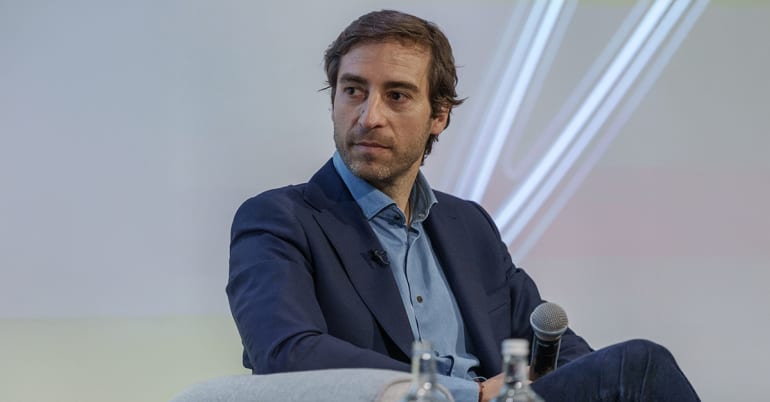
From pro footballer to sustainable biochemical entrepreneur: a conversation with Mathieu Flamini
Mathieu Flamini is a former professional footballer whose career included spells at Olympique de Marseille, Arsenal, and AC Milan. Today, Mathieu Flamini is Chief Executive Officer (CEO) of GFBiochemicals, which is working to develop bio-based alternatives to fossil-derived chemicals. In conversation with Marc Palahí, Lombard Odier’s Chief Nature Officer, at Lombard Odier Investment Managers’ recent Transition Investment Summit, Mathieu Flamini discussed his journey from elite sport to entrepreneurship, the role of green chemistry in the transition to a sustainable economy, and the challenges of scaling safer, more sustainable solutions.
You co-founded GFBiochemicals back in 2013, while you were still playing for AC Milan. Why did you move from football to biochemicals, and how has your experience as a footballer helped you as an entrepreneur?
Growing up, I had two big loves. The first one was football. I was a professional for nearly 20 years, starting my career in France – where I grew up – with Marseille. I joined Arsenal when I was 19, where I played for eight years. I then played for AC Milan for five years before I retired from football about seven years ago, when I was playing in Spain. So, I’ve been extremely privileged. I was a young kid with a dream of being a football player, and I managed to achieve this first dream. This is something I wish for everyone: to do what we love.
My second love was nature. My father was a diver, and when I was young, he and I would collect plastic on beaches. I was very aware of humankind’s negative impact on the planet.
That’s why, while I was still playing for AC Milan over a decade ago, I took the opportunity to co-found GFBiochemicals and started assembling a team of scientists. The idea was to develop one of the molecules of the future identified by the US Department of Energy, which at the time had not been produced at an industrial scale.
Founding GFBiochemicals enabled me to challenge myself both physically on the pitch and intellectually through entrepreneurship
Founding GFBiochemicals enabled me to challenge myself both physically on the pitch and intellectually through entrepreneurship. Many of the qualities that made me a successful footballer have also made me a successful entrepreneur, such as the ability to cope under pressure, resilience, hard work, and team spirit. As a football player, you need to perform with the team around you. As an entrepreneur, you also need to lead, listen to your team, and bring everyone in the same direction.
Sign up for our newsletter
What does GFBiochemicals make, and how do your products compare with fossil-based alternatives?
Something a lot of people don’t realise is that many everyday products – from shampoo and shower gel to cleaning products, detergents, sunscreen, fragrances, and the food we eat – are still heavily reliant on fossil-based ingredients. These “forever chemicals” have a negative impact not only on the planet, but also on our health.
At GFBiochemicals, we convert biomass – agricultural waste – into plant-based ingredients based on levulinic acid, a molecule derived from Earth’s most abundant organic polymer: cellulose. We work closely with large chemical and consumer goods producers to help them transition from fossil-based formulations to safer, bio-based alternatives.
The versatility of levulinic acid has enabled us to enter a wide range of markets, from personal care and fragrances to agrochemicals. For instance, our technology has enabled plant-based pesticides that reduce toxicity in food systems, and plant-based alternatives to the fossil-derived solvents found in many personal care products, detergents, and paints.
After ten years of research and development, we have around 200 patents protecting our technologies. Now, we are commercialising and scaling. It’s always a great moment when, after a decade, you can finally bring something to market.
Not everyone cares about sustainability, but everyone wants to live longer and better
I strongly believe that green chemistry is an industry of the future. But the narrative around sustainability is changing. Of course, your product must be sustainable to succeed. But people also want a better product, and you can only achieve this via innovation.
Now, we must also deliver on safety and cost-in-use competitiveness. Not everyone cares about sustainability, but everyone wants to live longer and better. And while a product may sometimes be more expensive upfront, there will still be a market for it so long as it’s cheaper to use. If you solve a real problem, people will pay. Ultimately, the success of our products depends on delivering the economies of scale our customers need through effective collaborations – just like any other technology.
The other point is that adoption doesn’t happen overnight. Reformulating a globally commercialised product requires a lot of tests, analyses, and time to introduce the new version to the market. It can take up to two years to go from starting a collaboration with a new customer to launching a reformulated product.
For any chemical or consumer goods producer, predictability and stability are key
In many ways, today’s geopolitical instability is an advantage for the biochemical sector, because we are competing with ingredients coming from the fossil-based industry.
For any chemical or consumer goods producer, predictability and stability are key. But when the price of fuel increases, so do the prices of fossil-based ingredients. This is where the biochemical sector can bring stability, because the availability of our feedstock – biomass – isn’t dependent on a favourable geopolitical landscape. And if the price gap between fossil- and bio-based ingredients reduces, our products become more competitive.
However, Europe is losing ground in chemicals. It used to represent 25% of the global market, but that has reduced to around 13%, while China is at 50%. If we don’t act, Europe risks losing this entire industry. We need fair competition, which means applying the same environmental rules to imports as to European producers. Otherwise, production shifts abroad, and Europe loses industrial capacity. We need action, not just discussion.
important information
This is a marketing communication issued by Bank Lombard Odier & Co Ltd (hereinafter “Lombard Odier”).
It is not intended for distribution, publication, or use in any jurisdiction where such distribution, publication, or use would be unlawful, nor is it aimed at any person or entity to whom it would be unlawful to address such a marketing communication.




share.