The global economy is being reshaped by forces that can no longer be treated separately: climate change, biodiversity loss, food vulnerability, water stress, and geopolitical uncertainty. In the Mediterranean, these interconnected forces are particularly visible, shaping the region’s long-term resilience and competitiveness.
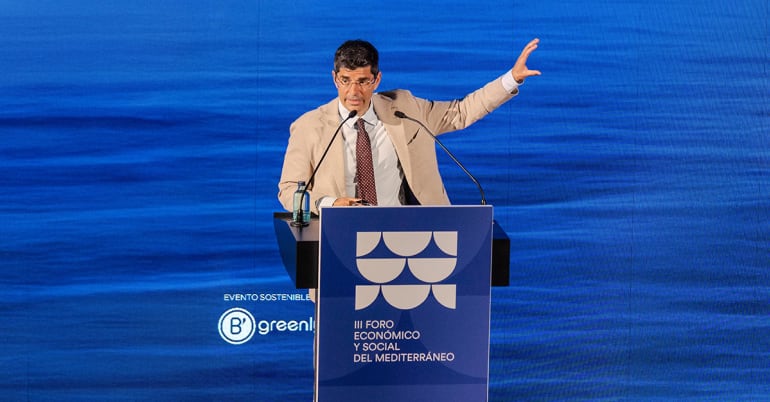
On 17 and 18 June 2026, the third Foro Económico y Social del Mediterráneo brought these issues together at CosmoCaixa in Barcelona, under the theme “Un mar de compromisos”, or “a sea of commitments”. Held in the presence of His Majesty King Felipe VI, the forum gathered institutional leaders, business representatives, academics, and civil society to discuss the future of the Mediterranean.
Against this backdrop, Dr Marc Palahí delivered one of the day’s most applauded interventions. The Chief Nature Officer at Lombard Odier Investment Managers and CEO of the Circular Bioeconomy Alliance argued that long-term prosperity depends on a profound shift: from extraction towards a regenerative model powered by life.
Nature explains our planet, it is what makes our planet special. It is the keystone infrastructure that regulates our planetary system, including our climate, the food we eat, the water we drink, and the air we breathe
His message was clear: the current economic model is reaching its limits because it has failed to recognise nature as the infrastructure on which prosperity depends. Nature, Palahí argued, is not simply a resource to extract, but the most valuable infrastructure we have. “Nature explains our planet, it is what makes our planet special. It is the keystone infrastructure that regulates our planetary system, including our climate, the food we eat, the water we drink, and the air we breathe,” he said. This was the starting point of Palahí’s keynote. Before economies can rethink how they grow, invest, and compete, they first need to rethink how they value the natural systems on which they depend.
Nature as economic infrastructure
Palahí began with a simple but often overlooked idea: nature is not a passive backdrop to human activity, but the system that enables it. It regulates the climate, supports food production, filters water, stores carbon, maintains soil fertility, and sustains the living processes on which economies depend.
Yet, conventional economics has failed to value these functions, “because it values only what has a price, but cannot put a price on everything that has value. Trees, birds, and bees do not send bills to us.” Palahí argued that this disconnect has distorted our view of value, leading markets to overlook the ecological foundations that make our economy viable.
The consequence is visible. An extractive model powered by fossil resources has delivered unprecedented growth and technological development, but at a high cost. For the first time in human history we have changed the climate of our planet and we are also crossing the so-called planetary boundaries.
Palahí described this as a historical tipping point. Once planetary boundaries are crossed, climate change, biodiversity loss, and ecosystem degradation start to reinforce one another. Forest loss, for example, weakens natural carbon sinks and releases more carbon into the atmosphere. This accelerates climate change, increases the risk of wildfires, and drives further forest loss.
Externalities become ecosystem risks, ecosystem risks become economic losses
At this tipping point, he warned, the planet can no longer absorb the shocks generated by our economic model. Those shocks are now being reflected back as ecosystem risks and financial losses. “Externalities become ecosystem risks, ecosystem risks become economic losses.” He noted that global insured losses linked to the combined effects of climate change and nature degradation have doubled over the past five years. For the last six years, they have consistently exceeded USD 100 billion1. The overall economic losses, which include uninsured losses, are much larger still. In Europe, the economic losses linked to climate change have increased at EUR 10 billion every 12 years across the last five decades.
Read also: Building a Circular Bioeconomy to address the growing risk of wildfires
Food systems at the centre of the crisis
Food systems made this global argument tangible, particularly in a Mediterranean context. Agriculture, water, soil health and landscape resilience are central to economic stability.
Palahí described food systems as both a victim and a driver of the nature-climate crisis. Recent research published in Environmental Research Letters reinforces this warning. It identified 16 examples of food price rises around the world following periods of extreme heat, drought, or rainfall between 2022 and 20242. These included sharp price movements in coffee, cocoa, and olive oil. In the EU, olive oil prices rose by 50% between January 2023 and January 20243, after drought hit Spain and Italy, illustrating how climate and ecosystem pressures can feed directly into household costs, corporate margins and inflation dynamics.
According to the European Investment Bank, adverse weather such as droughts costs the EU agricultural sector more than EUR 28 billion a year on average, equivalent to around 6% of annual crop and livestock production, yet only 20% to 30% of those losses are insured4. Under a business-as-usual scenario, such losses could almost double over the next two decades, while catastrophic years could generate losses of around EUR 90 billion5.
Three drivers help explain this vulnerability: a warmer atmosphere that intensifies drought and heavy rainfall, extractive agricultural practices that degrade soils, and biodiversity, and overly complex supply chains that prevent capital from flowing upstream, where investment in nature infrastructure is most needed.
Food systems therefore cannot be treated simply as a sector to decarbonise. They are a foundational pillar of the economy and a critical arena for systemic transformation. Palahí noted that food systems are responsible for 33% of greenhouse gas emissions6 and are linked to up to 80% of deforestation and biodiversity loss7.
Regenerative agriculture works with nature, rather than against it. It restores biodiversity and soil health, increases crop diversity, reduces physical disturbance, and replaces synthetic inputs with biological ones
From extractive growth to regenerative value chains
For Palahí, the response begins with a different model of food production. Regenerative agriculture works with nature, rather than against it. It restores biodiversity and soil health, increases crop diversity, reduces physical disturbance, and replaces synthetic inputs with biological ones.
This is not only an environmental agenda; it is an economic one. Palahí identified three interconnected outcomes: lower costs and higher farming profitability, reduced emissions and pollution alongside stronger carbon sinks and biodiversity, and greater resilience to extreme weather events. The logic is particularly relevant in regions already exposed to drought, wildfires, soil degradation, and flood risks, including the Mediterranean. As Rosario Sánchez, Spain’s Secretary of State for Tourism, noted in another session, “If tourism does not respect the environment and redistribute wealth, it is not economically viable.” The same logic applies to food, land use, and industrial value chains: resilience is becoming a prerequisite for competitiveness.
Palahí’s answer was to move beyond fragmented sustainability measures towards a new economic paradigm. “It requires moving from an extractive economy powered by fossil resources towards a regenerative economy powered by Nature, which prospers in harmony with Nature: a circular bioeconomy,” he said.
There is no other way than to go back to an ‘open’ system. One that is ultimately powered by the external and reliable source of energy that we have: the sun
An economy powered by life
Palahí framed the circular bioeconomy as a scientific and economic shift, rather than a slogan. The industrial era, he argued, changed the energy foundation of the economy by moving from an open system powered by the sun to a system dependent on finite fossil resources stored within the planet.
“There is no other way than to go back to an ‘open’ system. One that is ultimately powered by the external and reliable source of energy that we have: the sun. To do that, Nature is our best strategy. Our best partner. Because Nature is the interface between the sun and us,” he said.
In this model, nature converts solar energy into biological resources and renewable biochemical energy. With the right knowledge, investment, and governance, these resources can support value chains that replace fossil inputs across sectors, including food, textiles, construction, packaging, energy storage and chemicals.
At the forum, this perspective also resonated with the blue economy, which seeks to support growth and livelihoods while preserving ocean and coastal ecosystems. Costas Kadis, European Commissioner for Fisheries and Oceans, argued that “the future of our coastline depends on new business models, such as fishing tourism and innovation in the bioeconomy.” His point reinforced one of Palahí’s central messages: the bioeconomy extends across the living systems and local economies that underpin the region’s prosperity.
“This is what a Circular Bioeconomy is: an economy ultimately powered by the sun. An economy that values and invests in biodiversity and nature-based solutions as the true engine of our economy,” Palahí said.
The practical implications are far-reaching. Regenerative agriculture can restore soil health and strengthen landscape resilience. Closer-to-nature forestry can produce wood while strengthening biodiversity and forest resilience. Bio-based materials can replace fossil-derived inputs, such as engineered wood products that reduce reliance on steel and concrete in the construction industry.
Read also: King Charles III celebrates the CBA UK launch
The role of capital
One of Palahí’s strongest messages was that knowledge and technology are no longer the main constraints. The greater challenge is to shift mindsets, incentives, and capital flows. The transition to a circular bioeconomy requires investment in landscapes, farms, forests, communities and new industrial value chains, alongside closer collaboration between public authorities, companies, researchers, and financial institutions.
The King’s address reinforced this call for shared responsibility. His Majesty King Felipe VI underlined that “the strength of this forum lies in its ability to gather different views and listen to different realities,” while stressing that people should remain “at the centre of any development strategy, whether public or private.” For a circular bioeconomy to scale, regenerative value chains must create value not only for investors and businesses, but also for local communities and the landscapes on which they depend.
The objective is not to use nature to compensate for economic damage, but to embed nature within the way value is created
For investors, the implications are significant. If ecosystem degradation is becoming an economic risk, then investing in resilience, restoration, and regenerative production can become a source of long-term value. The objective is not to use nature to compensate for economic damage, but to embed nature within the way value is created.
Palahí captured this distinction clearly: “A Circular Bioeconomy is about understanding, valuing and investing in Nature as the true engine to transform our economy rather than offsetting its failure. It is about moving from offsetting tactics to insetting strategies that deliver transformational action.”
Read also: Realigning finance around nature
A Mediterranean lens on a global transition
The Mediterranean has long been a place of trade, culture, and connection, but also one where the risks of an unstable climate and degraded ecosystems are increasingly visible. Water scarcity, extreme heat, wildfires, pressure on coastal systems, food security and tourism intensity all pose difficult questions for policymakers and businesses.
Yet these same characteristics make the region a natural testing ground for a circular bioeconomy. Its diverse landscapes, agricultural heritage, forests, cities, ports, and innovation hubs offer the basis for new models of cooperation.
Nature does not belong to us; we belong to nature
For Palahí, however, the transition is not only technical. It is also philosophical. It requires moving from an extractive mindset to a regenerative one. “Nature does not belong to us; we belong to nature,” he said. His closing reflection returned to forests. Before trees evolved and forests expanded, he reminded the audience, the planet was far warmer, with atmospheric CO₂ levels around ten times higher than today. Forests helped make Earth habitable by shaping the climate, soils and water cycles on which life, human civilisation and, eventually, human evolution depended.
“This is why I like to say that this is the planet of the trees and not the planet of the apes,” he said. For the Mediterranean, the opportunity is to turn vulnerability into leadership within a transition that extends far beyond the region. Palahí’s keynote left the audience with a simple but demanding proposition: the economy cannot be stronger than the natural systems that sustain it. If economies are to prosper in the decades ahead, their future may depend not on extracting more from nature, but on learning once again how to work with it.



share.