When you visit our website, information may be stored or recovered on your device, mainly in the form of cookies. We use essential cookies to ensure the website works as it should, and statistical and marketing cookies for audience measurement and content customisation purposes. We rely on Google for statistical and marketing cookies in order to measure website performance and display relevant advertising. For more information on this, please also refer to the Google policy on Business Data Responsibility.
From the Cookie Management Centre, you can set your preferences with respect to the use of cookies: accept or reject certain categories, accept all, or reject all. For detailed information on all cookies used across these three categories, please refer to our Cookie Policy.
Please note that blocking certain cookies may affect your experience and the services offered.
Essential cookies Always active
Essential cookies help the website to work as it should by enabling necessary functionalities, such as navigating between pages and accessing secure areas. These cannot be disabled in our systems.
Statistical cookies
Statistical cookies help us understand how visitors interact with our site by collecting and communicating browsing information. They make it possible to identify the most and least visited pages and to improve the overall performance of the site.
Marketing cookies
Marketing cookies are used to display relevant advertising and measure the performance of campaigns. If you choose not to allow these cookies, you will continue to see ads, but they will be less relevant to your interests.
Choose the purposes for which we may use Google products to collect and use your data:
User storage: to technically permit advertising functionality.
User data for advertising: to optimise our advertising campaigns.
Ad customisation: to tailor advertising to your interests.
Building a circular bioeconomy to tackle the growing threat of forest fires
key takeaways.
Forest fires, droughts, and floods are not isolated phenomena, but rather the symptoms of an economic model that has surpassed the limits of the Earth’s resilience
Dependence on fossil fuels has altered the climate and damaged rural landscapes, causing biodiversity loss and weakening their capacity to withstand extreme weather events
Preventing and extinguishing fires is necessary, but not sufficient: in order to tackle the root causes of wildfires it is essential to transform our economic model
A circular bioeconomy can contribute to reconciling the economy with ecology, placing nature at the heart of value creation
Attracting investment, employment, and innovation to the rural world is the key to boosting its resilience, generating prosperity, and reducing environmental risks in the long term.
Article published in El Periódico on 30 July 2026.
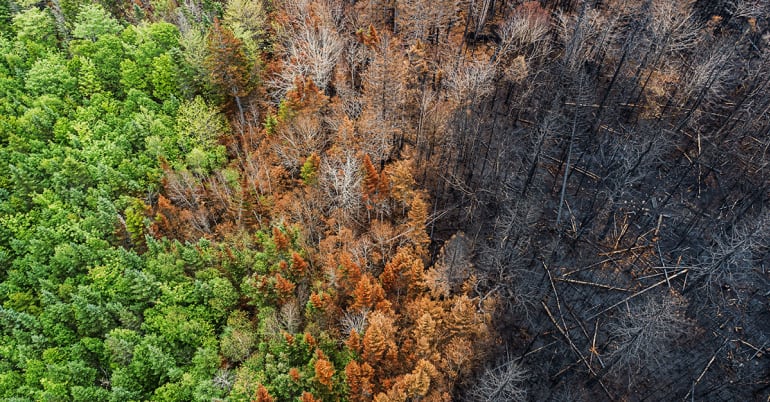
While New York, the world’s financial centre, sees its skies turn grey from the smoke of wildfires that are devastating the forests of Canada, in Spain more than 153,000 hectares have burned. That is six times more than in the same period last year, which was itself the worst year in three decades.
In a world where we have surpassed the limits of the Earth’s resilience, the so-called negative externalities of our economy – climate change, biodiversity loss, landscape degradation – are fuelling ever more intense flames, and the smoke they generate can be visible hundreds or even thousands of miles away.
Sign up for our newsletter
It is becoming increasingly difficult to ignore the obvious. Economic externalities are giving rise to environmental risks such as drought, flooding, forest fires, and heatwaves, and are rebounding like a boomerang in the form of rising economic losses. The economy is setting fire to itself, and the flames are growing higher. As I noted at the Mediterranean Economic and Social Forum, over the last five years insurers’ worldwide losses due to climate change are double what they were across the previous ten years. In Europe, economic losses from extreme events like flooding, fires, and droughts have grown at a pace of EUR 10 billion every twelve years over the last five decades.
Economic externalities are giving rise to environmental risks which, in turn, are rebounding like a boomerang in the form of rising economic losses
These extreme events – and their economic impact – are the symptoms of an economic system that is undergoing a multi-organ crisis, akin to a fever when the body fights an illness. This crisis is the result of having followed an economic diet based on fossil fuels for more than a century.
Fossil fuel resources are extracted and do not regenerate, and our economy has taken this same extractive, non-regenerative approach to everything it consumes – even to nature, the bedrock infrastructure that regulates our planet and the economy itself. Fossil fuel resources have not only been our source of energy, but have also permeated every sector of the economy: agriculture (e.g. fertilisers and pesticides), fashion (polyester), chemicals and pharmaceuticals, and construction (concrete and steel).
As a non-renewable resource that cannot be regenerated, fossil fuels have not only changed the climate of our planet, but have also untethered our economy from the Earth’s ecology. The words “economy” and “ecology” come from the same Greek word “oikos”, which means our common home, our shared life space. Ecology (from the Greek “logos”) means to “understand” our common home. Economy (from the Greek “nomos”) means to “manage” our common home. But we cannot manage what we do not understand. The fossil fuel era has uncoupled us from the biological web that gives the Earth its purpose: nature.
We cannot modify the territory at scale without modifying the economic model that created it
Back to the problem of forest fires. As a symptom of a “sick” economy, the solution cannot come by investing merely in suppressing or extinguishing fires – this fails to address the root causes. Nor will the solution come by way of preventive measures alone. The problem goes deeper – we cannot modify the territory at scale without modifying the economic model that created it.
It is important to keep in mind that the fossil fuel-based economic system has brought about two major structural transformations that have led us to today’s extreme situation:
Firstly, changes in the physics of the atmosphere. We must be aware that, due to the laws of thermodynamics, for every one degree centigrade rise in temperature, the atmosphere holds 7% more water. This means that, in dry seasons, the atmosphere absorbs more water from our soil and landscapes, causing more frequent and more intense droughts and forest fires. In addition, in rainy seasons, the atmosphere is going to return more water in the form of torrential rain. Droughts, fires, and flooding, paradoxically, are different aspects of the same problem.
Secondly, socio-ecological changes in our rural and urban landscapes. The fossil-fuel economy has produced ever more simplified and degraded landscapes that are less resilient to climate change and extreme weather events, at a time when such extreme events are becoming more frequent. In many parts of the world we have replaced complex natural ecosystems of high biodiversity (biodiversity = resilience) with simplified large-scale monocultures that largely depend on synthetic inputs like fertilisers and pesticides. Healthy soils are able to store much more water, safeguarding our landscapes against drought and floods, and yet this widespread use of agricultural chemicals is degrading soil and eroding biodiversity. In some parts of the world, including many European regions, this landscape simplification has been accompanied by a social exodus from the rural world and an unprecedented concentration in urban areas. This has led to an abandonment of the rural economy and a widespread loss of our ties to nature and its biological and ecological cycles. What were once mosaic landscapes in which forests, meadows, livestock, and farmland coexisted, have become landscapes with an unbroken continuity of biomass. This enormous shift has created urban-rural interfaces that are harder to manage (e.g. residential developments) in a context of climate emergency.
At this point, we should recall the words of Albert Einstein: “We cannot solve our problems by using the same kind of thinking we used when we created them.” We need to follow this advice now – we need a new mental framework as the basis of a new economic paradigm.
An economy that is aligned with the ecology of the Earth, a bioeconomy: where life, and not fossil fuel resources, is the driving force and raison d’être of our economy
A paradigm where economic prosperity grows within the ecological limits of our planet. An economy that is aligned with the ecology of the Earth. A bioeconomy – bio means life – in which life, not fossil-fuel resources, is the driving force and raison d’être of our economy.
We need a circular bioeconomy that attracts investment, employment, and innovation towards the rural world. A bioeconomy that can fully realise its potential to generate well-being and prosperity, while resolving the structural causes – climate change and rural socio-economic degradation – that underlie wildfires and other environmental risks. This paradigm shift requires overcoming the major dichotomies of the industrial age: ecology and economy, the rural and urban worlds, progress and nature.
important information
This is a marketing communication issued by Bank Lombard Odier & Co Ltd (hereinafter “Lombard Odier”).
It is not intended for distribution, publication, or use in any jurisdiction where such distribution, publication, or use would be unlawful, nor is it aimed at any person or entity to whom it would be unlawful to address such a marketing communication.
share.