Article published on “Voix d’entrepreneurs” in partnership with Le Figaro on 24 September 2026.
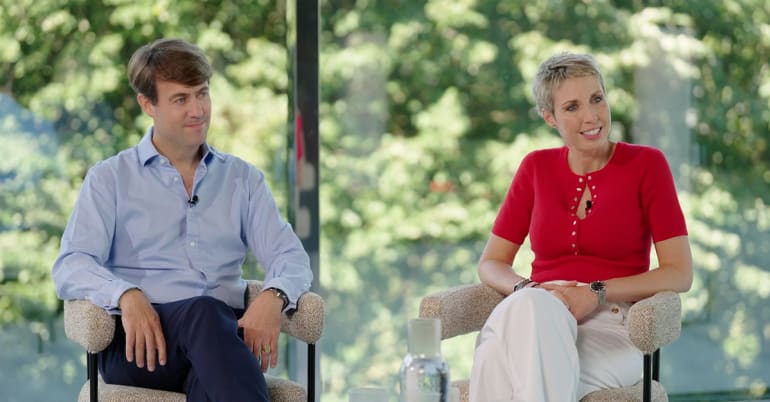
In the third and final section of this Lombard Odier podcast episode on family businesses and succession, Mathieu Flamini, co-founder and CEO of GFBiochemicals, Caroline Poissonnier, joint CEO of the Groupe Baudelet, and Édouard de Saint Pierre, Managing Director of Lombard Odier France, discuss what is really involved in handing over a business from one generation to the next. Their discussion makes clear that succession goes far beyond ownership and assets. For the generation taking over the reins, priorities include defining purpose, environmental impact, and the freedom to forge their own path.
Hear from the speakers on business succession, the next generation, and the future of family businesses:
On this final topic of succession, the three speakers expanded on their earlier discussions by exploring what is really being passed on from one generation to the next – beyond the company’s financial value, identity, employees, and products. Their response centred on the emotional dimension of succession. A company’s capital is only the tip of the entrepreneurial iceberg; beneath the surface lies a unique history, a sense of responsibility, and the expectations carried from one generation to the next.
Does that mean taking on a family business is a daunting prospect? Not necessarily.Édouard, Caroline, and Mathieu all share the view that sustainability, when considered early enough, can serve as a guiding thread rather than a constraint. It can steer a business through periods of transformation and give the next generation a clearer sense of purpose as they prepare to take the reins. The challenge is to strike the right balance between preserving what has been built without becoming locked in a fixed model that no longer fits.
The environmental transition is not about making reactive adjustments, but pursuing a carefully considered vision that has become a strategic advantage
Beyond returns
Mathieu Flamini manages GFBiochemicals, a green chemicals company on a mission to replace certain petrochemicals in many everyday products using materials derived from plants and waste. He sums up his ambition simply: “to offer solutions addressing climate change.”
When he embarked on this journey a decade ago, environmental issues were not as central to corporate thinking and strategy as they are today. While still an international footballer at the time, Flamini quickly recognised the growing imperative to protect resources and rethink how products are made. “Just like in football, a business leader has to be able to plan ahead. You have to think about what action to take before the ball reaches your foot,” he says, extending the sports metaphor. “In the same way, it’s essential to know the direction you want to steer the company in.” For Flamini, the environmental transition is not about making reactive adjustments, but pursuing a carefully considered vision that has become a strategic advantage.
related content.

entrepreneurs: bespoke wealth management.
learn more Environmental commitment is nothing new for Caroline Poissonnier either. It has long been embedded in the ethos of Groupe Baudelet, founded by her grandfather, Jean. “We were following sustainable development and circular economy principles back in 1989, under my grandfather, who was already using biogas from waste,” she recalls. “We were also transporting goods by river. We had set up an endowment fund, and across the board we were very conscious of the footprint that our business was leaving on the world. That is precisely what bing a B Corp. company is all about.” This demanding certification takes a cross-cutting approach, evaluating everything from a company’s social and environmental track record to its governance practices.
Read also: Leadership beyond the founder: vision, talent and the art of letting go | Lombard Odier
Édouard de Saint Pierre sees the same shift in how success is defined among the families he advises. Contrary to the criticism sometimes levelled at younger generations, the Lombard Odier France CEO considers them to be “every bit as ambitious as previous generations.” He explains that “when analysing performance, of course we talk about economic performance and KPIs, but the conversation is also widening out to include impact and the search for meaning. That has become indispensable.”
That sense of purpose can strengthen the enduring appeal of the family business, giving the next generation a clearer reason to become involved and carry it forward in their own way
This shift in how “value” is understood is also reshaping the way family businesses prepare for succession. Inheriting a financially healthy business is no longer enough; the next generation also wants to understand the values the business stands for and the ambitions it is pursuing. As de Saint Pierre puts it, “The incoming generation need to find a purpose to the company they are considering taking on. This drives the conversations we can have.” That sense of purpose can also strengthen the enduring appeal of the family business, giving the next generation a clearer reason to become involved and carry it forward in their own way.
Read also: How the next generation is reshaping private banking | Lombard Odier
The message to heirs: “Love your life!”
Caroline Poissonnier rejects the notion that an inheritance should be imposed on the next generation.“It is too large a burden to insist on an all-or-nothing stance,” she argues. For her, passing on a business is less about requiring children to take on stewardship of the family business than giving them the freedom and means to choose their own course, even if that means using the family capital to “create what they want to create.” Asked what she hopes to pass on to her own children, her answer is immediate: “Love your life; do what makes you feel alive!” She adds, “What I want to give my children is the gift of a smile. It's wanting to get up in the morning.”
Mathieu Flamini subscribes to the same philosophy. “The important thing is to do something that brings you pleasure; to find a purpose – a real reason for living,” he says. For him, passing on the business is still a far-off prospect. “For now, I am the first generation, and I am putting my all into building something viable.” In the meantime, his message to younger generations draws on lessons of his footballing career: enterprise demands hard work, persistence, and a willingness to make sacrifices. “I wasn't the best player on the pitch, but I spent 20 years in football through hard work and tenacity.”
Successful businesses are those that remain true to their DNA, while still being able to adapt to technological, environmental, and demographic shifts, and attract a talented workforce
Handing over a business is all about control
Édouard de Saint Pierre concludes the conversation by stepping back to the bigger picture. He argues that a business’s longevity is less about sticking faithfully to the past and more about whether it can strike the right balance between continuity and agility: “Successful businesses – whether family-owned or not – are those that remain true to their values, their DNA, while still being able to adapt to technological, environmental, and demographic shifts, and attract a talented workforce.”
The stakes extend far beyond the families involved. These transfers are also tied to France’s economic vitality, and ultimately its sovereignty. Family businesses account for 71% of French firms, and 69% of their owners see family identity as a source of competitive advantage.1
Cécile de Lisle, Executive Director of the Center for Family Business at the HEC Paris, helps put that advantage into a broader context. The EY barometer on the transfer of family businesses, published in October 2025, describes a model “capable of investing in projects with a generational horizon, of taking measured but decisive risks, and passing on knowledge and values down multiple generations.” It adds that these firms’ frugality and long-term view make them less volatile and better able to withstand shocks. De Lisle goes so far as to describe family businesses as “cementing the social contract.”
Read also (in French): Entreprises familiales : ce que révèle notre nouvelle étude | Lombard Odier
They represent a significant share of the French economy, accounting for 65% of GDP and 69% of employment. With half expected to change hands over the next decade, the scale of the succession challenge is considerable.2
Édouard de Saint Pierre believes that this reality brings a strategic dimension to their longevity “They represent the fabric of the French economy, and their continued survival is a matter of national sovereignty.” Passing on a family business is about more than preserving the family’s wealth. It is also about preserving centres of decision-making, expertise, and employment over the long term – and, in doing so, helping safeguard the country’s economic independence.
To find out more, visit the Le Figaro YouTube channel where you can listen to the full “Entrepreneur’s Voice” podcast.


share.