Article published on “Voix d’entrepreneurs” in partnership with Le Figaro on 17 September 2026.
In the second part of our Entrepreneur’s Voice podcast, three very different journeys converge on a shared understanding of what it takes to lead a business through growth, change, and succession.
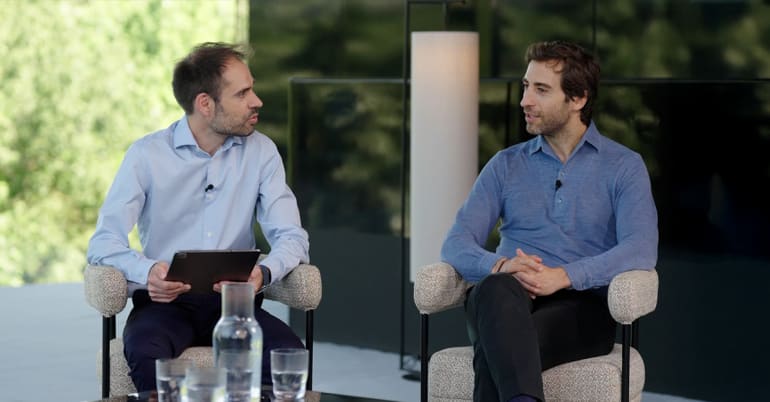
Caroline Poissonnier, joint CEO of the Baudelet Group, Mathieu Flamini, co-founder and CEO of GFBiochemicals, and Édouard de Saint Pierre, Local Managing Director of Lombard Odier France, join Sébastien Couasnon, creator and presenter of podcasts dedicated to entrepreneurs, to explore how leadership evolves as a business grows and ultimately prepares for life beyond its founders.
From family governance and entrepreneurship to the lessons of elite sport, their experience points to a common principle: enduring leadership is about more than authority. It requires clear direction, the ability to attract the right talent, and the confidence to move a business forward without losing sight of the values that shaped it.
Discover the video to watch the full conversation and hear from Caroline Poissonnier, Mathieu Flamini, and Édouard de Saint Pierre:
What makes a good leader?
Success is not about having all the answers. It is about setting a clear direction, bringing together the right people, and creating a shared sense of purpose rooted in values.
For Caroline Poissonnier, leadership means guiding a multigenerational family business forward while remaining true to the values on which it was built. For Mathieu Flamini, it is rooted in discipline, resilience, and the collective spirit of elite sport, translated into the demands of entrepreneurship. For Édouard de Saint Pierre, it is shaped by years of supporting families as businesses, ownership, and wealth pass from one generation to the next.
A leader needs “vision, foresight, and a heart that beats for their company – and knows how to convey that to all of their teams”
Vision as a source of legitimacy
Caroline Poissonnier did not simply inherit the right to lead the Baudelet Group. She spent a decade earning it. Founded by her grandfather in 1964 as a waste collection, sorting and recycling business, Baudelet is now an organisation of around 900 employees. Since 2018, Caroline has led the group alongside her brother, Jean-Baptiste. That decade inside the family business mattered. It gave both siblings operational credibility and a detailed understanding of the company they would eventually be asked to shape. But technical understanding, Caroline argues, only takes a leader so far.
The qualities that become increasingly important at the top of an organisation are harder to quantify: judgement, anticipation, emotional intelligence, and the ability to translate an idea for the future into something other people want to help build. A leader, she says, needs “vision, foresight, and a heart that beats for their company – and knows how to convey that to all of their teams.”
It’s an important distinction. Authority can be inherited through ownership, but leadership must be earned. For family businesses in particular, succession depends on more than preserving a founder’s legacy. It requires the next generation to build its own credibility while giving people confidence in where the business is going next.
Finding the people who make you better
Mathieu Flamini arrived at the same conclusion from a very different starting point.
Before becoming an entrepreneur, he spent years competing at the highest level of professional football. Today, he is the co-founder and CEO of GFBiochemicals, a green chemicals company that uses plant-based alternatives to petrochemicals found in many everyday products.
At first glance, the two careers could hardly seem further apart. To Mathieu, however, many of the fundamentals are familiar. Elite sport teaches discipline, resilience, sacrifice, and the ability to perform under pressure. It also teaches something fundamental about talent: individual ability matters, but rarely in isolation.
The answer is not to attempt to become the expert in every field: it’s to delegate and, above all, to trust the people around you
Business brought one important difference: when a football match ends, a player can relax once the final whistle blows. The responsibility of running a business does not stop at the end of the working day, however. The questions continue into mornings, evenings, and weekends. Employees depend on decisions being made. Investors expect answers. Difficult moments ultimately make their way to the person at the top. For a founder, that intensity can create a temptation to remain involved in everything. Mathieu learned quickly that this was impossible.
Read also: Entrepreneurs: family business succession and sustainable innovation | Lombard Odier
Without a background in chemistry, Mathieu found himself working alongside doctors, researchers, and specialists who understand their disciplines far more deeply than he did. The answer was not to attempt to become the expert in every field. It was to delegate and, above all, to trust the people around him. A philosophy which can be summarised in what has become a classic expression: “If you’re the smartest person in the room, you’re in the wrong room.”
related content.

entrepreneurs: bespoke wealth management.
learn more Caroline Poissonnier shares the same belief. “I spend my time looking for people who are better than me in their field to work with,” she says. Her ambition is not to accumulate talent, but to build a team with complementary strengths.
For both Caroline and Mathieu, delegation is therefore about far more than efficiency. It is an expression of trust: choosing the right people, giving responsibility, and creating the space for them to contribute at their best.
Reinventing yourself while remaining faithful to who you are
Taking over a family business raises another, even more delicate, question: how can you make your mark without compromising the legacy you have inherited? For Caroline, the answer lies in ensuring the company’s values remain aligned with those of the people leading it. “You must be faithful to what you’ve received. At the same time, a business has to reflect the people who manage it,” she says.
It is a view echoed by Édouard de Saint Pierre, Local Managing Director of Lombard Odier France, who sees longevity as a constant balance between continuity and change: “The secret of longevity is to reinvent yourself while remaining true to who you are.”
For Édouard de Saint Pierre, a successful transfer requires “constant alignment with the needs of the times and the new generation that embodies them”
His work with family businesses facing succession has reinforced that belief. In his view, a successful transfer requires “constant alignment with the needs of the times and the new generation that embodies them,” while remaining firmly anchored in the company’s values and DNA. Lombard Odier offers a powerful illustration of that principle: established in 1796, the Firm has evolved over more than two centuries and seven generations while preserving continuity in its partnership model and core values.
But this continuity doesn’t happen by itself. It must be structured. For Édouard, that means professionalising governance: clarifying roles, bringing in outside perspectives, and establishing formal channels for dialogue. Done well, these structures do more than support succession. They help prevent generational differences from becoming lasting divisions.
Read also: How the next generation is reshaping private banking | Lombard Odier
At Baudelet, that space is deliberately protected. Twice a year, Caroline and her brother step away from the day-to-day business for a retreat with an external advisor. Operational issues are pushed to the sidelines. Instead, they examine their relationship as siblings, their responsibilities as shareholders, and the direction they want the company to take.
These are conversations easily postponed when businesses are busy. They are also often conversations that determine whether a family enterprise successfully reaches the next generations.
A business that cannot function without its founder may be successful, but it is not yet fully independent. A business with strong governance, capable management, and a clear purpose can continue creating value after the person who started it has moved on
The courage to become replaceable
Perhaps one of the most difficult decisions a founder can make is when to step down.
Mathieu returns once again to football. One of the greatest risks for an athlete, he observes, is “staying on a year longer than you should.” The same thought now informs the way he considers his role as an entrepreneur. There may come a point when the business he helped create needs a different kind of leader for its next stage of development.
For founders, that possibility can be uncomfortable. Building a company often demands such intense personal commitment that separating the identity of the individual from the identity of the business becomes difficult. The qualities that helped create success – discipline, commitment, and hard work – can make relinquishing responsibility particularly challenging. Yet preparing to become dispensable may be one of the clearest signs of leadership maturity. A business that cannot function without its founder may be successful, but it is not yet fully independent. A business with strong governance, capable management, and a clear purpose can continue creating value after the person who started it has moved on.
Across these two distinct entrepreneurial journeys, the message is strikingly consistent: leadership is not about making yourself indispensable, but about building an organisation that can thrive without you. It means setting a clear direction, trusting the right people, and staying true to the values that define the business, and knowing when to make space for what comes next.
To find out more, watch the full Entrepreneur’s Voice podcast on Le Figaro’s YouTube channel.


share.