When you visit our website, information may be stored or recovered on your device, mainly in the form of cookies. We use essential cookies to ensure the website works as it should, and statistical and marketing cookies for audience measurement and content customisation purposes. We rely on Google for statistical and marketing cookies in order to measure website performance and display relevant advertising. For more information on this, please also refer to the Google policy on Business Data Responsibility.
From the Cookie Management Centre, you can set your preferences with respect to the use of cookies: accept or reject certain categories, accept all, or reject all. For detailed information on all cookies used across these three categories, please refer to our Cookie Policy.
Please note that blocking certain cookies may affect your experience and the services offered.
Essential cookies Always active
Essential cookies help the website to work as it should by enabling necessary functionalities, such as navigating between pages and accessing secure areas. These cannot be disabled in our systems.
Statistical cookies
Statistical cookies help us understand how visitors interact with our site by collecting and communicating browsing information. They make it possible to identify the most and least visited pages and to improve the overall performance of the site.
Marketing cookies
Marketing cookies are used to display relevant advertising and measure the performance of campaigns. If you choose not to allow these cookies, you will continue to see ads, but they will be less relevant to your interests.
Choose the purposes for which we may use Google products to collect and use your data:
User storage: to technically permit advertising functionality.
User data for advertising: to optimise our advertising campaigns.
Ad customisation: to tailor advertising to your interests.
Fondation Lombard Odier and the Swiss Polar Institute join forces to help improve natural hazard mitigation in the Swiss Alps
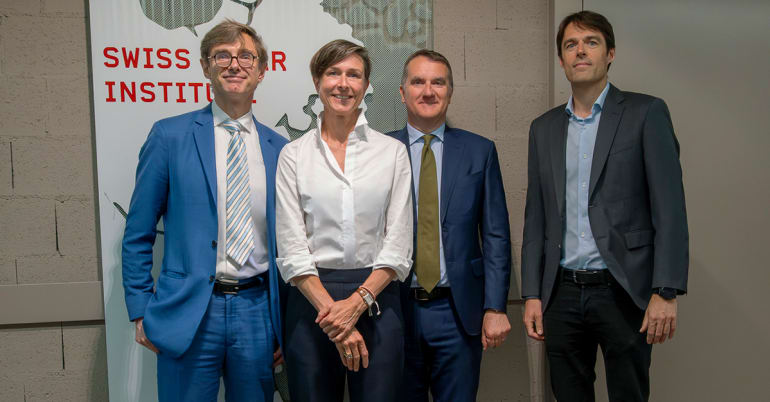
Following the tragic partial collapse of the Birch Glacier on the Valais village of Blatten in May 2025, Fondation Lombard Odier and the Swiss Polar Institute joined forces, engaging in a multi-year collaboration with the new “IceTools Initiative”. The project’s goal is to help Switzerland – and, by extension, high mountain regions in other countries – anticipate and prepare for future disasters of comparable or greater severity, in the context of significant cryospheric changes driven by climate warming. The initiative was officially launched on 12 May 2026 during a gathering of all involved stakeholders in Sion, with representatives of both organisations, of the scientific community and of the Valais cantonal authorities.
The year 2025 was designated by the United Nations as the International Year of Glaciers’ Preservation, at a pivotal moment in time for high-mountain ecosystems. Across the globe, glaciers are melting, collapsing, and vanishing at an unprecedented pace.
Sign up for our newsletter
Recent scientific assessments reveal that Swiss glaciers have lost a quarter of their volume since 2015. Over 1,000 small glaciers have already disappeared. Since preindustrial times, temperatures in Switzerland have risen by nearly 3°C – twice the global average increase.
The consequences extend far beyond the loss of a natural symbol and are already reshaping lives and landscapes. The accelerating rate of changes in the Alps is intensifying natural hazards such as floods, debris flows, and landslides. These risks became a devastating reality on 28 May 2025, when the village of Blatten in Canton Valais was destroyed. Although experts had identified this scenario as a major threat – closely monitoring the Birch Glacier and evacuating residents as a precaution – it is now crucial to investigate the complex interlinkages that caused this natural disaster in order to improve the preventive tools for such events in the future.
Faced with this urgent need for action, Fondation Lombard Odier and the Swiss Polar Institute (SPI) launched the “IceTools Initiative” in early 2026, which will run until 2028. Its objective is to maximise the lessons learned from the Blatten disaster and other similar events in the past. It is designed to advance and integrate technological innovation and operational readiness for alpine hazard cascades by improving modelling, early detection of precursors, and risk reduction for alpine communities. Its goal is to help Switzerland – and, by extension, high-mountain regions in other countries – anticipate and prepare for future disasters of similar or greater severity.
The IceTools Initiative will involve experts from ETH Zurich, EPFL, University of Lausanne (UNIL), University of Zurich (UZH), and the Swiss Federal Institute for Forest, Snow and Landscape Research (WSL). It is composed of three complementary actions which will unfold in the coming months:
First, as the Blatten event provides a rare opportunity for comprehensive post-event analysis – enabled by an exceptional dataset of remote sensing, field observations, eyewitness accounts, and climatic records – the project aims to unravel the complex interactions between geological, glaciological, mechanical, and climatic factors that led to the cascading failure. In coordination with the cantonal authorities of Valais, the work will be conducted by a consortium of researchers based in Switzerland and abroad, including experts directly involved in monitoring and managing the event.
Secondly, with the objective of enabling confident, evidence-based decision making in future hazard situations, IceTools will support the development of the next generation of observational and modelling tools. The initiative will thus foster the optimisation and testing of existing research-oriented tools to bring them to operational applicability.
Finally, to ensure that the innovations developed within IceTools lead to real-world improvements, the initiative integrates targeted dissemination as a way to leverage the findings. The goal is to enable a structured transfer of knowledge to all relevant stakeholder groups – from frontline authorities, via the scientific community, to the local population.
For Fondation Lombard Odier, the partnership is part of its recently launched environmental programme, which supports projects combining science, innovation, and impact on the ground. With pilot collaborations launched at first with international organisations, the Foundation’s environmental programme now complements its portfolio with a project focusing on Switzerland.
For SPI, this programme is a swift response to the rising urgency in cryospheric hazards in high-altitude regions. The partnership with Fondation Lombard Odier is rooted in SPI’s commitment to federate Swiss polar and high-altitude science in support of local stakeholders and decision-making in the Swiss Alps.
Danièle Rod, Executive Director, Swiss Polar Institute, comments: “The Blatten event is a stark reminder of how vulnerable we all are in the face of the fast-paced changes in the Alps. There is a rising need for action and, as a science organisation, it is our responsibility to address it. The IceTools Initiative is an agile platform that will generate much-needed knowledge and help translate cutting-edge science into effective strategies for the challenges we face in the Alps.”
We are convinced that the IceTools Initiative holds tremendous potential to develop innovative solutions that will have a long-term impact in the field of natural hazard mitigation
Dr Maximilian Martin, Secretary General, Fondation Lombard Odier, and Global Head of Philanthropy, Lombard Odier Group
Dr Maximilian Martin, Secretary General, Fondation Lombard Odier, and Global Head of Philanthropy, Lombard Odier Group, comments: “In line with the Foundation’s long-standing commitment to innovation and evidence-based approaches, we are convinced that the IceTools Initiative holds tremendous potential to develop innovative solutions that will have a long-term impact in the field of natural hazard mitigation in high-mountain regions. This collaboration with the Swiss Polar Institute mobilises the best of Swiss and international science towards an important challenge that concerns us all. We look forward to the fruits of this important body of work.”
press release
Fondation Lombard Odier and the Swiss Polar Institute join forces to help improve natural hazard mitigation in the Swiss Alps



share.