When you visit our website, information may be stored or recovered on your device, mainly in the form of cookies. We use essential cookies to ensure the website works as it should, and statistical and marketing cookies for audience measurement and content customisation purposes. We rely on Google for statistical and marketing cookies in order to measure website performance and display relevant advertising. For more information on this, please also refer to the Google policy on Business Data Responsibility.
From the Cookie Management Centre, you can set your preferences with respect to the use of cookies: accept or reject certain categories, accept all, or reject all. For detailed information on all cookies used across these three categories, please refer to our Cookie Policy.
Please note that blocking certain cookies may affect your experience and the services offered.
Essential cookies Always active
Essential cookies help the website to work as it should by enabling necessary functionalities, such as navigating between pages and accessing secure areas. These cannot be disabled in our systems.
Statistical cookies
Statistical cookies help us understand how visitors interact with our site by collecting and communicating browsing information. They make it possible to identify the most and least visited pages and to improve the overall performance of the site.
Marketing cookies
Marketing cookies are used to display relevant advertising and measure the performance of campaigns. If you choose not to allow these cookies, you will continue to see ads, but they will be less relevant to your interests.
Choose the purposes for which we may use Google products to collect and use your data:
User storage: to technically permit advertising functionality.
User data for advertising: to optimise our advertising campaigns.
Ad customisation: to tailor advertising to your interests.
Why a changing world is strengthening the case for sustainable investing – from system stress to structural opportunity
The transition to a sustainable global economy is no longer a distant concept. Our economic model is already being reshaped. And while the underlying system changes are often not immediately visible, they are becoming increasingly difficult to ignore.
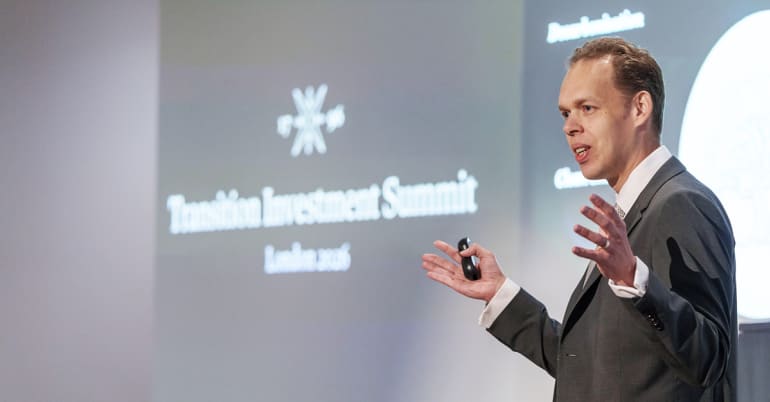
On 13 May, Lombard Odier Investment Managers (LOIM) hosted its Transition Investment Summit – a title that made it clear the reality of the transition was not in question. Instead, the discussion centred on how it is unfolding, where pressure points are emerging, and how investors can position themselves for what comes next.
As Bettina Ducat, Co-Head at LOIM, observed in her opening remarks, the current environment reflects something deeper than cyclical volatility. “The world is spinning faster,” she said. “This is not just an energy crisis. It is a stress test for an entire system.”
That system spans energy, supply chains, technology, and nature. And it is being reshaped by a combination of geopolitical instability, resource dependency, and rapid innovation. For investors, disruption is inevitable. The challenge they now face is to understand it, so they can identify and invest in the opportunities it will unlock.
The market is proving its power. This transition is not driven by politics. It is driven by economic competition
The summit opened with a conversation featuring Secretary John Kerry, 68th U.S. Secretary of State and Co-Executive Chair of Galvanize, a global asset manager investing at the intersection of energy innovation, resilience, and intelligence.
Setting the tone for the day, John Kerry said, “The market is proving its power. This transition is not driven by politics. It is driven by economic competition.”
Sign up for our newsletter
This is an important distinction. Investment in clean energy has overtaken fossil fuels globally, not simply because of policy, but also because the economics are increasingly compelling. For instance, though it was once dependent on subsidies, solar power has become one of the cheapest sources of energy available.
At the same time, demand is accelerating. From artificial intelligence (AI) infrastructure to electrification and urban growth, energy supply is struggling to keep up with rising consumption. This imbalance is creating both constraints and opportunities, driving investment across the system, from generation to efficiency.
John Kerry emphasised that the forces shaping the transition – supply, demand, and pricing – aren’t new. What is different is the scale and speed of their effects. One by one, what were once the transition’s hypotheticals have become realities deeply embedded in market dynamics.
If the transition is rooted in economics, then the way we think about sustainability must evolve.
Dr Thomas Hohne-Sparborth, Head of Sustainable Investing at LOIM, challenged the idea that sustainability is a separate investment theme or a question of values alone. Instead, he framed sustainability as a way of understanding structural changes across the economy.
If systems outperform, they scale. And if they scale, they win
“Sustainability has been somewhat misunderstood,” he noted. “When we speak about opportunity, others hear cost.” This disconnect has narrowed the debate, often reducing sustainability to carbon and environmental metrics while overlooking wider transformations that matter to both people and markets.
At its core, Dr Thomas Hohne-Sparborth’s argument is straightforward. Sustainability is about identifying where systems are evolving to deliver improved outcomes for society as well as the environment without compromising – and, ideally, strengthening – the underlying economics.
For example, while the case for a net-zero economy is clear and compelling, we are adopting the renewables we need to get there because modular technologies and learning curves are making them increasingly affordable. In healthcare, new models are improving access and efficiency while reducing long-term costs. And in financial systems, digital tools are expanding access by lowering barriers to participation.
The same dynamic is visible across these and other economic systems. Efficiency increases affordability. Affordability drives accessibility. And accessibility expands markets. This is why opportunities to improve outcomes for both our planet and society are often also investment opportunities – because wherever systems are becoming more sustainable, they are also becoming more scalable and competitive.
“If systems outperform, they scale,” Dr Thomas Hohne-Sparborth said. “And if they scale, they win.”
His argument implies that, for investors, adopting a broader perspective than they may have taken in the past will be beneficial. Today’s opportunity set extends beyond individual sectors or labels. Now, investors must identify where entire systems are being reshaped and new forms of value are emerging.
We all agree emissions must fall. But energy demand continues to grow
Managing the transition in the real world
While the direction of travel may be clear, the route remains complex.
In a discussion led by Dr Budha Bhattacharya, Head of Systematic Research at LOIM, Alex Grant, Senior Vice President and UK Country Manager at Equinor – an international energy company committed to long-term value creation and a low-carbon future – addressed the practicalities of the energy transition.
“We all agree emissions must fall,” he said. “But energy demand continues to grow.”
This reality creates a delicate balance. Renewable energy capacity is expanding rapidly, yet fossil fuels still account for the majority of global energy use, particularly in transport, heating, and industrial applications. However, fossil fuel supply is also declining naturally. If traditional energy investment falls too quickly without adequate replacement for the resulting supply losses, the result is not acceleration. It is disruption in the form of higher prices, supply shortages, and economic instability that risks undermining public support for the transition.
“The goal is not simply to reduce energy use at any cost,” Grant said, “but to provide the energy society needs in increasingly decarbonised ways.”
This perspective highlights the importance of managing the transition rather than forcing it. Systems must evolve without creating instability that could ultimately slow progress.
The goal is not simply to reduce energy use at any cost, but to provide the energy society needs in increasingly decarbonised ways
This sense of momentum, and the risks of misjudging it, was captured vividly by Greg Jackson, Founder and Chief Executive Officer (CEO) of Octopus Energy, speaking in a session moderated by Dr Michael Urban, Head of Marketing at LOIM.
“The energy transition right now is like crossing a motorway and you’re halfway across,” he said. “This is the worst time to lose your nerve.”
The analogy reflects a critical moment. Significant capital has already been deployed, infrastructure is being built, and new technologies are scaling. Yet the benefits are not fully visible to consumers, particularly in an environment of rising costs and political tension.
Greg Jackson pointed to countries such as Norway and Spain, where greater progress in clean energy systems is showing that they can deliver lower costs and greater resilience. At the same time, he emphasised that generating more clean energy alone isn’t enough. If the transition is to succeed, we need to redesign our energy system entirely.
For Greg Jackson, the ill-fated Apollo 13 mission is a case study on how we must approach the project. When Apollo 13’s oxygen tank exploded en route to the Moon, the role of the mission’s engineers instantly changed from routine technical support to figuring out how the crew could sustain their crippled vessel long enough to return safely to Earth using only what could be found amongst its meagre cargo.
“That’s exactly how we think about the energy system,” Greg Jackson said. “Here are the tools – renewables, batteries, electric vehicles (EVs), heat pumps. Now, how do we run the world cheaper and better using these tools instead of the old ones?”
The energy transition right now is like crossing a motorway and you’re halfway across. This is the worst time to lose your nerve
Doing so will entail optimisation as well as substitution. As Greg Jackson pointed out, companies like Amazon show that businesses that succeed over the long term are those that focus on reducing costs for their customers. The same applies to the transition, where, as is so often the case, affordability is a prerequisite for scale.
Jennifer Devine, Head of Wiltshire Pension Fund, provided a complementary perspective as an asset owner with over 80,000 beneficiaries and a time horizon stretching close to a century.
“We are going to end up in whatever world comes out of this,” she said.
For her fund, the transition is not optional. It is embedded in long-term fiduciary duty. The challenge lies in balancing that responsibility with the diverse views of the fund’s members, as well as navigating the complex data underpinning their investment decisions.
“You can see the risks,” Jennifer Devine said. “And once you see them, you can’t ignore them.”
Jennifer Devine’s approach combines climate scenario analysis, asset-level risk assessment, and targeted allocations to transition opportunities. Effective communication is also vital, enabling the fund to explain complex investment decisions and their outcomes to beneficiaries clearly and credibly.
From industry to everyday products
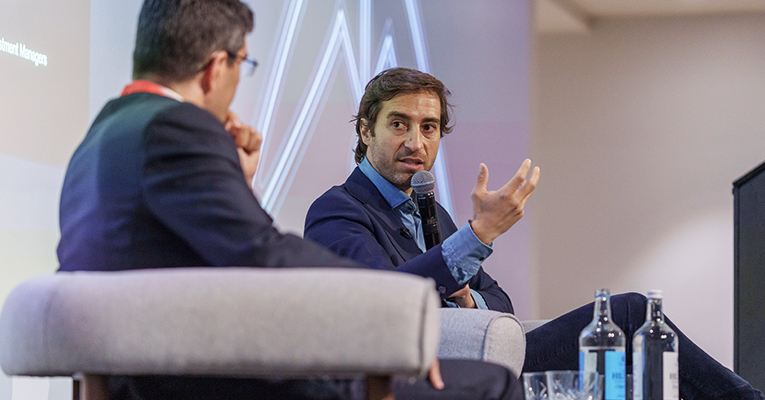
The transition is most tangible in its effects on companies and their business models. Elsewhere, the effects may be harder to spot. But, as Mathieu Flamini, Co-founder and CEO of GFBiochemicals and former Premier League football player, underscored, they are no less important – including his example: the chemical inputs that underpin everyday products.
“Almost every product we use every day relies heavily on fossil-based chemicals,” he said.
Found throughout the industrial sector, from cosmetics and cleaning products to agricultural systems, these inputs are usually invisible yet central to modern life. Mathieu Flamini’s company focuses on converting agricultural waste into bio-based alternatives and working with major industrial and consumer brands to integrate them into existing formulations.
The environmental incentives of such a project are clear. But while functional and commercial motivations are also at play, Mathieu Flamini isn’t worried about them compromising his green objectives.
If people understand that what they use every day affects their health, behaviour will change
“Green chemistry is not just about sustainability,” he said. “It is about industrial evolution.”
For Mathieu Flamini’s products to scale, they must meet three criteria: they must be sustainable, competitive on performance and cost, and safe. And although consumers may not always prioritise sustainability directly, they’re increasingly responsive to health and safety considerations. The safety criterion, then, is particularly important at GFBiochemicals.
“If people understand that what they use every day affects their health, behaviour will change,” Mathieu Flamini said. Crucially, such a shift in awareness is possible around products throughout the economy. Therefore, he argues, safer products have the potential to accelerate adoption far more quickly than regulatory frameworks alone.
Materials, molecules, and physical constraints
Further along the value chain, the transition is also manifesting in materials and industrial processes. Robert Baylis, Technical Lead at InnoEnergy, highlighted how electrification is increasing demand for critical resources such as copper, lithium, and rare earths.
“We are moving from a hydrocarbons-based system to a materials-based system,” he explained. This has created new challenges – from supply concentration to long development timelines – and introduced a level of volatility that investors must navigate effectively.
The transition is also redistributing value along the chain, increasing the importance of processing, innovation, and systems integration. And at the most granular level, this transformation even extends to the molecular structure of materials themselves.
In the plastics circularity session, Alexandre Ouimet-Storrs, Portfolio Manager at LOIM, and Remy Buser, CEO and co-founder of Bloom Biorenewables, explored how bio-based chemistry can replace fossil inputs.
Bloom’s work focuses on lignin, a class of complex organic polymers found in most plants that has historically been underutilised. During conventional processing, lignin is degraded and often burned. Bloom has developed a process to stabilise its molecular structure during extraction, preserving its properties and enabling lignin to be used in high-performance materials such as resins and adhesives.
“Lignin is essentially the glue of a tree,” Remy Buser explained. “But until recently, we did not know how to use it properly.”
Beyond the initial scientific discovery and understanding of its potential, scaling such an innovation demands industrial development, cost reduction, and a phased approach to market entry. High-value applications provide the starting point, with broader adoption following as production scales.
All of this must work in practice as well as in theory, a sentiment Remy Buser echoed as he closed with a reminder that the transition is constrained by engineering realities as well as economics. “We live in a physical world,” Remy Buser said. “And in the end, physics always wins.”
100% of our economy depends on 100% of nature
Nature as economic infrastructure
To live in a physical world is also to live in the material world of nature that emerges from it. Here lies another dependency, as Marc Palahi, Chief Nature Officer at LOIM, made explicit: “100% of our economy depends on 100% of nature.”
Yet these dependencies have long been under-recognised. Environmental degradation has been treated as an externality, even as its economic consequences have become increasingly evident.
Alongside José María Ortiz, Managing Partner at NatureCo – an investment platform focused on regenerative value chain operators – Marc Palahi highlighted how this is changing. Companies are now experiencing the effects directly, from disrupted supply chains to rising costs linked to climate volatility. As a result, nature has gone from being seen as something to either exploit or merely preserve, to a form of infrastructure that requires active nurturing and investment.
In response, sectors are switching to new, regenerative models, particularly in agriculture. By restoring soil health, improving biodiversity, and reducing dependence on synthetic inputs, such models aim to stabilise production and reduce risk.
For businesses, this is a strategic as well as an environmental shift — one driven by the growing need for resilience and supply security.
Transition is not static…It continues to move forward, and so must we
Positioning for what comes next
Closing the summit, Bettina Ducat returned to its central theme: while the scale of the system changes we need to create a sustainable economy has long been obvious, there is also growing clarity around the direction of travel as it is already being revealed across industries, technologies, and markets.
“Transition is not static,” Bettina Ducat said. “It continues to move forward, and so must we.”
Critically, this is not a short-term investment theme. It is a structural shift that will continue to shape the global economy for decades. To navigate it successfully, investors must adopt a broader perspective that recognises how economic systems are evolving and where they are creating value along the way.
In a world defined by change, stability no longer comes from standing still. It comes from moving with the transition.
important information
This is a marketing communication issued by Bank Lombard Odier & Co Ltd (hereinafter “Lombard Odier”).
It is not intended for distribution, publication, or use in any jurisdiction where such distribution, publication, or use would be unlawful, nor is it aimed at any person or entity to whom it would be unlawful to address such a marketing communication.



share.