When you visit our website, information may be stored or recovered on your device, mainly in the form of cookies. We use essential cookies to ensure the website works as it should, and statistical and marketing cookies for audience measurement and content customisation purposes. We rely on Google for statistical and marketing cookies in order to measure website performance and display relevant advertising. For more information on this, please also refer to the Google policy on Business Data Responsibility.
From the Cookie Management Centre, you can set your preferences with respect to the use of cookies: accept or reject certain categories, accept all, or reject all. For detailed information on all cookies used across these three categories, please refer to our Cookie Policy.
Please note that blocking certain cookies may affect your experience and the services offered.
Essential cookies Always active
Essential cookies help the website to work as it should by enabling necessary functionalities, such as navigating between pages and accessing secure areas. These cannot be disabled in our systems.
Statistical cookies
Statistical cookies help us understand how visitors interact with our site by collecting and communicating browsing information. They make it possible to identify the most and least visited pages and to improve the overall performance of the site.
Marketing cookies
Marketing cookies are used to display relevant advertising and measure the performance of campaigns. If you choose not to allow these cookies, you will continue to see ads, but they will be less relevant to your interests.
Choose the purposes for which we may use Google products to collect and use your data:
User storage: to technically permit advertising functionality.
User data for advertising: to optimise our advertising campaigns.
Ad customisation: to tailor advertising to your interests.
Collector car market: performance, trends, and opportunities
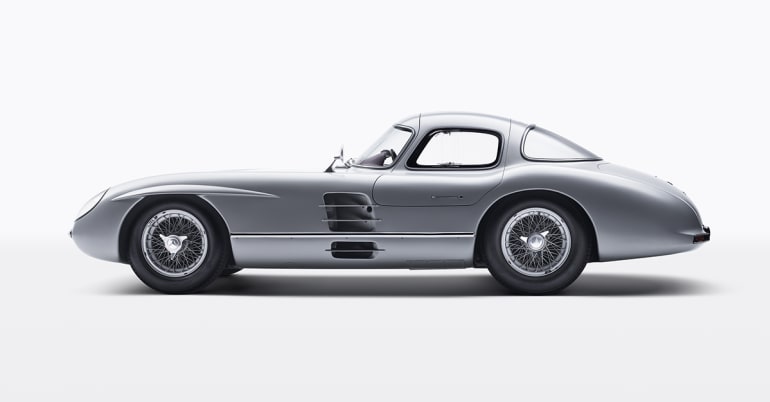
1955 Mercedes-Benz 300 SLR Uhlenhaut Coupé
Over the past two decades, the global collector car market has matured from a niche enthusiast pursuit into a recognised alternative collector asset class. In doing so, it has become increasingly relevant to wealth managers and family offices looking beyond traditional financial instruments. Depending on the parameters used to define the market, the total value of the global collector car fleet is estimated at anywhere from several hundred billion US dollars to more than USD 1 trillion, with annual turnover of approximately 10%.
Over the past two years, the market for collector cars has undergone a notable transition: shifting from post-pandemic optimism to a more measured, data-driven environment shaped by higher interest rates and other macroeconomic realities. The landscape is being influenced by multiple forces, including digital transformation, shifting demographics and increasing geopolitical fragmentation. While the start of the 2026 season delivered some encouraging early signs, it is too early to call a new bull market.
Over the past two years, the market for collector cars has undergone a notable transition: shifting from post-pandemic optimism to a more measured, data-driven environment
Collector cars in brief
The collector car market can broadly be divided into three distinct segments:
“everyday” collector cars, produced in relatively large numbers by brands like MG, Austin-Healey, Jaguar, Porsche or Mercedes-Benz
“investment-grade” cars, which command a clear premium above the cost of a full restoration
modern supercars and hypercars
The first category is often regarded as sub-investment grade because the cost of a comprehensive restoration often exceeds the asset’s value. Ownership and maintenance costs also tend to represent a significant proportion of value. Here, the appeal is rarely purely financial. Instead, it lies in the intangible rewards of ownership: the pleasure of driving, the lifestyle associated with the cars, and access to events, networks, and communities that surround them.
Sign up for our newsletter
Supercars and hypercars, produced in limited numbers from the late 1980s onwards by manufacturers such as McLaren, Ferrari, Lamborghini and Aston Martin, as well as specialist marques such as Pagani, can command significant premiums, occasionally trading hands for multiples of their original list price. But a substantial proportion in this category still behaves largely as depreciating assets.
Value is highly sensitive to accumulated mileage or kilometres. In many cases, the strongest pricing is achieved by so-called “delivery mileage” examples, typically showing only double or low triple-digit mileage. As a general rule, the newer the vehicle, the more critical a low odometer reading becomes in determining value. There are, however, some notable exceptions. Earlier landmark models, such as the Porsche 959, Porsche Carrera GT, Porsche 918 Spyder, the McLaren F1, certain 12-cylinder Lamborghinis and a number of limited-production Ferraris, can generally absorb higher mileage, sometimes running into the thousands or even tens of thousands, without seeing values materially compromised.
In many cases, the strongest pricing is achieved by so-called “delivery mileage” examples, typically showing only double or low triple-digit mileage
While considerably smaller, as only a limited number of models achieve such status, it is the second category that encompasses the most valuable collector cars in existence. At the top end, exceptional examples can command prices in the tens of millions of US dollars, euros, or pounds sterling. These cars are defined by extreme rarity, exceptional provenance, significant competition pedigree, and wider cultural significance, whether as apexes of technological innovation or as defining expressions of luxury, beauty, or craftsmanship. In the case of competition cars, their value is underpinned by tangible links to halo events such as the 24 Hours of Le Mans, the 12 Hours of Sebring, and Formula One.
Representative examples of this category include the Bugatti Type 57S Atlantic, the Ferrari 250 GTO (which achieved prices of up to USD 70 million), the Ferrari 250 LM, the McLaren F1, and the 1955 Mercedes-Benz 300 SLR Uhlenhaut Coupé, whose EUR 135 million sale is widely regarded as the most expensive car ever sold. Many of these cars are represented in benchmark indices, including the Historic Automobile Group International (HAGI) Top Index, as well as marque-specific HAGI indices covering brands such as Ferrari, Porsche, Mercedes-Benz, Lamborghini, and BMW. The HAGI Top Index currently comprises 50 car models drawn from 19 marques, with four sub-indices, including a Ferrari Index with 12 constituent models, a Porsche Index with 14 constituent models, and a Mercedes-Benz Index with 23 constituent models. Marque-specific indices for Lamborghini and BMW were added in 2018 and 2023, respectively.
Another sub-index includes 24 models from 17 classic car marques other than Porsche and Ferrari. In terms of structure, the HAGI indices are capitalisation-weighted: the average price for each model in the index is multiplied by the number of surviving cars of that model known to exist. Monthly price data for each constituent model are collected by HAGI and its affiliates and are based entirely on actual transactions worldwide, including private sales, dealer sales, marque specialists, and auction results.
The long-term evolution of the collector car market, as documented by the HAGI Indices, can be broadly divided into four distinct phases.
Between 2008 and the end of 2016, the market enjoyed a strong post-financial crisis growth cycle. During this period, many segments delivered double-digit annual returns, driven by increased global liquidity, rising wealth, and growing recognition of collector cars as an alternative asset class.
This was followed by a consolidation phase between 2016 and 2020, characterised by largely sideways index movement and greater price selectivity across the market.
In the aftermath of the Covid pandemic, the market entered a renewed growth phase from 2020 to 2022, marked by heightened demand, increased transaction volumes, and strong price appreciation. This period was supported by excess central bank liquidity, low interest rates, and shifting consumer preferences in search of returns.
Since 2022, the market has entered a second phase of consolidation, coinciding with sharply rising interest rates and a rally in technology and AI-related investments.
Since 2022, the market has entered a second phase of consolidation, coinciding with sharply rising interest rates and a rally in technology and AI-related investments
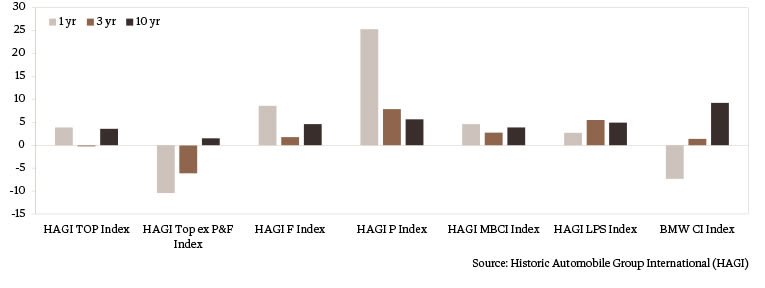
One-year, three-year and 10-year returns are summarised in the figure below. The HAGI Top Index shows an average 10-year return of 4.5% with Ferrari, Lamborghini and BMW exceeding 5%. In the last three years, annual returns were lower than the average over the last 10 years for the reasons mentioned before. More recently, the one-year return across all brands has exceeded the 3-year and 10-year averages.
One-year, three-year and ten-year average returns
HAGI F: Ferrari Index, HAGI P: Porsche Index, HAGI MBCI: Mercedes Benz Index, HAGI LPS: Lamborghini Index, BMW: BMW Index
At the beginning of 2026, the market produced a handful of striking outlier results, most notably among the rare Ferrari models, such as the 288 GTO, F40, F50 and Enzo, as well as the Porsche Carrera GT. In January, for example, a low-mileage Ferrari Enzo in a rare yellow specification with a bespoke interior, achieved USD 17.9 million at Mecum. This was followed in March by a black example selling for USD 15.2 million at Broad Arrow. By comparison, cars in the more common red configuration continue to transact in the mid to upper-single-digit millions, particularly within the dealer market. This remains the case despite the headline auction results, underscoring the distinction between exceptional, highly specified cars and the model’s broader trading range. Notably, US-based cars have recently achieved stronger results, further highlighting the influence of tariffs, as well as provenance, specification, and point of sale on pricing outcomes. However, it remains too early to interpret these isolated transactions as the start of a new sustained bull market phase.
Shifting demographics and the rise of contemporary cars
A 2025 survey by the Federation of British Historic Vehicle Clubs (FBHVC), which examined the British collector car market, found that 53% of historic vehicle owners also own a so-called “youngtimer” car, generally defined as a car around 20 years old. The research also indicated that owners aged between 25 and 34 are especially attuned to the wider cultural and social value of historic vehicles.
A 2025 survey by the Federation of British Historic Vehicle Clubs (FBHVC) found that 53% of historic vehicle owners also own a so-called “youngtimer” car, generally defined as a car around 20 years old
This data points to a clear generational shift. Younger collectors are increasingly gravitating towards more recent classics, signalling a transition away from older vintage models and towards younger collector cars. In fact, contemporary cars built from 2000 onwards or “youngtimers”, appear to be capturing the greatest share of buyer interest currently.
In many ways, history seems to be repeating itself. In the 1980s, it was cars built in the 1960s, such as the Ferrari 250 GTO, that experienced the strongest appreciation. Today, models such as the BMW E30 M3 Evo, Ferrari Enzo, Audi Sport Quattro, Lamborghini Countach, Porsche Carrera GT and Schumacher-era Ferrari Formula 1 cars rank among the most sought-after contemporary collector cars.
Dietrich Hatlapa founded the Historic Automobile Group International (HAGI), an independent research and advisory group, in 2007. He is also the author of Better Than Gold: Investing in Historic Cars, widely regarded as a seminal work on the collector car market, first published in 2011 and revised in 2014.
important information
This is a marketing communication issued by Bank Lombard Odier & Co Ltd (hereinafter “Lombard Odier”).
It is not intended for distribution, publication, or use in any jurisdiction where such distribution, publication, or use would be unlawful, nor is it aimed at any person or entity to whom it would be unlawful to address such a marketing communication.





share.