Formerly the passion of a select few, classic cars today occupy a distinctive place in the world of tangible assets. Combining cultural heritage, emotional appeal, and increasing relevance for wealth planning, the segment sits at the crossroads of passion and investment. In a world where economic and societal markers are shifting rapidly, what is the real significance of classic cars today? And how should one assess an asset shaped as much by generational dynamics as by technological transformations?
To shed light on these questions, Lombard Odier France hosted an event entitled “Classic cars: passion or investment?”. The evening brought together Vladimir Grudzinski, Co-founder and CEO of CarJager, Maxime Lépissier, Partner and expert at CarJager, and Alexis Chardigny, Senior Private Banker at Lombard Odier France and car enthusiast, alongside motoring journalist and collector Grégory Galiffi. Their discussions and analyses sketched the picture of a paradoxical market – expanding, yet undergoing profound change.
With annual transactions of EUR 45 billion, growth of around 10% p.a. since 2000, and a total fleet value estimated at nearly EUR 800 billion1 in 2024, the classic car market stands out as one of the most dynamic and resilient segments in the world of “passion” assets
A constantly growing globalised market
The figures speak for themselves. With annual transactions of EUR 45 billion, growth of around 10% p.a. since 2000, and a total fleet value estimated at nearly EUR 800 billion in 2024, the classic car market stands out as one of the most dynamic and resilient segments in the world of “passion” assets. For Alexis Chardigny, Senior Private Banker at Lombard Odier France and car market expert, this trajectory perfectly illustrates the way tangible assets have become a structuring pillar of alternative asset management.
This expansion is not, however, down to chance. It is supported by a phenomenon rarely observed in the realm of collectors and collecting: the near-uniformity of tastes worldwide. A Ferrari 275 GTB, a Porsche 964RS, or a Lamborghini Countach now attract the same degree of interest from enthusiasts and collectors across the globe – primarily in Europe, the US, and Asia, from Paris to Los Angeles, via Dubai and Tokyo. For Maxime Lépissier of CarJager, this is a decisive advantage: “It’s a global market. The reference points are the same everywhere. A Ferrari F40 has the same evocative power worldwide.”
This cultural alignment in the world of luxury and classic cars creates unusual market depth, reinforced by the international circulation of vehicles. A case in point: CarJager, the digital trading platform for vintage, classic, and sports cars founded in France in 2018, now conducts nearly half its transactions outside its home country, illustrating the fluidity of the global market.
Yet this broader momentum conceals a series of structural paradoxes that were extensively emphasised by the event’s participants.
What most buyers don’t know is that almost 50% of the market actually takes place off-market – away from the public listings and instead via private networks, discreet collectors, specialised brokers, or word of mouth
An apparently accessible market that remains very opaque
The internet has upended investors’ relationship with the market. Price guides, archives, sale histories, and expert videos: today, everything appears to be accessible in just a few clicks. Yet this impression of apparent accessibility to the whole market can be misleading.
As Vladimir Grudzinski, Co-founder and CEO of CarJager, points out: “The cars available online are only the tip of the iceberg.” What most buyers don’t know is that almost 50% of the market actually takes place off-market – away from the public listings and instead via private networks, discreet collectors, specialised brokers, or word of mouth.
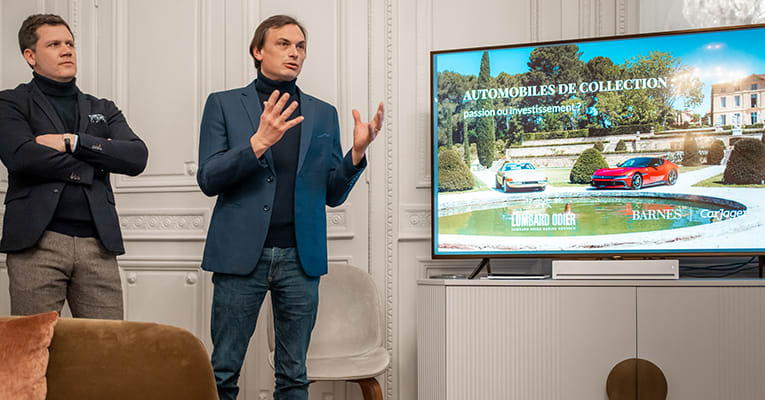 Maxime Lépissier (partner and expert at CarJager) and Vladimir Grudzinski (co-founder and CEO of CarJager)
This invisibility creates a form of organised scarcity, but also a degree of confusion. The market is crowded with intermediaries with uneven practices, transactions lacking safeguards, and vehicles whose provenance, history, or authenticity cannot always be verified. Maxime Lépissier describes “a buying experience that is often lengthy, complex, and unsettling”, particularly for newcomers who are unfamiliar with the process and less able to spot the pitfalls in certain listings.
It was precisely to deal with this grey area that CarJager developed its model in 2018, by structuring information, consolidating sources, professionalising, and securing each stage of the client journey. As Vladimir Grudzinski puts it succinctly: “This market has historically been analogue. Coming up with a digital platform in 2018 was the equivalent of Christopher Columbus discovering America.”
New generations: a historic shift in tastes
At the heart of the issue lies a major transformation: the evolution of automotive desire. The iconic models of the 1950s to 1970s – long regarded as the undisputed foundation of the market – are losing some of their lustre in the eyes of enthusiasts. The Jaguar E-type, classic Alfa Romeos, and 1960s Maseratis are all seeing their values soften, reflecting a deeper sociological shift. Vladimir Grudzinski explains: “The enthusiasts who saw these cars on the streets when they were young are increasingly unable to buy them as they grow older. They pass them on, but the next generation doesn’t identify with the same automotive culture.”
Conversely, today’s buyers aged 30 to 50 – the group that now drives much of the demand – are turning in large numbers to the models of their own childhood: the Porsche 964 and 993, Ferrari 360 Modena, BMW M3 E46, or the Lamborghini Diablo.
These cars – more recent, more reliable, and more usable in everyday terms – offer an ideal and attractive compromise: analogue charm combined with a degree of mechanical modernity.
And the surge in prices confirms it: a Porsche 964 Carrera 2, bought for EUR 25,000 in the early 2000s, now sells for more than EUR 80,000. Another telling example is the Ferrari F430 Scuderia which, once seen as just a development of an evolution of a standard model, now comfortably exceeds EUR 300,000 in excellent condition. Today, the modern-classic segment stands out more than ever as the driving force in the luxury and classic car market.
Ferrari occupies a unique position in this market. The brand with the famous Cavallino Rampante, through its mastery of the primary market, strict allocation of cars to clients, and its “Icona” programme, helps boost desirability and worldwide demand
Contemporary supercars: between fascination and hyper-speculation
The most dizzying price increases, however, have been seen in the supercars from the 1990s onwards. The Pagani Zonda LM Roadster, originally priced at around EUR 1 million, recently sold for USD 11 million,2 a clear illustration of the speculative power inherent to the segment.
Ferrari occupies a unique position in this market. The brand with the famous Cavallino Rampante (its iconic black prancing horse logo), through its mastery of the primary market, strict allocation of cars to clients, and its “Icona” programme, , helps boost desirability and worldwide demand. The naturally aspirated V12 engines (found in the 812, F12, or 599 models, for example) are, more than ever, considered strong investment vehicles, while some hybrids, such as the SF90, paradoxically struggle to retain value. Factors such as oversupply, the limited-series allocation programme, diversification, and rapid technological turnover work against these models, which do not appeal to purist collectors.
This ambivalence fosters increased caution among experts. As Maxime Lépissier observes: “Even the most prestigious manufacturers struggle with hybrid technology: it looks fantastic on paper, but has sometimes been developed too quickly.”
France, a market under pressure from taxation
The global collectors’ market may be healthy, but the climate in France is distinctly less favourable. Between the environmental penalties, weight-based taxes, increasingly strict standards, low-emission zones, and the potential introduction of a wealth tax on cars, the signals being sent by the authorities in recent years have been discouraging.
The example cited by Maxime Lépissier speaks for itself: “An Audi RS3, marketed at EUR 80,000, incurs an additional penalty of around EUR 70,000. In total, the car therefore costs its buyer EUR 150,000 in France, compared with EUR 80,000 everywhere else in Europe.”
Such disparities naturally encourage French buyers to turn to imports or forgo certain new purchases. In the medium term, this pressure could further strengthen the market’s international dimension.
Certain rules are foundational: selecting the right vintages, favouring authentic specifications, and understanding generational cycles can help anticipate market movements and value trends
Passion or investment?
One of the most insightful takeaways from the conference was the way participants placed passion at the centre of wealth planning. Vladimir Grudzinski made an unexpected but apt comparison with the world of horses: “When you buy a horse for EUR 300,000, you know that in 20 years it will no longer be there. Yet you buy it anyway.” The analogy is telling: a classic car is not a purely financial asset, it’s also a “passion” asset. It requires regular maintenance and sensible, considered use, generating significant costs for its owner. It lives, evolves, and ages, and therefore cannot be approached in the same way as a share or a traditional private equity product.
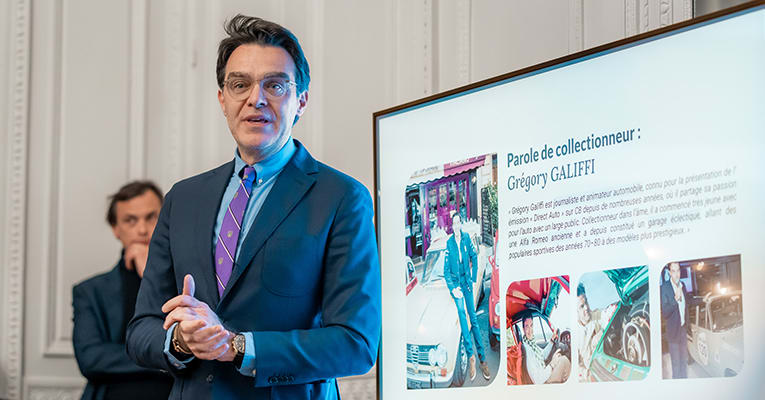 Grégory Galiffi, journalist and collector
Nevertheless, certain rules are foundational: selecting the right vintages, favouring authentic specifications, and understanding generational cycles can help anticipate market movements and value trends. It is within this delicate balance between rationality and passion that the sustainable performance of this tangible asset class is built. Grégory Galiffi expresses this simply, echoing Maxime Lépissier: “For exceptional cars from makers such as Ferrari, Porsche, and a few others, the French perspective doesn’t come into it: the value of an F40 is the same worldwide.”
The energy transition with the electric vehicle market, far from extinguishing the passion for cars, may strengthen the patrimonial appeal of exceptional combustion-engine models
Ten-year outlook: a market set to evolve while remaining true to itself
Looking five to ten years ahead, several key trends are already emerging. The classic models of the 1950s to 1970s will continue to segment into absolute icons – such as the Ferrari 275, the Mercedes 300 SL, or the historic Bugattis – and secondary models that are losing momentum.
The “modern classics” (or “youngtimers”, cars produced between the 1980s and the early 2010s) will continue their ascent, driven by a passionate and financially capable generation. Ferrari is likely to maintain its benchmark status – in every sense of the word. According to experts at this exceptional conference, contemporary supercars look set to remain a market of contrasts: some models will continue to be dynamic performers (such as the Porsche 918 Spyder, the Ferrari LaFerrari, or the McLaren P1), while others may run out of gas.
Finally, the energy transition with the electric vehicle market, far from extinguishing the passion for cars, may strengthen the patrimonial appeal of exceptional combustion-engine models. As Grégory Galiffi notes: “Collecting classic cars will become a luxury leisure pursuit, much like sailing or horse riding.”
Read also: Luxury electric vehicles: ambitions and challenges
A fully-fledged tangible asset
The booming classic car market is undergoing a period of profound transformation. Yet behind the fluctuations, trends, and regulatory pressures lies a constant: passion, which is passed on, reinvented, and adapted for new generations of enthusiasts, firmly establishing classic cars as fully-fledged tangible assets.
Within this complex environment, at Lombard Odier, this vision forms part of a broader long-term wealth management strategy for our clients. Our primary goal is not merely to advise, but to provide bespoke investment solutions capable of integrating alternative assets within a global, structured, and sustainable wealth management framework.




share.