When you visit our website, information may be stored or recovered on your device, mainly in the form of cookies. We use essential cookies to ensure the website works as it should, and statistical and marketing cookies for audience measurement and content customisation purposes. We rely on Google for statistical and marketing cookies in order to measure website performance and display relevant advertising. For more information on this, please also refer to the Google policy on Business Data Responsibility.
From the Cookie Management Centre, you can set your preferences with respect to the use of cookies: accept or reject certain categories, accept all, or reject all. For detailed information on all cookies used across these three categories, please refer to our Cookie Policy.
Please note that blocking certain cookies may affect your experience and the services offered.
Essential cookies Always active
Essential cookies help the website to work as it should by enabling necessary functionalities, such as navigating between pages and accessing secure areas. These cannot be disabled in our systems.
Statistical cookies
Statistical cookies help us understand how visitors interact with our site by collecting and communicating browsing information. They make it possible to identify the most and least visited pages and to improve the overall performance of the site.
Marketing cookies
Marketing cookies are used to display relevant advertising and measure the performance of campaigns. If you choose not to allow these cookies, you will continue to see ads, but they will be less relevant to your interests.
Choose the purposes for which we may use Google products to collect and use your data:
User storage: to technically permit advertising functionality.
User data for advertising: to optimise our advertising campaigns.
Ad customisation: to tailor advertising to your interests.
While Europe’s economy was in a decent place before the Middle East conflict, the energy shock will mean higher inflation, slower growth, and tighter monetary policy
The European Central Bank is wary of being slow to act and allowing price pressures to spill over beyond the energy sector. We thus expect it to raise interest rates twice this year
This risks a policy mistake that we expect it to reverse in 2027 by cutting rates, contrary to market expectations
Within developed markets, we prefer Japanese to European equities. We keep an underweight position in global sovereign bonds and a 12-month EURUSD forecast of 1.18.
Europe’s economy enters this energy price shock in a stronger position than in 2022. But with the energy scars from Russia’s invasion of Ukraine still fresh, we anticipate a misguided monetary policy response. We review the economic and asset class implications.
Before the Middle East conflict, Europe’s economy showed quiet resilience. Real GDP growth in the eurozone reached 1.5% in 2025. This was above expectations and narrowed the gap with the US economy – which grew by 2.1% - from a much wider difference seen in 2023-24. Solid growth in Europe was achieved despite the negative impact of higher US tariffs. While the German economy was stagnant, activity in southern and eastern Europe rebounded.
Sign up for our newsletter
The European Central Bank (ECB) had succeeded in bringing inflation sustainably back to its 2% target, after a 10.6% peak in late 2022. Furthermore, in this cycle, the ECB did not ‘overshoot’ with its policy calibration, as it did in 2014 when it was forced to cut interest rates into negative territory and keep them there for eight years. And the direction was encouraging: without the strikes on Iran, the ECB would have almost certainly have upgraded its growth outlook and downgraded its inflation forecast at its March 2026 policy meeting.
Before the Middle East conflict, Europe’s economy showed quiet resilience
Yet events in the Middle East forced it to do the reverse. Higher energy prices now threaten Europe’s economic outlook. Even in our base scenario of a limited duration conflict, we still expect oil prices to average USD 90/barrel over the next six months, inflicting pain on the continent as a major net energy importer. Natural gas prices in Europe – a key source of energy for heating across the continent – remain around 40% above their pre-crisis levels. Damage to key energy infrastructure in the Middle East that supplies European countries could take years to repair.
Central banks can often ignore the impact of a temporary energy shock. If energy prices stabilise or fall in line with futures prices – or contracts for delivery on future dates – then inflation will normalise automatically without a lasting impact. By the time any monetary policy tightening starts to take effect, it will just exacerbate the downward impact on growth from higher energy prices. But the ECB, with its pure inflation targeting mandate, can feel compelled to react in the face of such an event, unlike the Federal Reserve (Fed), which must also calibrate its policy to maximise employment.
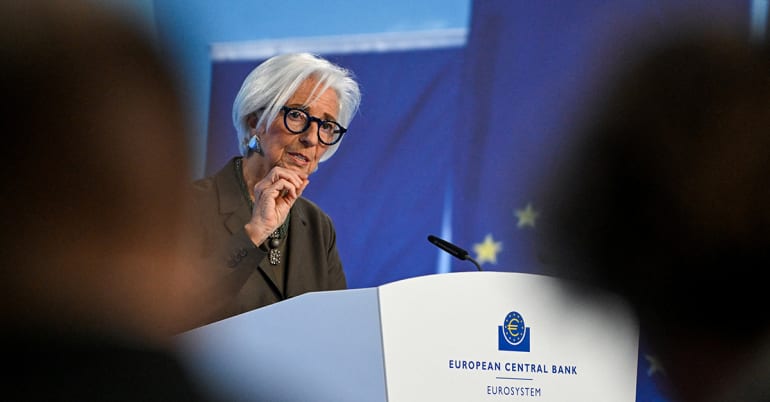
In a speech last month, ECB President Christine Lagarde also noted that memories of high inflation from 2022 are still fresh in European minds. That means that companies may be quicker to pass on costs and workers could push for higher wages this time round. Such ‘second-round’ effects would risk a more enduring impact on prices.
For these reasons, we now expect the ECB to raise interest rates twice in 2026, starting in June, to pre-empt second-round effects from rising energy prices. In our view, this risks a policy mistake that could leave Europe’s economy more vulnerable. Unlike in 2022, there are few signs of domestic inflationary pressures today. The labour market is in balance; wages are not accelerating; households are not spending generous fiscal handouts, as they were post-pandemic; nor is there any strong pent-up demand across the economy. Inflation expectations also remain in check.
We now expect the ECB to raise interest rates twice in 2026, to pre-empt second-round effects from rising energy prices
The ECB’s current policy rate of 2% also looks broadly ‘neutral’ – at a level that neither stimulates nor constrains growth. We thus expect the ECB to have to reverse the two 25 basis point hikes we forecast this year as the eurozone economy enters 2027 with falling price pressures and rising risks to growth. This is contrary to market expectations, which still sees the ECB holding rates around 2.5% through 2027.
The ECB was slow to raise rates when the energy shock hit in 2022 and it is now wary of repeating the error. Yet Europe’s economy is far better placed to deal with today’s energy shock than it was four years ago. Forced to sever ties with Russian gas, governments across the continent have rapidly diversified supplies and invested heavily in renewables. The region’s fiscal response also looks more targeted and measured this time round. In 2022, we estimate that governments spent 2.5% of GDP on measures to insulate companies and consumers from higher energy prices. Today, these measures are lower and far less likely to stoke inflation.
Europe’s economy is far better placed to deal with today’s energy shock than it was four years ago
Growth in Europe also has more structural support today, following a significant fiscal boost from Germany. A EUR 500 billion special fund to finance infrastructure, defence spending and decarbonisation measures will support growth for over a decade, with spillover effects across the continent. German defence orders are increasingly oriented to domestic and European suppliers. In southern Europe, growth is also being supported by continued disbursements from EU funds.
That said, the continent is still vulnerable to higher energy prices, and consumer confidence fell to a two-year low in March. With domestic demand the main driver of growth we have lowered our full-year forecast to 0.9% this year, as we expect the loss of purchasing power, rising uncertainty, and tighter monetary policy to all have a negative impact.
With domestic demand the main driver of growth we have lowered our full-year growth forecast to 0.9%
Investment implications
After three years of flat earnings for European companies, analysts expect earnings growth to rebound to 12% this year. We see these expectations as too optimistic. Higher energy prices are pressuring companies' input costs and margins at a time when pricing power is becoming more constrained. While European equity valuations have corrected, they remain above long‑term averages. A higher-for-longer interest rate environment is also likely to weigh on sentiment and cap the potential for gains from here. We keep our overall exposure to global equities neutral, and within developed markets prefer Japan’s prospects to Europe’s.
We also keep our portfolio exposures to global sovereign bonds, including those of key European economies, at underweight levels, given the risks that inflation and fiscal deficits will rise. With news of the Iran-US ceasefire and negotiations, investors have started to reassess recent extreme negative sentiment towards the euro. Our 12-month EURUSD forecast remains 1.18.
This is a marketing communication issued by Bank Lombard Odier & Co Ltd (hereinafter “Lombard Odier”).
It is not intended for distribution, publication, or use in any jurisdiction where such distribution, publication, or use would be unlawful, nor is it aimed at any person or entity to whom it would be unlawful to address such a marketing communication.




share.