When you visit our website, information may be stored or recovered on your device, mainly in the form of cookies. We use essential cookies to ensure the website works as it should, and statistical and marketing cookies for audience measurement and content customisation purposes. We rely on Google for statistical and marketing cookies in order to measure website performance and display relevant advertising. For more information on this, please also refer to the Google policy on Business Data Responsibility.
From the Cookie Management Centre, you can set your preferences with respect to the use of cookies: accept or reject certain categories, accept all, or reject all. For detailed information on all cookies used across these three categories, please refer to our Cookie Policy.
Please note that blocking certain cookies may affect your experience and the services offered.
Essential cookies Always active
Essential cookies help the website to work as it should by enabling necessary functionalities, such as navigating between pages and accessing secure areas. These cannot be disabled in our systems.
Statistical cookies
Statistical cookies help us understand how visitors interact with our site by collecting and communicating browsing information. They make it possible to identify the most and least visited pages and to improve the overall performance of the site.
Marketing cookies
Marketing cookies are used to display relevant advertising and measure the performance of campaigns. If you choose not to allow these cookies, you will continue to see ads, but they will be less relevant to your interests.
Choose the purposes for which we may use Google products to collect and use your data:
User storage: to technically permit advertising functionality.
User data for advertising: to optimise our advertising campaigns.
Ad customisation: to tailor advertising to your interests.
Volatile UK politics not exactly a brave new world
key takeaways.
UK Prime Minister Keir Starmer is under pressure. His chances of staying in office look extremely narrow
A change of Prime Minister would not necessarily mean a large shift in fiscal stance. A new leader would operate under the same constraints; a significant increase in borrowing to fund additional spending is therefore not our base case
Political instability is not the dominant driver of higher Gilt yields, which have been rising since the start of the Middle East conflict, as higher energy prices put a stop to the Bank of England’s easing cycle
A gradual reopening of oil flows through the Strait of Hormuz – our base scenario – would bring UK economic fundamentals and potential rate cuts back into focus, supporting our medium-term constructive view on Gilts.
Political instability and a potential leadership contest in the UK are adding to the challenges of rising energy prices, driving up government bond yields. We examine the political risks and range of potential outcomes. A large shift in the UK’s fiscal stance is not our base case.
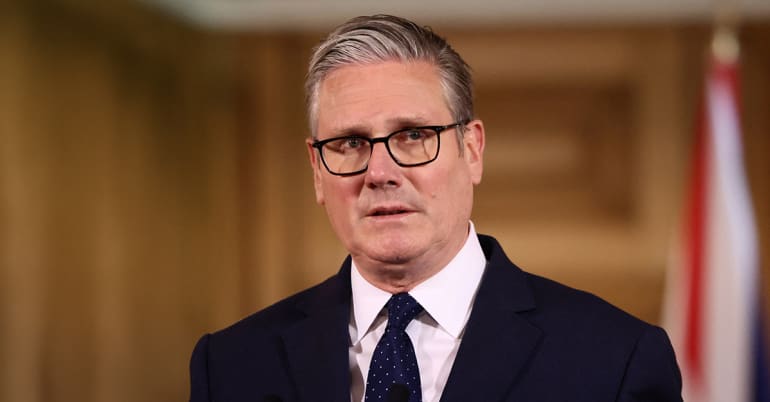
Suffering from very low popularity ratings already and struggling to recover from a number of recent mis-steps, UK Prime Minister Keir Starmer now faces a highly uncertain political future. Heavy losses for his Labour Party in local elections on 7 May may well prove the final blow to his term in office, as he is increasingly losing the support of Labour Members of Parliament and some of his cabinet ministers.
Political instability, and the potential launch of a protracted leadership contest, has driven up UK government bond yields across maturities, with 30-year Gilts hitting record highs. Investors are concerned that a shift to the left by the Labour Party in its next leader may lead to a much looser fiscal stance, by increasing borrowing and tolerating higher deficits again in the near future. Such an abandonment of fiscal discipline would result in higher yields, as compensation for investors to hold the increasing supply of government bonds.
Sign up for our newsletter
A further complication is the wide open and potentially protracted race for the next leader, driving further uncertainty and risk premium in Gilts. At the time of writing, no leadership contest has yet been launched, and Keir Starmer could himself run, resulting in a wide range of potential outcomes.
Any new Prime Minister would be subject to the same constraints that the current government is facing
A potential candidate the market sees as likely to increase spending is Andy Burnham, who has previously said the country should not be “in hock” to bond markets. However, Mr Burnham is currently Mayor of Greater Manchester, and would first need to secure a seat in Parliament before running. It is also likely that he would adopt a more measured stance on bond markets and fiscal risks if he were in power. Other potential candidates with a left-leaning stance include former deputy Prime Minister Angela Rayner and Energy Secretary Ed Miliband. Health Secretary Wes Streeting is a more centrist figure and may stick closer to Labour’s existing policies. His resignation from the cabinet on 14 May may act as a trigger for the leadership contest.
In any case, we would not expect a quick resolution to Labour’s leadership conundrum, given the multiple steps involved to elect one. If a contest is held, we would expect a new leader to be chosen by September, when Labour holds its annual conference, with Keir Starmer likely staying on as Prime Minister in the intervening period.
Crucially, any new Prime Minister would be subject to the same constraints that the current government is facing. The memory of the short tenure of Prime Minister Liz Truss in 2022, following a “mini-Budget” announcement that unsettled the market with large unfunded tax cuts, could also curb the spending enthusiasm of any new leader.
Contrary to some pre-election fears, the current Labour government has also kept a prudent fiscal stance since taking office in 2024, sticking to its fiscal rules and narrowing the government budget deficit from 5.2% to around 4.3% currently. At the same time, the economy’s current account balance has also improved, from a deficit of 3.6% in 2023 to just 2.4% last year. Labour’s fiscal rules include balancing spending with tax revenues by 2029-2030 and reducing public sector debt as a percentage of GDP over the same timeframe.
We therefore think that a radical change in fiscal stance is neither immediate nor particularly likely.
We think that a radical change in fiscal stance is neither immediate nor particularly likely
Political risk is not the main driver of Gilts
Moreover, while we think some degree of fiscal risk repricing may be a natural reaction to recent political events, this has not been the principal driver of rising Gilt yields. These were already on an upward trend since the outset of the Middle East conflict. Thus while the move in Gilts has been particularly pronounced in recent days, directionally it has mirrored recent trends in US, European, and Japanese yields, following a repricing of monetary policy expectations across major economies.
In the UK, the sharp increase in energy price inflation makes it highly unlikely that the Bank of England (BoE) can cut interest rates further this year, as was broadly anticipated in January. Indeed, market pricing now points to a high risk of rate hikes. This has reversed the strong rally in Gilts that was in place at the start of the year, when a combination of falling inflation, loosening labour market conditions, and soft economic growth were creating the conditions for accelerated monetary policy easing by the BoE.
Gilts were already on an upward trend since the outset of the Middle East conflict
An eventual resolution of the Iran conflict that gradually reopens oil flows through the Strait of Hormuz remains our base case scenario – and would result in a normalisation of UK inflation. Not only would this remove concerns about a higher policy rate in the near term, but together with a loose labour market and slow growth, would set up conditions for BoE easing to resume in 2027. This could reinforce our medium-term constructive view on Gilts.
CIO Office Flash
Volatile UK politics not exactly a brave new world
This is a marketing communication issued by Bank Lombard Odier & Co Ltd (hereinafter “Lombard Odier”).
It is not intended for distribution, publication, or use in any jurisdiction where such distribution, publication, or use would be unlawful, nor is it aimed at any person or entity to whom it would be unlawful to address such a marketing communication.




share.