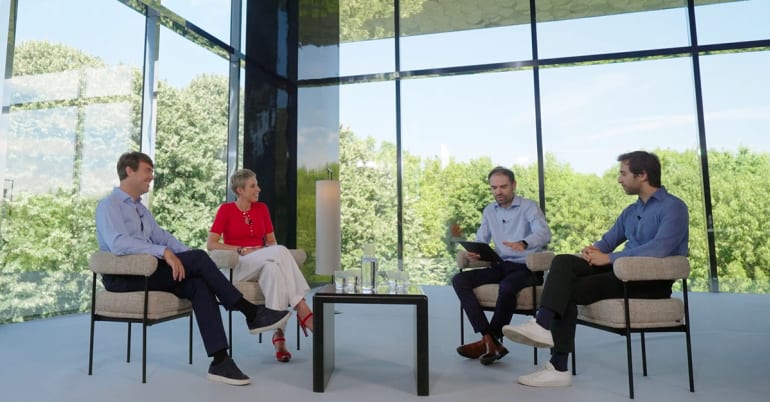
At the Paris Philharmonic, Caroline Poissonnier, joint CEO of the Baudelet Group, Mathieu Flamini, co-founder and CEO of GFBiochemicals, and Édouard de Saint Pierre, Managing Director of Lombard Odier France, shared their experiences in a conversation chaired by Sébastien Couasnon. Taking over a family business, building a venture from the ground up or planning for succession all bring their own challenges. Their journeys highlight the decisions leaders face at pivotal moments. Different paths, shaped by the same questions: what to build, what to transform and what to pass on.
Watch the video to hear Caroline Poissonnier, Mathieu Flamini and Édouard de Saint Pierre share their perspectives on entrepreneurship, business transformation and succession.
In the first episode of Lombard Odier's podcast series on sustainability and family businesses, the discussion turns to one of the defining moments in an entrepreneur's journey: taking over a business. When Caroline Poissonnier assumed leadership of the Baudelet Group alongside her brother, Jean-Baptiste, the pair had to earn the trust of their parents, their employees and themselves. Most importantly, they needed to define a shared vision for the future of the business despite their very different personalities
For Mathieu Flamini, entrepreneurship meant stepping into an entirely new arena. After a career at the highest levels of professional football, he had to learn to navigate the demands of building and leading a business, where success is measured over years rather than seasons.
Turning to the question of succession, Édouard de Saint Pierre explored the principles that should guide entrepreneurs as they prepare for the future of their businesses. As he noted, a company is more than just capital. This is especially relevant in France, where business transfers have been rising since 2022. According to the Directorate General for Enterprise, 37,000 businesses changed hands in 20241, a trend expected to continue in the next decade. Research by Bpifrance Le Lab shows that 40% of business leaders intend to transfer their companies between 2025 and 20302, placing succession firmly on the agenda for a growing number of entrepreneurs.
related content.

entrepreneurs: bespoke wealth management.
learn more Reinventing a family business without abandoning heritage
Founded by Caroline Poissonnier's grandfather as a waste collection, sorting and recovery business, the Baudelet Group has undergone a significant transformation under the next generation's leadership. Today, its activities span four complementary areas: environment, energy, commerce and wellbeing.
Your energy is the only KPI that really counts
Caroline Poissonnier believes that future leaders of family businesses face a choice: build experience elsewhere before returning to the company, or learn the business from the inside out. She opted for the latter, spending a decade working her way up alongside her brother, Jean-Baptiste, gaining a deep understanding of the Group's operations and drawing lessons from the inevitable mistakes made along the way.
In 2018, their visions for the business began to diverge. Jean-Baptiste championed a locally focused business, while Caroline was eager to innovate and accelerate growth. At one stage, she even considered leaving the company. Yet what could have become a breaking point ultimately laid the foundations for a new balance. Jean-Baptiste took charge of operations, while Caroline assumed responsibility for governance, strategy and external relations. Together, they transformed and diversified the Baudelet Group while remaining true to its environmental roots.
Each ultimately refocused on what Caroline describes as their own "zone of talent and fulfilment". For her, that meant creating the Group's wellbeing division and launching Leaderkiff, an initiative dedicated to entrepreneurs' mental health. Her mantra: "Your energy is the only KPI that really counts." Today, she continues to advocate for that approach through training programmes, conferences and her book The Anti-Burnout Kit for Business Leaders.
A business transfer is not simply the transfer of shares or capital. It is about history, convictions and responsibilities
From the football pitch to green chemistry
Barely a decade ago, Mathieu Flamini was still wearing his AC Milan football shirt. Today, he is the co-founder and CEO of GFBiochemicals, a green chemistry company that uses that uses plant-based materials and agricultural waste to produce bio-based ingredients capable of replacing petroleum-derived substances in a wide range of everyday products.
"Our goal is to produce bio-based ingredients. You find petroleum derivatives everywhere, in shampoos, deodorants... This industry needs to transition," he explains. Put simply, he wants to "stop chemical pollution".
The ambition is matched by the scale of the market. "The global solvents market is valued at around USD 35 to 40 billion3, with total volumes approaching 30 to 40 million tonnes," he explains. Yet turning that vision into reality required years of groundwork, from developing technologies and securing patents to obtaining the certifications needed to commercialise new products.
Today, GFBiochemicals is focused on its next challenge: scaling up. The aim is to move from a niche offering to a mainstream solution, produced at industrial scale and accessible to a far broader market.
Read also: From pro footballer to sustainable biochemical entrepreneur: a conversation with Mathieu Flamini
Succession is as much about people as it is about capital
Complementing these two entrepreneurial journeys, Édouard de Saint Pierre, drew on years of experience advising families on business succession. Working closely with business owners, he has come to view succession as far more than a financial exercise. As he notes: "A business transfer is not simply the transfer of shares or capital. It is about history, convictions and responsibilities."
A successful transfer is one that preserves the family's assets, but above all its relationships
That is also what makes succession such a sensitive issue. Because it is bound up with family history, passing on a business is often as emotional as it is strategic. Differences in vision between siblings, or a younger generation that is not yet ready to take on the responsibility, can become significant challenges for a company's future.
Success, therefore, cannot be measured solely on a balance sheet. "A successful transfer is one that preserves the family's assets, but above all its relationships," insists Édouard de Saint Pierre. The point carries particular weight given his own experience as he represents the eighth generation at the helm of Lombard Odier.
This dual imperative, both financial and human, lies at the heart of a long-term advisory approach: helping families navigate change, preserve what matters most and withstand the test of successive generations
To learn more, watch the full Voices of Entrepreneurs podcast on Le Figaro's YouTube channel

share.