When you visit our website, information may be stored or recovered on your device, mainly in the form of cookies. We use essential cookies to ensure the website works as it should, and statistical and marketing cookies for audience measurement and content customisation purposes. We rely on Google for statistical and marketing cookies in order to measure website performance and display relevant advertising. For more information on this, please also refer to the Google policy on Business Data Responsibility.
From the Cookie Management Centre, you can set your preferences with respect to the use of cookies: accept or reject certain categories, accept all, or reject all. For detailed information on all cookies used across these three categories, please refer to our Cookie Policy.
Please note that blocking certain cookies may affect your experience and the services offered.
Essential cookies Always active
Essential cookies help the website to work as it should by enabling necessary functionalities, such as navigating between pages and accessing secure areas. These cannot be disabled in our systems.
Statistical cookies
Statistical cookies help us understand how visitors interact with our site by collecting and communicating browsing information. They make it possible to identify the most and least visited pages and to improve the overall performance of the site.
Marketing cookies
Marketing cookies are used to display relevant advertising and measure the performance of campaigns. If you choose not to allow these cookies, you will continue to see ads, but they will be less relevant to your interests.
Choose the purposes for which we may use Google products to collect and use your data:
User storage: to technically permit advertising functionality.
User data for advertising: to optimise our advertising campaigns.
Ad customisation: to tailor advertising to your interests.
Article published in NZZ am Sonntag on 27 September 2026.
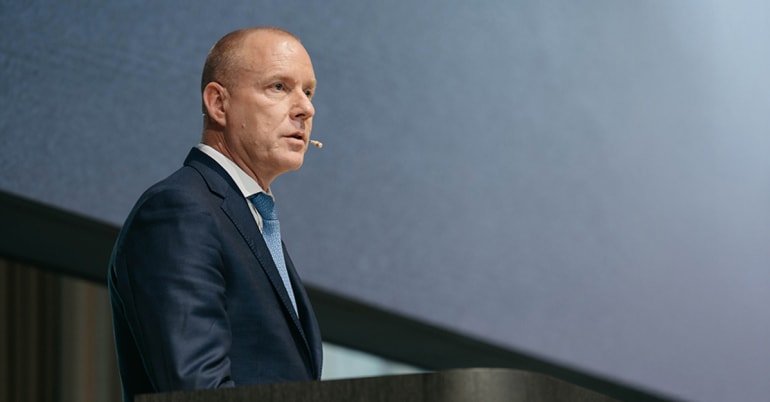
Michael Strobaek is not afraid to utter the four most dangerous words in financial history: “This time is different,” says the Global CIO Private Bank, Lombard Odier. “We are only at the beginning of a long evolution in AI. I don’t see a bubble.” The assumption that this time everything will be different is emblematic of the collective illusion that characterises a speculative bubble. Investors dismiss the established rules regarding valuations and market cycles as outdated.For the legendary investor John Templeton, the phrase “this time is different” summed up the all-too-human tendency towards self-deception.
Sign up for our newsletter
Strobaek is well aware of this. As a long-standing financial professional, he also has vivid memories of the bursting of the dot-com bubble in 2000. Nevertheless, he insists that AI is different. This groundbreaking technology is being implemented by companies at an incredible pace, and it is replacing well-educated and highly paid people. The adoption is taking place much more broadly than was the case with the internet back then. Investors are also well aware of the risk of a speculative bubble, which may now prevent excesses. Emerging market semiconductor shares and technology firms are no longer particularly expensive following the price corrections of recent weeks. “So even in terms of valuations, there is nothing to suggest an AI bubble,” says Strobaek, who works at the Zurich office of the Geneva-based bank.
Even in terms of valuations, there is nothing to suggest an AI bubble
The investment expert also does not believe that Chinese AI competitors – who often make their models available for free download – will be able to disrupt American firms’ plans. “I would be very surprised if American companies, with their huge investments in AI, were to completely lose their way and then be overtaken by the Chinese,” says Strobaek.
For geopolitical reasons alone, two largely separate ecosystems would emerge. And regardless of whether one uses a Chinese or an American AI model, in both cases a great deal of computing power and energy is required. “The massive investments in AI infrastructure are likely to pay off one way or another.”
Strobaek also sees no problem, for the time being, with circular financing. This refers to the controversial practice whereby tech conglomerates invest in AI start-ups, but the capital then flows back almost immediately as revenue. This is because OpenAI, Anthropic, and the like use the money received to pay for AI chips or computing power from Nvidia, Amazon, or Google. AI infrastructure providers have a strong interest in seeing the entire ecosystem grow. That is why they are prepared to make capital available to their customers. “It reminds me of the car manufacturers who, at some point, started offering loans to make it easier for their customers to buy a car.” Because the AI infrastructure firms have a great deal of capital at their disposal, these circular funding arrangements do not pose a risk for the time being.
… the business model does not appear to be very sustainable. These companies have to constantly develop new models
Nor does Strobaek see any cause for alarm in the fact that technology firms are now issuing bonds on a large scale, something they had rarely done before: “Many of these companies have very solid balance sheets. It therefore makes sense for them to finance investments with debt as well as equity.”
Although Lombard Odier’s CIO does not fear an AI bubble, he urges caution regarding the upcoming IPOs. “Anthropic and OpenAI are likely to be listed at inflated valuations.” This was already visible with SpaceX’s IPO.
He does not know who will come out on top – whether it will be Anthropic, OpenAI, or another firm. “However, the business model does not appear to be very sustainable. These companies have to constantly develop new models which are already obsolete just a few months later.”
Strobaek expects these companies to eventually be swallowed up by the major technology firms, which have ample capital at their disposal. As a result, three to five major firms will ultimately dominate the market. And although Lombard Odier is convinced that the upward trend in AI remains unbroken, the bank recommends “a neutral allocation” to technology stocks. Clients should invest no more or less in these shares than the global equity indices suggest.
We currently see no end to the stock market rally
“At the moment, we favour stocks from the healthcare, financials, utilities, and materials sectors. We also expect emerging market equities and small caps to outperform,” says the CIO. He anticipates that the massive investments in AI, technology, energy, and defence will lead to a global economic upturn. “We currently see no end to the stock market rally,” he says. This will only happen if the private sector uses too much leverage and, on top of that, central banks raise interest rates sharply.
Real interest rates are rising now, but that is no cause for concern. In Strobaek’s view, this is a return to normal. Interest rates have risen to the levels last seen before the financial crisis of 2008 and 2009.
important information
This is a marketing communication issued by Bank Lombard Odier & Co Ltd (hereinafter “Lombard Odier”).
It is not intended for distribution, publication, or use in any jurisdiction where such distribution, publication, or use would be unlawful, nor is it aimed at any person or entity to whom it would be unlawful to address such a marketing communication.






share.