When you visit our website, information may be stored or recovered on your device, mainly in the form of cookies. We use essential cookies to ensure the website works as it should, and statistical and marketing cookies for audience measurement and content customisation purposes. We rely on Google for statistical and marketing cookies in order to measure website performance and display relevant advertising. For more information on this, please also refer to the Google policy on Business Data Responsibility.
From the Cookie Management Centre, you can set your preferences with respect to the use of cookies: accept or reject certain categories, accept all, or reject all. For detailed information on all cookies used across these three categories, please refer to our Cookie Policy.
Please note that blocking certain cookies may affect your experience and the services offered.
Essential cookies Always active
Essential cookies help the website to work as it should by enabling necessary functionalities, such as navigating between pages and accessing secure areas. These cannot be disabled in our systems.
Statistical cookies
Statistical cookies help us understand how visitors interact with our site by collecting and communicating browsing information. They make it possible to identify the most and least visited pages and to improve the overall performance of the site.
Marketing cookies
Marketing cookies are used to display relevant advertising and measure the performance of campaigns. If you choose not to allow these cookies, you will continue to see ads, but they will be less relevant to your interests.
Choose the purposes for which we may use Google products to collect and use your data:
User storage: to technically permit advertising functionality.
User data for advertising: to optimise our advertising campaigns.
Ad customisation: to tailor advertising to your interests.
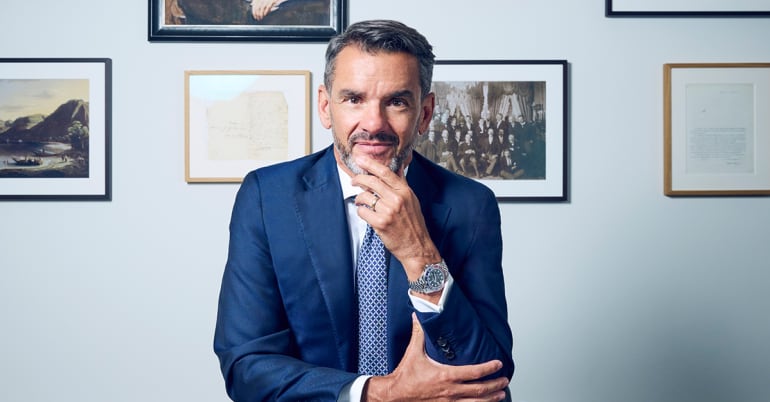
The future of wealth management is human... and technological – interview with Serge Fehr
Serge Fehr
Head of the Swiss Domestic Region for Private Clients
key takeaways.
Artificial intelligence is transforming wealth management by optimising portfolios, enhancing analytical capabilities and automating numerous processes
Technological tools have become an expected part of the client experience, but on their own they no longer represent a sustainable competitive advantage
Trust-based relationships and personalised guidance remain essential to addressing the growing complexity of wealth situations
Holistic wealth management helps align investments with life goals, financial security needs and wealth transfer objectives
The future of wealth management will be hybrid, combining the power of technology with human judgement and experience.
Article published in Le Temps, 16 August 2026
Artificial intelligence is changing what we do at a speed that was difficult to imagine only a few years ago. What initially seemed like a simple technological development has now become a structural transformation. AI optimises portfolios, multiplies analytical capabilities tenfold, and automates a large number of standard processes. This evolution is a reality. It would be a strategic error to ignore it.
At the same time, technology is increasingly becoming an accepted expectation among clients. Clients now expect modern digital tools to be integrated into financial services, offering efficiency, precision and scalability. But because they are becoming the norm, they have stopped being a genuine point of differentiation. The future of wealth management therefore does not depend on the use of technology in itself, but on how it is combined with human expertise.
The future of wealth management therefore does not depend on the use of technology in itself, but on how it is combined with human expertise
Relationships built on trust, a sustainable competitive advantage
It is often believed that interactions between clients and banks will in future be primarily between a person and a machine. This vision fails to recognise a fundamental reality about what it means to be human: human beings need other human beings. Personal relationships are not an outdated model: they are an essential part of our life in society, and therefore of guidance founded on trust, which can only be created through human interaction.
If we think back to the Covid-19 pandemic, it showed us how challenging the loss of human contact could be and, conversely, how enthusiastically the return of face-to-face interaction and personal contact was welcomed. While digital technologies made many things possible during this period, they were never able to replace human interactions. This experience provides us with a clear conclusion for our profession: personal relationships remain structurally vital.
This reality is confirmed every day in our exchanges with wealthy families. Behind every pool of wealth are unique life stories, objectives, needs and priorities. No two situations are alike. Investment decisions are not based solely on the return outlook, but also on life plans, risk tolerance, investment horizon, legal and fiscal frameworks, and even cross-border arrangements. Added to this are often family challenges, particularly when several generations are involved and sometimes competing interests need to be reconciled.
In the high-net-worth client segment, this complexity is ever-increasing. The structures through which wealth is held often span multiple jurisdictions, fiscal issues transcend national boundaries, bank and non-bank assets need to be analysed together, and the problems associated with wealth transfer often extend beyond a single generation. Such situations cannot be standardised.
High-quality advice is not only generated from data. It also draws on an understanding of the person behind it
In this environment, technology can bring considerable added value. It is capable of dealing with huge data volumes, identifying correlations and providing remarkable analytical precision. But what it cannot do is place that information within the context of a person’s unique life circumstances. This is precisely where judgement, experience and discernment remain essential. High-quality advice is not only generated from data. It also draws on an understanding of the person behind it.
This is why holistic wealth management must be considered the foundation of all high-quality advice. It is the prerequisite for really understanding a client's situation. This is a challenging process involving a high level of personalisation, requiring an in-depth analysis of all the relevant factors.
Above all, a holistic approach to wealth is a profoundly human process. It starts with listening and is based on trust. It requires a sincere willingness to understand a person's objectives, values and motivations. Only on this basis can a sustainable and appropriate strategy be developed.
To achieve this, it is useful to gain an overall view of a client’s financial situation, which can be structured around four distinct functions. First, financial security, aimed at covering essential needs and guaranteeing stability over the coming years. Secondly, the achievement of life goals, which underpins the client's long-term ambitions and objectives. Thirdly, the creation, preservation and transfer of wealth from an intergenerational perspective. Finally, the emotional dimension, which covers investments motivated by passion, personal convictions or specific interests without necessarily being driven solely by rational criteria.
Because true value is born where technology ends: in listening, in the attention given to every person, and in the ability to imagine, for each client, a solution tailored to their individual circumstances
Such an approach brings greater transparency. It allows us to clearly distinguish different investment objectives, to refine the management of risks and to align every investment with its specific purpose. It is also a reminder that financial assets represent much more than a simple portfolio allocation: they reflect individual aspirations and family responsibilities.
Tomorrow's wealth management will be hybrid, but its heart will remain human. Technology will provide speed, precision and analytical power. People, meanwhile, will provide something that cannot be replaced: genuine listening, which builds long-term trust. More than ever before, the banker will be a long-term partner, supporting each and every client in all aspects of their wealth, thanks to an approach shaped by centuries of service to families. Because true value is born where technology ends: in listening, in the attention given to every person, and in the ability to imagine, for each client, a solution tailored to their individual circumstances.
important information
This is a marketing communication issued by Bank Lombard Odier & Co Ltd (hereinafter “Lombard Odier”).
It is not intended for distribution, publication, or use in any jurisdiction where such distribution, publication, or use would be unlawful, nor is it aimed at any person or entity to whom it would be unlawful to address such a marketing communication.



share.