“Throughout history, major economic transformations have always been driven by pain points and superior economics – much more than by policymaking or politics.”
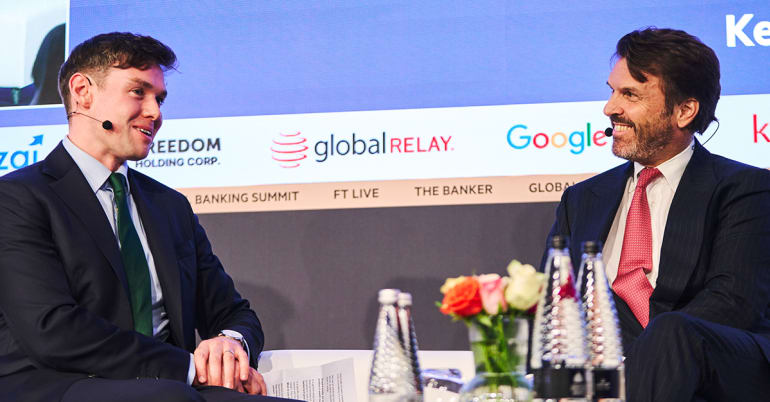
At the recent FT Global Banking Summit, held in London’s iconic Paternoster Square in the shadow of St Paul’s Cathedral, Hubert Keller, Lombard Odier’s Senior Managing Partner, shared with delegates his conviction that “a profound transformation is taking place across a number of significant economic systems,” driven by a response to what he called today’s “pain points.”
Joining some of the world’s leading finance executives for the annual three-day event, Hubert Keller took to the stage for a wide-ranging keynote interview moderated by Simon Foy, the FT’s European Banking Correspondent. Touching on everything from sustainable investing to Switzerland’s strengths as a hub for international wealth management, Hubert Keller explained why he remains confident in Lombard Odier’s unique business model, the future of Swiss banking, and the inevitability of the transition to an economy that is “net zero, socially constructive, and has a neutral to positive footprint on nature.”
Major economic transformations have always been driven by pain points and superior economics
Pain points drive sustainability transition
The Global Banking Summit convened shortly after the conclusion of Brazil’s COP30, which had left many observers disappointed at the lack of agreement on reducing fossil-fuel use and minimal action on deforestation. With that background, and in a political landscape where sustainability is no longer a “hot topic,” Simon Foy asked why Lombard Odier continues to be a vocal proponent of sustainable investing.
For Hubert Keller, the answer is simple: “We want to invest in tomorrow’s economy. As we move forward, we are more and more convinced that sustainability is the most important investment return conversation.”
This belief, he explained, stems from analysis of several fundamental system changes taking place in the global economy. “Major economic transformations have always been driven by pain points and superior economics,” he said. “If you look at pain points today – such as the impacts of climate change, nature depletion, or social issues – in some parts of our economy they are becoming unbearable.”
“Take, for example, the crisis in US home insurance, or the fact that yields in some food crops are now structurally declining, or the affordability of health systems in Western economies. There are a number of pain points which will require solutions either now, or in the very short term.”
We want to invest in tomorrow’s economy. As we move forward, we are more and more convinced that sustainability is the most important investment return conversation
Superior economics
In response to these pain points, new economic systems are emerging.
“Renewables are an example,” Hubert Keller noted. “Today, renewables are the cheapest way to generate electricity – and this is true across the world. In some industries, electric solutions are simply cheaper and more efficient. Also in food systems – for some food crops regenerative practices are starting to deliver better economics.”
The conclusion is that the global economy is transitioning towards a more sustainable model – driven not by policy or ethics, but by necessity, innovation, and superior economics.
“We can debate timing, but we don’t think we can debate the end-game. When you go through the consequences of this shift, we believe sustainability is very fertile ground for new investment opportunities.”
Politics and under-performance
What, then, should investors make of today’s political headwinds? Should they be concerned about the impact on the sustainability transition?
“It is true that policy-making can accelerate or slow down [the transition], but we don’t think it can de-rail what is currently unfolding,” Hubert Keller told the summit audience. “People tend to focus on the political debate, but if we look at what is happening in the real economy, the speed and scale of the transition continually surprises analysts. The key issue is to understand how the economy is being rewired.”
Acknowledging that some sustainable investment strategies have underperformed in recent years, he continued, “Overall there have been some great returns successes in some asset classes. There have also been disappointments, particularly in public equities. The last three to four years have been an incredibly difficult time for any active manager or active strategies because of the huge concentration of performance in a few big tech names. Another problem has been around investment themes that have been defined too narrowly. This means that a climate-focussed strategy, for instance, maybe has targeted just two or three sectors of the economy.”
“However, I believe there are plenty of opportunities to generate outperformance in public equities. The key is to take a systems change approach and understand how these big economic systems are getting rewired, where and how profit pools are shifting, and where margins are being generated. We believe, from an investment perspective, that this need not be a 10-year time horizon – we think this is a topic that is valid for deploying capital in today’s markets.”
Switzerland remains the ultimate hub of stability – every time there is major uncertainty in the world, wealthy clients tend to book their assets in Switzerland
The Swiss powerhouse
Delegates heard that the political headwinds faced by sustainable investors are part of a bigger picture of volatile geopolitics and a global reordering that is threatening many long-held assumptions. Against this backdrop, Simon Foy asked, is Switzerland’s position as a leading hub for international wealth management under threat?
Hubert Keller explained that, far from putting Swiss dominance at risk, today’s uncertainties are likely to work in Switzerland’s favour. “Switzerland has had a dominant market share in international wealth management for decades, if not more. I think the reason is always the same – Switzerland remains the ultimate hub of stability,” he said.
“Every time there is major uncertainty in the world, wealthy and international clients tend to want to book their assets in Switzerland and work with a Swiss bank. There are a number of reasons for this, including political stability, the rule of law, and our unique political system of direct democracy. We are also a small country, so we have looked internationally for clients and deployed capital internationally. As a result, we have built strong expertise that is difficult to replicate elsewhere.”
Lombard Odier’s unique positioning
At Lombard Odier, our deep Swiss roots and almost 230-year history position us ideally to help clients navigate through today’s volatility.
Hubert Keller noted, “We benefit from the strengths that Switzerland offers as a financial base. We also leverage the unique attributes of our business model. We are privately owned as a partnership. We are completely independent, so we can focus on clients rather than shareholders. And because we are owners and managers of the business we tend to be more cautious, perhaps more responsible – for instance, we don’t leverage the balance sheet as much as some of our peers.”
“We also own our own technology. At a time when digitalisation is going to be at the heart of the value proposition, particularly in the wealth management business, we believe it is important to own the technology.”
“But above all,” he concluded, Lombard Odier’s private ownership means “we have the privilege of being able to take a long-term view in everything we do.”
Some of the new systems that are emerging are based, very simply, on much better economics. We believe they will shape our economic and social future
Investing in system changes
This long-term approach is at the heart of our commitment to sustainable investing. As a bank run by entrepreneurs for entrepreneurs, with a long history of family ownership, our sole focus is on preserving and growing our clients’ wealth for the long term, generation after generation.
We believe that the opportunities unfolding for sustainable investors reach far further and more broadly than the climate transition alone. While growth continues in electrification and decarbonisation, we also see fresh opportunities in the shift to greater resource efficiency, nature-positive business models, and new healthcare systems that promise greater access to all.
We invest sustainably because we are convinced it is the best way to identify and participate in the global system changes that are underway. While policy and investor enthusiasm in sustainable finance may have appeared to peak in 2021, and today’s political winds have knocked sustainability from the top of the agenda, we believe the best time to invest may be now. Some investors have pulled back – so, too, have valuations.
Through almost 230 years of history, we have grown stronger by being always ready to rethink the conventional wisdom. Today, we believe that means filtering out the short-term noise, and taking a step back to understand the fundamental system changes that are shaping our economy for the long term.
As Hubert Keller told delegates at the Summit: “Some of the new systems that are emerging are based, very simply, on much better economics – that’s indisputable. We believe they will shape our economic and social future.”


share.