Nothing that endures is built in a single season. At the Royal Horticultural Society (RHS) Chelsea Flower Show, gardens appear fully formed. Trees bloom in perfect synchronicity. Behind this lies years of cultivation, careful timing, and decisions made long before the buds begin to bloom.
It is in this context that Lombard Odier is sponsoring Frank P Matthews at this year’s show, bringing together two legacies shaped over time. Founded over 125 years ago, Frank P Matthews has evolved as a British tree nursery through four generations of family ownership, with its story defined not by dramatic turning points, but by a steady accumulation of thoughtful, incremental decisions.
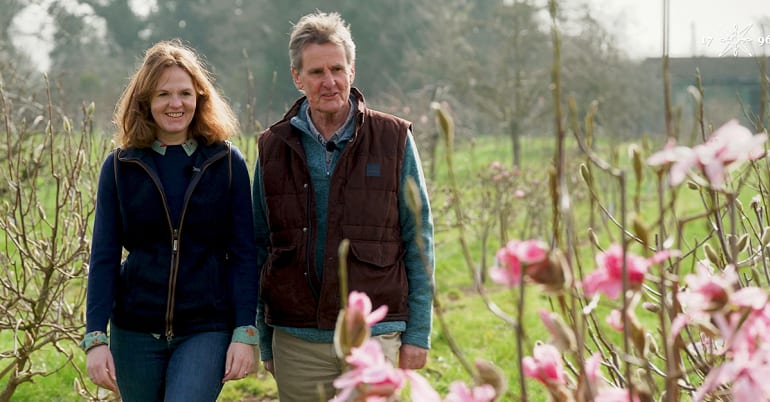
Today, it is led by Stephanie James Dunn, Managing Director and co-owner, alongside her father, Nick Dunn, Director and co-owner.
In a recent conversation at the nursery, they reflected on the importance of continuity, shared responsibility, and how the business has been sustained across generations. What emerged from the discussion was a strong sense of alignment and trust between family members, underpinned by a shared commitment to the long term.
Less visible, however, are the underlying mechanics. Succession has been shaped over nearly two decades, while effective judgement has been honed through continued exposure to risks that have required careful navigation.. Capital has been deployed thoughtfully, guided with patience rather than urgency.
As Mark Goddard, Chief Executive Officer (CEO) of Lombard Odier UK, notes, working with families across generations involves navigating complex dynamics, where discussions around succession, ownership, and direction are not always straightforward. As a firm of entrepreneurs in its seventh generation of private ownership, Lombard Odier approaches these questions with both experience and advisory expertise. Behind what appears to be organic lies a sequence of deliberate structural choices.
Rethinking succession: why “organic” is never accidental
Succession at Frank P Matthews is described in deceptively simple terms: a 19-year transition, built through a “series of progressions and discussions”, with father and daughter working side by side. The impression is one of continuity, something that feels gradual and almost intuitive.
Look more closely, however, and a more deliberate structure emerges.
Stephanie’s path into the business was not defined by a single role or a fixed trajectory. Instead, she moved through different parts of the nursery before assuming greater responsibility. This breadth of exposure allowed capability to develop incrementally. Just as importantly, sharing an office with her father meant daily observation of decisions, trade-offs, and pressures, allowing for an informal transfer of knowledge that a formal training programme couldn’t fully replicate.
Responsibility, in turn, was not handed over at a single moment but assumed gradually. It extended over time to both Stephanie and her husband, with confidence and leadership developing through experience rather than instruction. As she notes, her father was “very generous in giving me space to learn” while steadily increasing their responsibilities as time went on.
The earlier those conversations begin, the easier it becomes to build the structures, confidence, and shared understanding required for transition
However, when Stephanie first expressed interest in joining the business, her father’s first response was not enthusiasm, but caution. Nick Dunn’s first instinct was to try and “put her off.” Not from doubt about her ability, but from concerns around the business's exposure to forces beyond management's control. Weather. Markets. Shifts in customer demand. “You have to have a real passion,” he says. Over time, recognising that passion in Stephanie became part of the succession itself.
For many family businesses, this is where succession planning can become challenging. As Mark Goddard observes, families need to consider how to bring the next generation into the business “in a responsible way”, with the right education, support, and clarity around the role they will play. The earlier those conversations begin, the easier it becomes to build the structures, confidence, and shared understanding required for transition.
Beneath the surface: the structure behind decision-making
If succession at Frank P Matthews has been gradual, decision-making appears to have been similarly instinctive. Stephanie describes a business in which she and her father have “always been able to make decisions together”, helped by a “very clear direction” for the company and years of close collaboration.
That ease of decision-making should not be mistaken for a lack of structure. Decisions have been shaped by forces largely beyond management’s control, including volatile weather patterns, changing customer demand and the long production cycles involved in growing trees. Shared judgement has been formed through repeated exposure to the same pressures. Trust has been built not in principle, but in practice.
For Frank P Matthews, this implicit alignment has clearly been a strength. Nick credits Stephanie with understanding both the history of the business and the need “not [to take] too many risks”. Continuity, in this case, has not meant standing still. It has meant knowing which risks belong to the business, and which would compromise its resilience.
For other family enterprises, however, apparent alignment can be more fragile. Decision-making may feel harmonious while the founder remains active, or while trading conditions are benign. Under pressure, unresolved questions often surface: who has authority to decide where ownership ends and management begins, and how disagreement should be handled. In some cases, these tensions emerge at moments of transition, when assumptions that were never tested are suddenly made explicit.
In any family business, governance exists whether or not it is written down. The question is whether it has been tested before it is needed
This is where governance becomes less about formality and more about clarity. As Mark notes, families need to think through “who has the relevant rights within that decision-making process”, as well as the structures – such as a family charter – that help define roles within the wider family enterprise.
What looks intuitive at Frank P Matthews is, in reality, the product of years of shared experience. In any family business, governance exists whether or not it is written down. The question is whether it has been tested before it is needed.
Growth and capital allocation: patience over generations
At Frank P Matthews, growth has rarely followed a straight line. It has been defined less by expansion than by timing. As Nick explains, development has been “slow, gradual, organic”, significantly shaped by opportunity rather than just intent. “You have to be patient, to wait for opportunities.”
That patience becomes clearer when observed across generations. At key moments, capital has been deployed not to accelerate growth, but to reposition the business. The relocation of the nursery from Middlesex to Worcestershire in the late 1950s, prompted by the expansion of the road network around Heathrow, was not an expansion in the conventional sense, but a necessary reset, and a response to external pressures that ultimately redefined the company’s operating base. More recent investments have followed a similar logic. The development of a direct-to-customer retail channel extended market access, while acquisitions have strengthened breeding and trial capabilities reflecting a long-term investment in innovation.
related content.

our private banking expertise in the uk.
learn more This highlights the realities of a business where time, capital, and risk are closely intertwined. Trees take years to mature, and outcomes remain exposed to forces beyond management’s control. Over time, this creates a natural concentration, with both operational performance and family wealth closely linked to the business itself.
It is here that capital allocation becomes inseparable from long-term wealth planning. For many families, this raises a question of balance: how much capital should remain within the business, and how much should be diversified beyond it? How should growth be funded without increasing exposure to a single set of risks? As Mark notes, supporting families often involves structuring decisions to account for both business and personal assets.
At Frank P Matthews, patience is not the absence of action. It is a discipline applied to when and how capital is deployed.
Sustainability and stewardship: continuity beyond a single generation
Sustainability is not framed as a separate initiative at Frank P Matthews, nor as a response to external expectations. It is embedded in how the business operates.
Some of these decisions were not initially strategic. The move to peat-free growing media, now a defining feature of the nursery, began as a response to supply constraints. Over time, it became a permanent approach, recognising the environmental impact of peat extraction; peatlands are carbon sinks, so reducing peat use helps protect them and limit emissions. Other investments, including solar energy and water recycling, reflect a similar pattern: practical decisions shaped by necessity.
Underlying these choices is a simple premise. As Stephanie puts it, “we must make sure that we look after the soil… for generations to come.” Stewardship, in this context, is not an abstract principle. It directly underpins the business’s ability to continue operating over generations.
Read also: Soil-first farming – why regenerative agriculture is gaining ground
For Nick, the business carries a responsibility to preserve both the land and the standards established over more than a century. For Stephanie, the focus extends to future resilience, from adapting to climate variability to developing new varieties of tree suited to changing conditions.
Family ownership creates the space for this alignment. Without the pressure for short-term returns dictating every decision, the business can take a longer-term view. Sustainability becomes less about positioning, and more about ensuring that the business remains viable for those who will inherit it.
Long-term thinking is not a separate strategic construct at Frank P Matthews; it is something that is embedded in daily operational decisions.
related content.

entrepreneurs: bespoke wealth management.
learn more Five lessons from a multi-generational business
The experience of Frank P Matthews offers a range of lessons that extend beyond its sector:
1. Succession works best when it starts early and remains visible
In this case, a 19‑year transition period has allowed capability, confidence, and credibility to develop gradually over time. Leadership is not handed over at a single moment, but nurtured and earned over many years.
2. Commitment cannot be assumed
Here, commitment developed gradually through direct exposure to the realities and responsibilities of the business. Long-term engagement, rather than expectation, ultimately defined whether the next generation would take ownership in a meaningful way.
3. Alignment matters more than structure in the early stages
A shared sense of direction, reinforced over years of working together, reduced friction and made later governance decisions more effective.
4. Growth requires discipline
Not every perceived opportunity should be taken. As the Dunn family demonstrates, patience compounds, and expansion is most resilient when it extends capability rather than simply increasing scale.
5. Emotional alignment should not obscure financial reality
At Frank P Matthews, long-term ownership has created strong alignment around the business. In many family enterprises, however, family wealth, income, and identity can become heavily tied to a single business. Over time, managing that concentration becomes an important part of preserving resilience across generations.
This is where external perspective can add value. As Mark notes, families often benefit from structured conversations around succession, governance, and ownership, helping bring clarity for both the family and the business.
Most challenges in family enterprises are not operational, they are structural.
Questions every family-owned business should consider
Succession & Governance
- Do we have a clearly defined and documented succession plan?
- Are roles and responsibilities across family and management clearly understood?
- Do we have a governance framework, such as a family charter, in place?
Ownership & Exit
- How is ownership structured, and is it formally documented?
- How are family members compensated, and is this perceived as fair?
- What happens if a family member wishes to exit the business?
Wealth & Planning
- To what extent is personal wealth separate from business assets?
- Have we planned adequately for inheritance taxes and intergenerational transfer?
External Support
- Do we have trusted external advisors to support difficult conversations?
- Are we actively preparing the next generation for future responsibility?
Planting for the long term
At the RHS Chelsea Flower Show, what is visible lasts only a matter of days. Behind each display lies years of preparation, cultivation, and careful timing. The result is fleeting, but the process, by contrast, is long and exacting. The same can be said of Frank P Matthews, where continuity has been shaped over time, through sustained commitment and careful judgement. Continuity today reflects decisions taken over decades: succession shaped gradually, growth approached with restraint, and responsibility shared across generations. The business has endured not by avoiding disruption, but by adapting to it, while maintaining a clear sense of direction.
For family enterprises more broadly, the question is not whether disruption will occur, but whether the structure is strong enough to absorb it. That requires clarity, not only of ownership and governance, but of how decisions are made and how capital is deployed over time.
At Lombard Odier, as a firm of entrepreneurs with over 230 years of history, we work with families to bring structure to these questions, helping align business, ownership, and personal wealth so that continuity is not left to chance, but supported by design.


share.