When you visit our website, information may be stored or recovered on your device, mainly in the form of cookies. We use essential cookies to ensure the website works as it should, and statistical and marketing cookies for audience measurement and content customisation purposes. We rely on Google for statistical and marketing cookies in order to measure website performance and display relevant advertising. For more information on this, please also refer to the Google policy on Business Data Responsibility.
From the Cookie Management Centre, you can set your preferences with respect to the use of cookies: accept or reject certain categories, accept all, or reject all. For detailed information on all cookies used across these three categories, please refer to our Cookie Policy.
Please note that blocking certain cookies may affect your experience and the services offered.
Essential cookies Always active
Essential cookies help the website to work as it should by enabling necessary functionalities, such as navigating between pages and accessing secure areas. These cannot be disabled in our systems.
Statistical cookies
Statistical cookies help us understand how visitors interact with our site by collecting and communicating browsing information. They make it possible to identify the most and least visited pages and to improve the overall performance of the site.
Marketing cookies
Marketing cookies are used to display relevant advertising and measure the performance of campaigns. If you choose not to allow these cookies, you will continue to see ads, but they will be less relevant to your interests.
Choose the purposes for which we may use Google products to collect and use your data:
User storage: to technically permit advertising functionality.
User data for advertising: to optimise our advertising campaigns.
Ad customisation: to tailor advertising to your interests.
Geopolitical volatility meets market resilience – balancing the contradictions of our turbulent times
Western supremacy is over – the balance of global power is shifting towards rising powers such as China and India. Simultaneously, the US is turning its back on Europe –as a result, the longest period of peace and prosperity the ‘Old Continent’ has known since the Roman Empire could be in jeopardy.
Those hoping this is merely ‘the Trump effect’, and that the end of his term in office (in January 2029) will herald a return to normality, are likely to be disappointed. There is no going back – “We are entering a new world.”
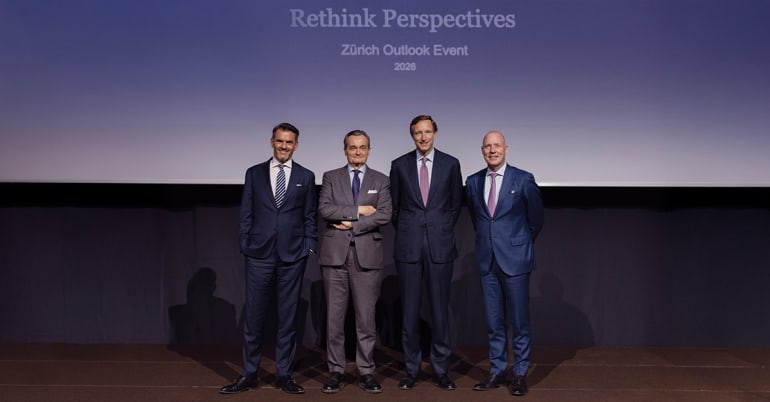
These were the stark warnings of Gérard Araud, former French Ambassador to the United States, speaking at our recent Rethink Perspectives event in Zurich. Held at a time of great geopolitical upheaval – as the world’s political leaders sparred in Davos, Greenland’s territorial integrity came under threat, and the future of NATO was brought into question – Rethink Perspectives offered a chance to cut through the noise and examine the fundamental geopolitical and macroeconomic forces behind the headlines.
There is no going back – we are entering a new world
Joining Gérard Araud, Frédéric Rochat, Lombard Odier’s Managing Partner, and Michael Strobaek, Global Chief Investment Officer, gave the investor perspective, and explained how Lombard Odier is positioning for this world in flux.
Sign up for our newsletter
G7 decline – BRICS on the up
The rise of the new world order can be seen in one simple statistic, Gérard Araud began. Over the last 50 years, the G7’s share of global GDP has fallen from 61% to 30%1 and is continuing to fall. At the same time, the rival BRICS alliance – which is made up of Brazil, Russia, India, China, and South Africa, plus a further six nations that joined in recent years – has seen its share of global GDP rise to 40%2. “This figure shows that the world has changed dramatically and, for us in the West, it’s changed at our expense,” Gérard Araud said.
This decline coincides with US isolationism, that risks weakening the West still further. However, he explained, this policy is not due to Trump – it is simply a reversion to the norm. “The West was happy with the United States as the boss. We have been living in the longest period of prosperity since the fall of the Roman Empire, but now the Americans are going back home.”
We have been living in the longest period of prosperity since the fall of the Roman Empire, but now the Americans are going back home
“This goes well beyond Trump, however. In 1797, George Washington gave a speech saying to Americans, ‘Don’t go to Europe. Avoid interfering in their policy, their wars.’ With some exceptions, that’s been their approach ever since. In 1945, the Americans came to Europe simply because of the Soviet threat. Now, since 2020, the Americans have been tiptoeing back out of Europe. The only difference is that if Kamala Harris had been elected, she would have closed the door gently, Trump is slamming the door on our fingers.”
“We have seen a radicalisation of Trump’s foreign policy in recent weeks,” Gérard Araud continued. “Since the abduction of [former Venezuelan President] Maduro there has been the arrest of two Russian ships in international waters; he has announced that he’s going to increase the US defence budget by 50%, which would make it 50–65% of the total global defence spend; he’s withdrawn the US from 66 international organisations; and he’s militarily threatened Mexico, Cuba, Colombia, and even Denmark, in the case of Greenland.” Trump has also announced the formation of his international ‘Board of Peace’, seen by many as a divisive move that will undermine the United Nations.
This behaviour, Gérard Araud explained, is inextricably linked to the changing world order. As the balance of economic might has shifted, the US recognises that, “the threat is China. China. China.” In response, President Trump is shifting to a pragmatic ‘balance of power’ approach to international relations, leaving longstanding alliances and the rules-based order weakened or broken altogether.
This is being compounded by political volatility across much of the West, he continued. “In a sense, nearly all liberal democracies are facing the same political crisis, which is that 30-40% of citizens are saying ‘enough is enough!’ There is an identity crisis. There is an obsession with immigration. You see it in the polling in France, Germany, and the UK, where the far right parties are gaining ground. Depending on how it’s handled it will change the direction of the world – it will have deep political and economic consequences, especially on the future of the European Union.”
Geopolitical risk tends to transmit to markets through supply chains and energy markets
Despite these worries, Michael Strobaek explained that investors should be reassured that markets are resilient. “Geopolitical risk tends to transmit to markets through supply chains and energy markets, which often means the oil price,” he said. “But the dominating force when it comes to energy supply is the United States, and if there is one thing that Trump has an interest in, it is to make sure the oil price doesn’t go up, because it plays such an enormous role in the cost of living of the average American. Yes, geopolitics are a risk, but markets tend to look through these things unless there are transmission channels to the real economy. In fact, moments of geopolitical risk can offer opportunities to buy.”
Michael Strobaek noted that the recent furore over President Trump’s ambition to ‘own’ Greenland has been difficult. However, he said, “it is essential to keep emotions out of the equation when it comes to investments. Markets are rational discounting mechanisms; they are not emotional.”
“So, what does this new world order mean for markets? The truth is that the economics, and especially the corporate earnings, in this new geopolitical order are very strong. And that is written in two letters – AI. I always get asked ‘is AI a bubble?’ Well, right now it looks as if the geopolitical race [for AI dominance] supports AI investments and earnings.”
It looks as if the geopolitical race [for AI dominance] supports AI investments and earnings
Betting against the US?
It is the case, however, that the US economy is growing below potential, with cautious businesses slowing their hiring and postponing capital investment, and consumption growth losing momentum, Michael Strobaek noted. Trump’s tariffs – which we expect to remain in place in some form whatever the outcome of a forthcoming US Supreme Court decision3 – are one cause. Though tariffs will weigh on the economy as US firms pass on higher imported goods prices to consumers, they are likely to remain a key long-term tool for President Trump.
Further uncertainty is being stoked by Trump’s efforts to undermine the independence of the Federal Reserve, with numerous public denouncements of Chair Jerome Powell, followed by the launch of a criminal investigation into Powell’s handling of a federal building renovation project – a move widely seen as intending to intimidate Powell into bringing interest rates down more quickly. However, Michael Strobaek noted, “The Fed’s interest-rate-setting process is structured so as to not fall under government control. Our view is that Trump is not likely to be successful in changing this. The Fed will lower interest rates – slower than Trump would like – but they will support markets. As long as the labour market can hold up – and it’s currently soft but not cracking – we don’t see recession in the US on the horizon.”
Against this backdrop, the US exceptionalism that investors have become accustomed to is waning, and new opportunities are appearing in emerging markets. “In equities, emerging markets have begun outperforming US equities for the first time in a decade or more,” Michael Strobaek said. “We’ve seen fantastic performance. Earnings are strong. Interest rates are coming down. Fiscal policy is supportive. We’ve got a preference for emerging markets now.”
Given today’s volatile environment, it is important for investors to diversify, he continued. “We are diversifying from the US and into emerging markets – debt, currency, and equities – and fixed income is back on the agenda. We believe the dollar could drop a bit more, but not much. While I do not believe tech is about to burst, we do have a question about some valuations, so we need to diversify there as well. Then gold – where we increased our allocations – remains a solid hedge in portfolios.”
Above all, he concluded, investors should have confidence in market resilience. “My message is, don’t look at your newspaper too much, or worry too much about what President Trump says. If earnings are good, interest rates are coming down, and there is stimulus into the economy, then it takes a lot for geopolitics to derail markets. This is the lesson we’ve seen from 2025.”
We live in a world of paradoxes – one that fuels uncertainty, but also optimism and opportunity
Balancing the contradictions
As Rethink Perspectives came to a close, Frédéric Rochat acknowledged that it can be hard to balance today’s many apparent contradictions: geopolitical instability; the breakdown in international alliances and the rules-based order; and the decline of Western economic dominance – with market resilience and continued economic growth.
“We live in a world of paradoxes,” he said. “It’s a world that in many areas fuels a sense of volatility and uncertainty, but in many other areas it fuels optimism and opportunity, including many investment opportunities.”
“It is important to note, though, that we are treading a narrow path. That’s why, at Lombard Odier, we’ve always seen it as an essential part of our mission to stay close to our clients, constantly rethinking the world around us, and helping them navigate what will undoubtedly continue to be a complex and volatile market environment. Above all, with 230 years of history, we are able to see the bigger picture – to separate the short-term turbulence from the deeper forces at work. By calmly taking a step back, we invest with one goal in mind – preserving and growing our clients’ wealth for the long term.”
This is a marketing communication issued by Bank Lombard Odier & Co Ltd (hereinafter “Lombard Odier”).
It is not intended for distribution, publication, or use in any jurisdiction where such distribution, publication, or use would be unlawful, nor is it aimed at any person or entity to whom it would be unlawful to address such a marketing communication.





share.