When you visit our website, information may be stored or recovered on your device, mainly in the form of cookies. We use essential cookies to ensure the website works as it should, and statistical and marketing cookies for audience measurement and content customisation purposes. We rely on Google for statistical and marketing cookies in order to measure website performance and display relevant advertising. For more information on this, please also refer to the Google policy on Business Data Responsibility.
From the Cookie Management Centre, you can set your preferences with respect to the use of cookies: accept or reject certain categories, accept all, or reject all. For detailed information on all cookies used across these three categories, please refer to our Cookie Policy.
Please note that blocking certain cookies may affect your experience and the services offered.
Essential cookies Always active
Essential cookies help the website to work as it should by enabling necessary functionalities, such as navigating between pages and accessing secure areas. These cannot be disabled in our systems.
Statistical cookies
Statistical cookies help us understand how visitors interact with our site by collecting and communicating browsing information. They make it possible to identify the most and least visited pages and to improve the overall performance of the site.
Marketing cookies
Marketing cookies are used to display relevant advertising and measure the performance of campaigns. If you choose not to allow these cookies, you will continue to see ads, but they will be less relevant to your interests.
Choose the purposes for which we may use Google products to collect and use your data:
User storage: to technically permit advertising functionality.
User data for advertising: to optimise our advertising campaigns.
Ad customisation: to tailor advertising to your interests.
The international, rules-based, model of the globalisation era has evolved into a new world order of ‘geoeconomics’ and strategic autonomy
Unless energy markets or supply chains are disrupted, geopolitical stress tends to be short-lived in asset prices. Advanced economies have also become more insulated as they have become less energy-sensitive
Investors should examine whether geopolitical events create material economic or resource constraints and whether they impair companies’ ability to make profits
Rather than trying to anticipate geopolitical shocks, we seek to build portfolios that can endure them through a robust strategic asset allocation.
The idea of a ‘new world order’ is anything but new. The phrase first appeared in the 19th century, and its intellectual development can be traced through British geographer and politician Halford Mackinder’s 1904 article ‘The Geographical Pivot of History’, which laid the foundations of modern geopolitics through his ‘heartland theory’. He argued that whoever controlled the heartland of Eurasia controlled global power. Mr Mackinder did not use the phrase ‘new world order’ in its contemporary political sense, but he articulated a durable and uncomfortable insight: global order is shaped less by ideals and declarations than by geography, power, and control over strategic resources.
Nearly a century later, the phrase returned to political prominence through US President George H. W. Bush, in a 1990 address to Congress, delivered as the First Gulf War loomed. President Bush outlined a vision of a rules-based international order anchored in multilateral institutions and underwritten by US leadership. The liberation of Kuwait soon followed and became the first major post-Cold War conflict conducted with explicit United Nations authorisation – a brief moment when power and legitimacy appeared aligned rather than in tension.
The 1990s and early 2000s witnessed the beginning of an era of globalisation. While Europe implemented monetary union in 1999, China’s accession to the World Trade Organization (WTO) in 2001 was widely interpreted as convergence rather than rivalry. Markets internalised this worldview. Defence spending declined as a share of GDP across developed economies, supply chains crossed borders, and energy and commodities were treated primarily as economic inputs rather than strategic weapons. The prevailing belief was that economics would discipline politics.
Sign up for our newsletter
The irony, of course, is that the period was anything but peaceful. Wars were frequent, but conflicts were framed as counterterrorism or security operations rather than contests over spheres of influence. Over time, however, the assumptions underpinning the post-Cold War order quietly eroded. China did not converge politically even as its share of nominal global GDP rose from roughly 4% at WTO entry to close to one-fifth today. Russia increasingly rejected the post-Cold War settlement, from its actions in Georgia in 2008 to Crimea in 2014 and the full-scale invasion of Ukraine in 2022. Multilateral institutions weakened amid the rise of national populism.
The Covid-19 shock crystallised these trends. Governments were reminded how interconnected the world had become. This was visible not only in the speed of viral transmission, but also as supply chain disruptions triggered shortages in medical equipment, semiconductors, shipping capacity, commodities, and labour. This interdependence meant vulnerability. Therefore, policy priorities shifted decisively from supply chain efficiency to supply chain resilience.
The ‘Trump-era new world order’ looks less like a rupture than an acceleration
In this context, the ‘Trump-era new world order’ looks less like a rupture than an acceleration. Security, sovereignty, and strategic autonomy have moved ahead of cost efficiency, with economics once again serving geopolitics rather than the reverse. Trade policy, industrial subsidies, and tariffs are again tools of statecraft. ‘Geoeconomics’ is no longer a theoretical construct; it is the operating reality of major world powers.
Markets are discounting machines, not moral arbiters
Geopolitics examines how geography, power, and strategic constraints – control over critical technologies, physical chokepoints, and access to natural resources – shape the behaviour of states. Macroeconomics, by contrast, focuses on the economy in aggregate, analysing growth, inflation, employment, and capital flows, and typically assumes that imbalances adjust over time through prices and policy. The two are inseparable. Macroeconomic outcomes depend on the smooth functioning of flows – of goods, capital, energy, and labour – while geopolitics determines where those flows can move, and where they cannot.
Because financial markets are primarily macro-driven, geopolitics has historically generated limited, and short-lived, stress in asset prices. This is evident in measures such as the VIX index of US equity market volatility, often called the ‘fear gauge’.
Spikes in geopolitically-driven volatility tend to be episodic rather than persistent. Markets respond meaningfully to geopolitics only when key economic transmission channels, specifically energy and commodity markets or supply chains, are disrupted. Such disruptions might include restrictions on critical technologies such as semiconductors; the weaponisation of commodities like oil or rare earths; trade barriers that alter prices; or the closure of physical chokepoints – from the Strait of Hormuz to the Suez Canal – that interrupt supply chains. Without such channels, geopolitics tends to make for loud headlines but quiet prices.
Geopolitical events have rarely been the primary cause of macroeconomic downturns
Furthermore, geopolitical events have rarely been the primary cause of macroeconomic downturns. The clearest exception remains the Yom Kippur War of 1973. The oil embargo that followed triggered a severe energy shock, pushed inflation sharply higher – exacerbated by pre-existing wage and price controls in the US – and culminated in a deep recession. More often, geopolitical events coincide with, and exacerbate, existing vulnerabilities: the First Gulf War alongside the 1990 recession; the 11 September 2001 terror attacks following the bursting of the dot-com bubble; or Russia’s invasion of Ukraine during the Federal Reserve’s tightening cycle in 2022.
Since the 1990s, market reactions to geopolitical shocks have generally been more muted as advanced economies have become far less energy-intensive – with the US shifting from a major net oil importer to a net exporter by the early 2020s – and policy frameworks have become better at cushioning such shocks. When politics fails to adapt, markets and economic agents usually do.
Research from the International Monetary Fund reinforces this view. Geopolitical risks are often priced heuristically: their uncertain duration, scope, and low frequency make them difficult to quantify in advance. In the meantime, their tail-risk nature as relatively rare but potentially extreme occurrences means they are underpriced until they materialise. As tensions persist without immediate economic disruption – as in the case of US-China relations – investor attention often fades rather than intensifies.
Markets are not moral arbiters of world events; they are discounting machines
This does not mean markets ignore geopolitical risk. They ignore noise. However unsettling the headlines – and however immediate they may feel in an age of continuous media exposure – markets are not moral arbiters of world events; they are discounting machines.
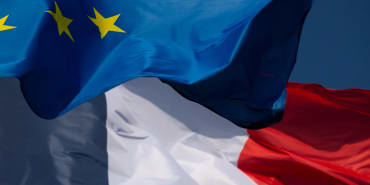
France’s snap elections in June 2024 offer a useful illustration. Political uncertainty rose, but the adjustment occurred through relative asset pricing rather than outright collapse. The CAC 40 lagged broader European equity markets, French sovereign spreads over German Bunds widened, and credit-default-swap spreads moved modestly above historical averages – a repricing of risk premia, not a systemic event.
Discipline in a geopolitically-driven world
If history suggests that markets can ignore geopolitical noise, this is not a licence for complacency. A geopolitically charged environment and shifts in the international order demand discipline, analytical distance, and an unemotional framework.
First, in such a world, the investor’s edge does not come from predicting events, but from understanding which outcomes are unaffordable.
Geopolitical strategist Marko Papic captures this through the concept of ‘material constraints’: the hard physical, economic, and resource limits that bind policymakers regardless of ideology. Energy availability, fiscal capacity, supply chains, demographics, and industrial capabilities ultimately determine what governments can do, separating the merely possible from the truly probable. Focusing on these constraints, rather than political rhetoric or media hyperbole, can help keep investors grounded amid relentless news flow.
A disciplined investor should ask…: does this impair companies’ ability to generate profits?
Second, markets are anchored in profits. Corporate earnings support equity valuations, employment, and consumption – the latter comprising around 70% of US GDP – and generate the tax revenues that finance public spending.
A disciplined investor should therefore ask a simple question: does this geopolitical event impair companies’ ability to generate profits?
Profits are a function of revenue growth and margins. If demand remains intact and costs are not structurally impaired by supply disruptions, trade barriers, or sustained price shocks, geopolitical events are unlikely to leave lasting scars on earnings. Outside of recessions, companies tend to keep growing earnings.
Geopolitics therefore belongs primarily to the realm of long-term strategic asset allocation rather than short-term tactical reaction. The world is not simply changing; it is adapting – unevenly, noisily, and often inefficiently. The task of the Intelligent Allocator is therefore not to forecast the next geopolitical shock, but to ensure portfolios are built with sufficient resilience to endure them. Understanding the objectives of major economic actors, and more importantly the material constraints that limit those objectives, remains essential to distinguishing durable shifts from transient fear.
Global CIO Viewpoint
The Intelligent Allocator: Geopolitical fear travels faster than capital
This is a marketing communication issued by Bank Lombard Odier & Co Ltd (hereinafter “Lombard Odier”).
It is not intended for distribution, publication, or use in any jurisdiction where such distribution, publication, or use would be unlawful, nor is it aimed at any person or entity to whom it would be unlawful to address such a marketing communication.





share.