When you visit our website, information may be stored or recovered on your device, mainly in the form of cookies. We use essential cookies to ensure the website works as it should, and statistical and marketing cookies for audience measurement and content customisation purposes. We rely on Google for statistical and marketing cookies in order to measure website performance and display relevant advertising. For more information on this, please also refer to the Google policy on Business Data Responsibility.
From the Cookie Management Centre, you can set your preferences with respect to the use of cookies: accept or reject certain categories, accept all, or reject all. For detailed information on all cookies used across these three categories, please refer to our Cookie Policy.
Please note that blocking certain cookies may affect your experience and the services offered.
Essential cookies Always active
Essential cookies help the website to work as it should by enabling necessary functionalities, such as navigating between pages and accessing secure areas. These cannot be disabled in our systems.
Statistical cookies
Statistical cookies help us understand how visitors interact with our site by collecting and communicating browsing information. They make it possible to identify the most and least visited pages and to improve the overall performance of the site.
Marketing cookies
Marketing cookies are used to display relevant advertising and measure the performance of campaigns. If you choose not to allow these cookies, you will continue to see ads, but they will be less relevant to your interests.
Choose the purposes for which we may use Google products to collect and use your data:
User storage: to technically permit advertising functionality.
User data for advertising: to optimise our advertising campaigns.
Ad customisation: to tailor advertising to your interests.
Decrypting: investing in uncertainty and thinking about tomorrow’s finance
Two important forces are reshaping the investment landscape. On the one hand, geopolitics – including Middle East tensions and uncertainties over the trajectory of energy prices, inflation, and interest rates – is, now more than ever, key for the market outlook. On the other, the financial sector is in the midst of a structural transformation in its infrastructure, with the digitisation of securities and tokenisation.
It is in this context that clients and experts gathered at our event “Decrypting: macroeconomic outlook and the digital asset revolution”. Nadine Mottu, Partner and Co-head ‘Grandes Familles’, a service that specialises in working with large international families, began with a reminder of the vision of our new Geneva headquarters, 1Roof. The vision is to bring many of our experts together under one roof to deliver transparency, flexibility, sustainability, and bespoke solutions for our clients. As geopolitics and structural transformations continue to reshape investment, they provoke some important questions around the second part of that vision.
How do we stay invested with discipline amidst an increasingly chaotic geopolitical environment? Under what conditions could an oil shock destabilise the global economy? And, beyond the current macroeconomic environment, how is tokenisation already reshaping financial systems and infrastructure?
Sign up for our newsletter
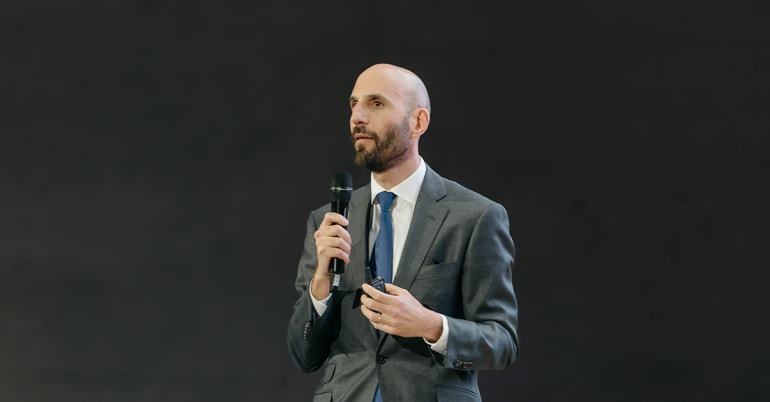
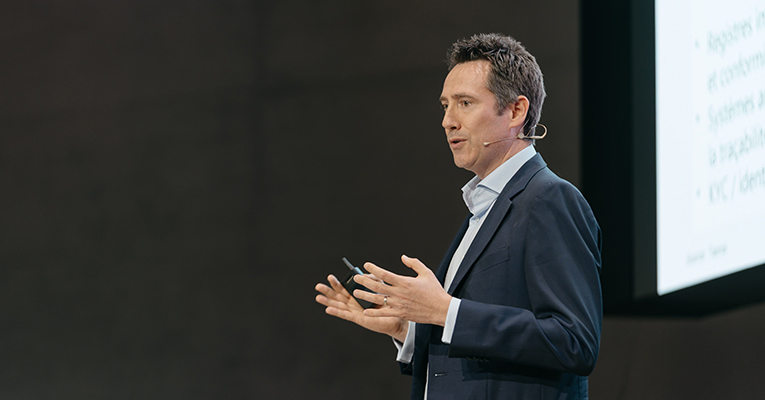
To answer these questions, the event was divided into two parts. Samy Chaar, Partner, Chief Economist and CIO Switzerland at Lombard Odier, began by analysing the macroeconomic drivers of a particularly eventful start to the year, with conflicts, oil prices, global growth, interest rates, and US corporate profits all key to the outlook. Then, Sébastien Dessimoz, Co-founder and Managing Partner of our partner, Taurus – a leading Swiss provider of digital banking infrastructure – revealed how tokenisation is already spurring the evolution of capital markets and their infrastructures.
A conflict is not, in itself, a reason for disengagement, as long as the fundamentals remain resilient
Staying the course despite a geopolitical shock
Examining a start to 2026 marked by rising tensions in the Middle East, Samy Chaar pointed out a counter-intuitive fact: twelve months after the start of a conflict, markets in general tend to be rising. This observation is not intended to minimise the current geopolitical shock, but to point out that markets tend to focus more on the trajectories of economic growth, profits, and interest rates. Samy Chaar’s presentation focussed on “the need to remain invested as long as the global economy remains in expansion”.
He based his reasoning on two mechanisms. The first is the ongoing resilience of the global activity. “In an economic expansion, companies continue to generate profits, people have jobs, and they continue to fuel consumption.” The second concerns interest rates. More often than not, phases of sustained market weakness tend to coincide with cycles of rapidly rising interest rates, as capital costs suppress company valuations and impact balance sheets.
Together, these mechanisms lead Samy Chaar to a clear conclusion: “A conflict is not, in itself, a reason for disengagement, as long as the fundamentals remain resilient.”
Even so, Samy Chaar emphasised the need to monitor oil prices closely. As he observed, “economic repercussions from the conflict will depend on how long it lasts and its effects on the oil market”. He stresses that the oil shipping chokepoint of the Strait of Hormuz is “key for China”, while OPEC’s spare capacity could buffer some of the volatility in a scenario of limited disruption.
Samy Chaar also argued that distinguishing between base and risk scenarios during an oil shock is crucial, while noting that net energy importers Europe and Asia would be particularly exposed. While the risk of a significant oil shock cannot be ignored in the current environment, it will depend on the market impact via the transmission channels of energy prices, inflation, interest rates, and confidence. Therefore, Samy Chaar argues, “There would have to be a very strong surge in oil prices to cast doubt on the economic expansion from which we are all benefiting.”
There would have to be a very strong surge in oil prices to cast doubt on the economic expansion from which we are all benefiting
US corporate profits as buffers
Samy Chaar also focussed on the dynamism of American profits, particularly for technology companies. “The market only values one factor: the ability of companies to generate profits,” he noted, a point the US proves as it continues to attract global capital flows.
Samy Chaar is sceptical of interpretations of today’s macroeconomic environment that draw strong parallels with the technology bubble of the late 1990s. Today, he explained, “you have no price–profit disconnection,” with price rises being “consistent with the rise in earnings per share”. In other words, while the market may remain vulnerable to corrections, today’s rising share prices remain connected to corporate fundamentals.
Beyond the economic cycle, Samy Chaar also highlighted the importance of strategic competition between the US and China, which acts as a powerful engine of investment and technological innovation. While China is ahead in terms of industrial capacity and energy, the United States has a clear advantage in computing capacity linked to artificial intelligence (AI) and in other strategic technological segments. Consequently, Samy Chaar argues the two powers have “reason to feel challenged and to invest more heavily”.
For investors, Samy Chaar noted, the key consequence of this competition is that “it injects investment into the system” – and the significant flows of capital into technology, energy, defence, and productive infrastructure are likely to serve as a macroeconomic buffer. In this context, Europe’s chronic underinvestment could also begin to be reversed in response to the same geopolitical pressures pushing the US to strengthen and secure its strategic industrial capacities.
In the second part of the webinar, Sébastien Dessimoz, Co-founder and Managing Partner of Taurus, discussed the ongoing transformation of financial infrastructure and, in particular, the rise of tokenisation and digital assets.
He began with a simple explanation of tokenisation, which entails digitising securities by converting them into tokens recorded on a blockchain. Broadly speaking, a digital asset can be understood as the electronic representation of an asset, a security, or a unit of account, held on a distributed ledger.
A digital asset can be understood as the electronic representation of an asset, a security, or a unit of account, held on a distributed ledger
The significance of digital assets is, therefore, not limited to crypto assets or passing trends. More fundamentally, they are reshaping how financial rights are issued, held, transferred, and traded within a digital infrastructure.
Sébastien Dessimoz, Co-founder and Managing Partner of Taurus
An operational and structured Swiss framework
Sébastien Dessimoz also pointed out that, in Switzerland, tokenisation no longer exists in a grey zone. Since a new law on distributed ledger technology came into force in 20211, Switzerland has had a legal framework for recording certain rights on distributed ledgers and issuing shares digitally.
In short: digital assets are here to stay. They have passed from the theoretical into the practical field. As a result, experimental applications – such as the issuing of registered security rights, seamless transfers of natively digital securities, and electronic exchange on digital platforms – are gradually being established as a concrete field, where law, operational standards and market infrastructure are starting to converge.
A clear benefit of rising tokenisation is that it reduces the barriers between private and public capital markets. This is because tokenisation can enable traditional securities to become electronic, more easily transferable, and, potentially, more liquid
Blurring the line between private and public markets
Sébastien Dessimoz believes that a clear benefit of rising tokenisation is that it “reduces the barriers between private and public capital markets”. This is because tokenisation can enable traditional securities – which, historically, have been highly fragmented and administratively complex – to become electronic, more easily transferable, and, potentially, more liquid.
Crucially, Sébastien Dessimoz noted that simply digitising a security on a blockchain is not enough to realise these benefits, as the payment also needs to be able to circulate within the same digital environment. Otherwise, part of the transaction must still go through traditional financial infrastructure.
This is the logic that Sébastien Dessimoz used when highlighting the importance of stablecoins – digital currencies whose values are stabilised by virtue of their being indexed to a traditional currency, like the US dollar or the Swiss franc – and other digital currencies that can be used directly in this type of exchange.
How tokenisation could drive the use of money market funds
Sébastien Dessimoz highlighted one particularly compelling use case for tokenisation: money market funds.
While some regulatory frameworks allow money market funds to be used as collateral for over-the-counter (OTC) derivatives subject to margin calls, the operating delays inherent to traditional banking infrastructure limit their use in practice. Sébastien Dessimoz argues that, if money market funds are tokenised, they become almost instantly transferable, enabling them to be used more readily as collateral for OTC derivatives. McKinsey estimates this market to be worth at least USD 2 trillion by 2030.
Tokenisation has huge potential – but significant challenges remain
Although positive on the ultimate potential of tokenisation, Sébastien Dessimoz nevertheless argued that “the market is still in its infancy, and there are some challenges still to address.”
In other words, the technology alone is not enough. If tokenisation is to become mainstream, Sébastien Dessimoz believes that all actors – including issuers, banks, infrastructure providers, custodian banks, investors, and regulators – must be able to operate within laws, rules, and standards that are both comprehensive and compatible. That is what associations like the Capital Markets and Technology Association (CMTA) aim to achieve.
Sébastien Dessimoz’s concluding point was, “If you are the only one able to store tokens in your portfolio and there is nobody willing to accept them, it is hard to trade them with a counterparty.” Tokensation’s potential is clear. Now, the deployment of digital assets depends on the market creating shared applications, common infrastructure, and real network effects. But as the number of banks and institutional players worldwide able to offer services in this area continues to grow, Sébastien Dessimoz believes the signs are encouraging.
Tokensation’s potential is clear. Now, the deployment of digital assets depends on the market creating shared applications, common infrastructure, and real network effects
Thinking through the noise
Winding up the conference, Nicolas Chatillon, Partner and Co-head Grandes Familles at Lombard Odier, issued a reminder of the importance of “keeping a cool head in the face of the current geopolitical shock”. And, returning to the subject of asset tokenisation, he added that “finance is at the start of a revolution that is certain to be systemic” – a revolution that will bring together two different timelines: the urgency of markets and the longer timeframe of infrastructure.
In a world of geopolitical uncertainty, economic fragmentation and technological innovation, the ability to understand the underlying trends shaping our world becomes a decisive advantage for investors. With our rigorous, long-term analysis, we seek to take a step back: providing our clients with a considered view, while identifying the structural changes that are already remodelling the economic and financial environment.
This is a marketing communication issued by Bank Lombard Odier & Co Ltd (hereinafter “Lombard Odier”).
It is not intended for distribution, publication, or use in any jurisdiction where such distribution, publication, or use would be unlawful, nor is it aimed at any person or entity to whom it would be unlawful to address such a marketing communication.



share.