When you visit our website, information may be stored or recovered on your device, mainly in the form of cookies. We use essential cookies to ensure the website works as it should, and statistical and marketing cookies for audience measurement and content customisation purposes. We rely on Google for statistical and marketing cookies in order to measure website performance and display relevant advertising. For more information on this, please also refer to the Google policy on Business Data Responsibility.
From the Cookie Management Centre, you can set your preferences with respect to the use of cookies: accept or reject certain categories, accept all, or reject all. For detailed information on all cookies used across these three categories, please refer to our Cookie Policy.
Please note that blocking certain cookies may affect your experience and the services offered.
Essential cookies Always active
Essential cookies help the website to work as it should by enabling necessary functionalities, such as navigating between pages and accessing secure areas. These cannot be disabled in our systems.
Statistical cookies
Statistical cookies help us understand how visitors interact with our site by collecting and communicating browsing information. They make it possible to identify the most and least visited pages and to improve the overall performance of the site.
Marketing cookies
Marketing cookies are used to display relevant advertising and measure the performance of campaigns. If you choose not to allow these cookies, you will continue to see ads, but they will be less relevant to your interests.
Choose the purposes for which we may use Google products to collect and use your data:
User storage: to technically permit advertising functionality.
User data for advertising: to optimise our advertising campaigns.
Ad customisation: to tailor advertising to your interests.
Exploring ‘Silicon Valhalla’ – can AI be built in Europe?
key takeaways.
Sweden and the Nordic region stand out as Europe’s tech success story, producing more billion dollar companies per capita than any other major European country
Europe’s tech ecosystem is scaling quickly, now approaching USD 4 trillion in value and steadily gaining global market share
A significant capital gap persists, with European founders far less likely to raise large funding rounds than their US counterparts
AI now represents nearly 40% of European tech investment, though confidence in Europe’s ability to define its technological future remains low
A maturing ecosystem – fuelled by founder networks, falling start-up costs and returning entrepreneurs – positions Europe for stronger momentum in the next decade.
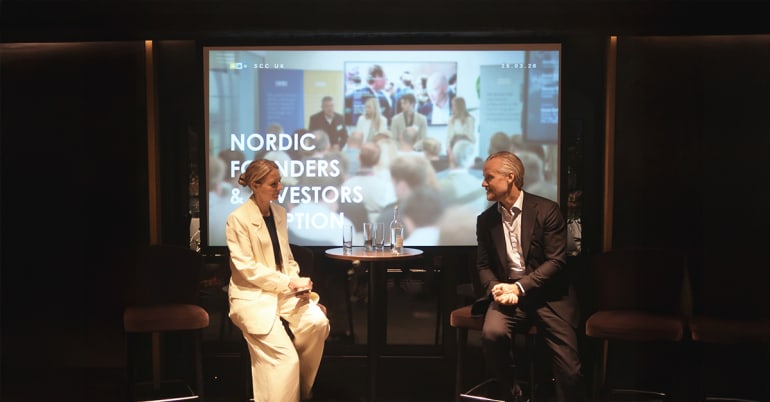
How has Sweden been so successful in nurturing tech champions? And in a strategic race to dominate artificial intelligence (AI) led by the US and China, what role will Europe play? These were some of the questions explored at a Lombard Odier Founders Reception event in London, which we co-hosted with the Swedish Chamber of Commerce for the UK.
Senior Private Banker Alina Aroni set the scene by discussing the cross-cutting role AI plays in geopolitics, technology and capital investment, while Ben Blume, Partner at venture capital firm Atomico highlighted the rapid growth in European tech.
“We’ve gone from an ecosystem worth under USD 1 trillion in 2016, to one approaching USD 4 trillion today, with almost 50% of that in private hands.”
Sign up for our newsletter
Today we are at a turning point, Ben argued. Europe has gone from 1% of global start-ups in the 1980s – as a share of venture-capital backed global enterprise value – to 17% currently, according to data from Dealroom. The continent continues to take market share from the US.
As a result, there are now more than 1,200 European companies with over USD 100 million in revenues or that are valued at more than USD 1 billion, according to Atomico’s latest ‘State of European Tech’ report.
With the founders and the right talent, the next decade could see a further step change, Ben argued.
We’ve gone from an ecosystem worth under USD 1 trillion in 2016, to one approaching USD 4 trillion today, with almost 50% of that in private hands
Still, there are challenges to overcome – not only closing the capital gap with the US, but empowering talent and making it easier to build across borders at scale.
“We also need to learn to champion risk, and that requires a culture shift,”
Building founder networks and bringing different parts of the innovation landscape is key here, noted Lombard Odier’s UK CEO Mark Goddard. He highlighted the importance of knowledge-sharing across Europe, and cross-border connectivity.
Atomico’s research found that in 2025, 27,000 European founders started companies, roughly the same number as in the US. A European founder has a 1.9% chance of reaching a billion-dollar company valuation; in the US the likelihood is a comparable 2.1%.
But getting the same access to capital is dramatically harder in Europe. Statistically, a European founder has less than half the chance of raising more than EUR 50 million of capital in a funding round than a US counterpart.
Statistically, a European founder has less than half the chance of raising more than EUR 50 million of capital in a funding round than a US counterpart
Nevertheless, Ben pointed to some encouraging recent signs, including the EU-INC initiative to register a company that can operate across European borders quickly, and an EU Visa Strategy. Furthermore, a Franco-German initiative to improve financing for innovative ventures recently published some interesting proposals in the Kukies Noyer report.
And while many European founders still look to the US to scale up, many are now returning to Europe to reinvest and support the entrepreneurial community. Back in 2006, Skype entrepreneur Niklas Zennström launched Atomico to build a robust European tech ecosystem. Now that ecosystem is increasingly mature, bringing more funding and founders with hands-on experience to start-up companies – Plural, a new EUR 400-million fund launched by European tech founders in 2024, is one example.
[Sweden is] a small country. So, as a founder, you know you have to go global on day one. That mindset is an advantage
The Nordic success model
The Nordic ecosystem is a large part of Europe’s success story to date. A panel event moderated by tech investor, advisor and board member of the Swedish Chamber of Commerce, Fredrik Nylander, explored some of the reasons behind Sweden’s success.
Successful businesses launched in the early 2000s such as Skype and Spotify have encouraged a new generation of entrepreneurs and shifted the culture as well as bringing in more funding. The reception also explored the role of Sweden’s welfare state in giving entrepreneurs a social safety net if their new business ventures fail.
Today, Swedish tech firms such as Klarna, Lovable and Legora compete on the global stage. Despite a population of just over 10 million, Sweden produces more billion-dollar tech companies per capita than any other major European country.
“We’re a small country. So, as a founder, you know you have to go global on day one – That mindset is an advantage,” noted Fredrik.
According to Atomico research, 39% of European tech investment is now in AI and digital ecosystems
Building AI in Europe
According to Atomico research, 39% of European tech investment is now in AI and digital ecosystems. Here, Europe can leverage its expertise across different “centres of excellence”, from London to Stockholm, Berlin, Paris, Amsterdam, and Helsinki.
Yet confidence is still lacking. In Atomico’s 2025 report, the company asked tech leaders: ‘Can Europe define its technological future on its own terms in an era of AI?’ Just 35% responded “yes.”
“That outcome is not determined by entrepreneurs alone,” Ben said. “It depends on the decisions made by the people who allocate capital, take risks and back founders.”
While the US will likely continue to dominate in the creation and training of large language models (LLMs) which require huge investment, Europe has an opportunity to expand in tooling and infrastructure, as well as software and applications.
Costs to start and build a business have fallen, noted Fredrik, and the community is also benefitting from the support of unicorns and bigger corporates.
“The ecosystem is maturing, and success breeds success,” added Daniel Matson, Global Head of Private Assets at Lombard Odier.
Over the next decade, European tech firms will need to raise capital at a scale they have never manage to mobilise before now. Their success here will be key as the world is reshaped by AI and its productivity promise.
important information
This is a marketing communication issued by Bank Lombard Odier & Co Ltd (hereinafter “Lombard Odier”).
It is not intended for distribution, publication, or use in any jurisdiction where such distribution, publication, or use would be unlawful, nor is it aimed at any person or entity to whom it would be unlawful to address such a marketing communication.




share.