When you visit our website, information may be stored or recovered on your device, mainly in the form of cookies. We use essential cookies to ensure the website works as it should, and statistical and marketing cookies for audience measurement and content customisation purposes. We rely on Google for statistical and marketing cookies in order to measure website performance and display relevant advertising. For more information on this, please also refer to the Google policy on Business Data Responsibility.
From the Cookie Management Centre, you can set your preferences with respect to the use of cookies: accept or reject certain categories, accept all, or reject all. For detailed information on all cookies used across these three categories, please refer to our Cookie Policy.
Please note that blocking certain cookies may affect your experience and the services offered.
Essential cookies Always active
Essential cookies help the website to work as it should by enabling necessary functionalities, such as navigating between pages and accessing secure areas. These cannot be disabled in our systems.
Statistical cookies
Statistical cookies help us understand how visitors interact with our site by collecting and communicating browsing information. They make it possible to identify the most and least visited pages and to improve the overall performance of the site.
Marketing cookies
Marketing cookies are used to display relevant advertising and measure the performance of campaigns. If you choose not to allow these cookies, you will continue to see ads, but they will be less relevant to your interests.
Choose the purposes for which we may use Google products to collect and use your data:
User storage: to technically permit advertising functionality.
User data for advertising: to optimise our advertising campaigns.
Ad customisation: to tailor advertising to your interests.
Despite political noise and diverging rate cycles, the global backdrop remains resilient enough to favour staying invested over attempting to time markets
Emerging markets and selected credit opportunities are regaining appeal, reinforcing the case for genuine diversification across regions and asset classes
In developed markets, a defensive tilt towards companies with strong cash flows and sustainable dividends offers stability in a concentrated, fully valued environment
With currencies, gold and AI all reshaping return drivers, disciplined asset allocation and risk management will be critical in turning volatility into opportunity.
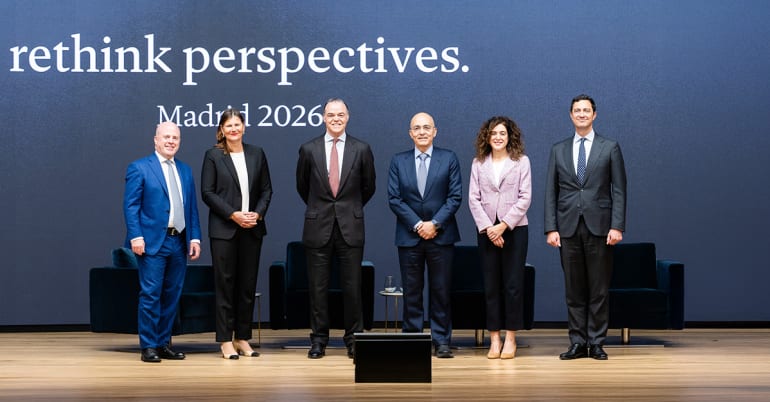
How will the global economy and markets perform in 2026? That was the key question as Lombard Odier brought together clients and expert speakers at its signature Rethink Perspectives event held recently in Madrid.
Host Iván Basa Segimont, Managing Director of Lombard Odier in Spain, opened the day’s event by highlighting an investment paradox – despite high volatility, conflicting political narratives, and asynchronous central bank trajectories, growth remains solid.
For those attending – both in-person and on-line from Latin America and Switzerland – he explained that the purpose of the event was not to “predict” 2026, but to select reference points – where earnings growth is to be found, which assets offer potential, which stabilising factors are most suited to the current environment, and how to stay invested in a world of volatility and uncertainty.
Emerging markets are offering better earnings per share growth than developed markets
Sign up for our newsletter
Opportunities and diversification
Nannette Hechler-Fayd’herbe, Head of Investment Strategy, Sustainability and Research, CIO EMEA, expanded on this point. Staying invested, she noted, is essential: “If we are not in the markets, very quickly we begin to miss out on major opportunities.”
Where, then, are these opportunities to be found? Striking a deliberately controversial note, she continued, “Right now, emerging markets are offering better earnings per share growth than developed markets,” emphasising that, although risks remain, the combination of earnings, valuations, and diversification potential is making EMs attractive once again.
Diversification quickly became a key theme of the day. “We find opportunities not just in equities, but in bonds too,” she said. In a year when returns may be bumpy, “Multiplying sources of return is a factor in building resilience.” This focus on resilient income aims to stabilise portfolio performance, allowing reallocation towards performance drivers when entry points become more attractive, she explained.
China: caught between technological ambition and political discipline
When it comes to China, Nannette Hechler-Fayd’herbe set out the key requirement for investors. Very simply, she said, it is “understanding the priorities of the Chinese government.”
In the technology and artificial intelligence (AI) sector, she noted, “Chinese technology offers better prices in IT, communication services, and technology platforms. Everyone is going to remember the moment DeepSeek put out an AI model capable of highly competitive solutions compared to the more familiar models designed in the USA.”
Technological competition between the world’s great powers, she noted, can redistribute value beyond just the US tech leaders. For investors, this makes it all the more important to separate out the AI theme from the constraints that apply to each individual market – regulation, governance, and industrial priorities.
Technological competition between the world’s great powers can redistribute value beyond just the US tech leaders
Developed markets: selective and defensive
In developed markets, which are more expensive and concentrated, Nanette Hechler-Fayd’herbe explained why she prefers a “more defensive” stance, favouring companies that provide stability. “Investing in stocks offering high dividends is a factor in stability,” she explained, noting her preference for “a high dividend being paid,” instead of merely favouring firms with a high reported yield.
An important nuance to this, she explained, is that investors should look beyond the promise of static returns, to focus on cash flow and governance discipline. There is also a resurgence of interest in small- and mid-caps, she noted, where earnings momentum appears to be improving. When it comes to portfolio resilience this is key, because as earnings growth broadens beyond mega caps, resilience improves naturally, with performance becoming less reliant on a narrow group of stocks.
Interest rates and currencies – the return of differentiation
Rethink Perspectives was held shortly after the US Federal Reserve had maintained the Fed funds range at 3.5% to 3.75%, and reaffirmed its data-driven approach. At the same time, US inflation was still at 2.7% over the twelve months to December 2025 (or 2.6% excluding food and energy).
Against this backdrop, Nannette Hechler-Fayd’herbe attributed dollar weakness seen at the start of 2026 to “cyclical” forces relating to monetary cycles. She challenged the idea of the “end” of the dollar, instead highlighting opportunities for currency diversification, especially into the yen, which she called “one of the most undervalued currencies” in a country gradually emerging from a quasi-deflationary regime.
Currency is once again becoming a lever for diversification as well as a source of volatility to be navigated. In this context, hedging, careful selection of time horizons, and consistency with portfolio objectives are crucial
For investors, she explained, currency is once again becoming a lever for diversification as well as a source of volatility to be navigated. In this context, hedging, careful selection of time horizons, and consistency with portfolio objectives are crucial.
Inflation and productivity
Joining the Rethink Perspectives panel, Jorge Nuño, Senior Portfolio Manager, turned to the complex question of inflation. “Talking about inflation is always very complicated, because it’s so hard to forecast,” he said, noting that numerous factors could all support disinflation in today’s environment, including basis effects, a slowdown on the labour market, higher productivity, and the impact of housing.
Silvia García-Castaño, Head of Investments (Madrid), echoed this point. “We are in an environment where very few jobs are being created, but no one is being fired,” she explained. This supports consumption – which “makes up 70% of US GDP” – but it doesn't automatically feed in to a wage-price spiral.
Delegates at the conference heard that productivity can “buy time” when it comes to inflation concerns, with US “productivity currently rising at 4.9% per year,” a figure in line with recent official publications. However, Silvia García-Castaño noted, the labour market and state of the services sector are the key pivot points for assessing the inflation trajectory.
Fed independence: a core risk
Senior Portfolio Manager, Claudio Ortea, commented on the forthcoming change in Fed leadership. “As far as markets are concerned, the perception that the Fed is politically controlled represents a significant risk,” he said. Noting that the Fed operates under a dual mandate – inflation and employment – he explained that the body is currently in “wait and see” mode.
Further, he said, in periods of political volatility, perceived independence underpins currency credibility, influences the term premium, and ultimately shapes valuations. Even in the absence of a specific event, uncertainty alone can generate a risk premium, he warned.
related content.
In the newsour Managing Partners
In the newsour Managing Partnersentrepreneursspain
Technology and AI: expensive but supported by capital flows
Recent months have seen growing concerns that the AI sector is marked by significant overpricing, and may be entering ‘bubble’ territory.
Jorge Nuño, Senior Portfolio Manager, tackled the question head on. “We are investing in technology and AI, which are very expensive. So, is this a bubble?” he asked, noting that bubbles are defined by “an irrational increase in prices” that often ends in “corrections of the order of 50%.”
Lombard Odier’s Madrid team is keeping its cool, he explained, adding that AI investment remains buoyant and is being financed by the cash flow of hyperscalers, rapid adoption, and the market’s ability to absorb the financing costs.
Gold: volatile but strategically useful
Responding to an audience question about the role of gold in portfolios, Nannette Hechler-Fayd’herbe acknowledged that prices had moved more quickly than expected – “We hit our twelve-month target in three weeks,” she said.
Despite this, gold remains an important addition to portfolios. “Any fall in the gold price would be an opportunity” for those who do not currently hold it, she said, emphasising that price rises have been driven by structural demand. “Over the last few years, it has been central banks that have been the main buyers of gold,” she said. In this context, gold’s role extends beyond a tactical hedge; it functions as a reserve asset that reinforces confidence within a diversified allocation.
Gold’s role extends beyond a tactical hedge; it functions as a reserve asset that reinforces confidence within a diversified allocation
Protecting portfolios – staying invested
With market volatility a central concern for many investors, Silvia García-Castaño gave a warning about attempting to ‘time’ investments. “Markets fall, then recover,” she said, and waiting for the “perfect moment” often means missing the rebound. Instead, investors should “spread the risk in portfolios by combining diversifying elements – quality and defensive sectors – with stabilising elements – at times this may be the dollar, at other times, gold.” Eligible investors should also consider “structured products and certain other currencies like the Swiss franc.” In this way, investors accept that a portfolio will fall when shocks occur, but will also recover as speedily as possible.
Nannette Hechler-Fayd’herbe agreed, highlighting the importance of staying invested. Though investors should keep an eye on stress points in the global economy, recession does not appear imminent, she said, concluding, “We are seeing weakness in the US labour market, but not to an extent that concerns us.”
As Rethink Perspectives drew to a close, a central theme emerged: 2026 will be a year for portfolios that are diversified and resilient, able to cope with shocks without abandoning the long-term growth engines. For investors this means taking a disciplined and selective approach, and transforming volatility into opportunities for adjustment rather than emotional decisions.
At Lombard Odier, we are determined to help clients navigate today’s volatile environment by taking a step back from the uncertainty and calmly rethinking the evidence, so that we can build customised, resilient, diverse portfolios aligned with each client’s unique long-term objectives.
important information
This is a marketing communication issued by Bank Lombard Odier & Co Ltd (hereinafter “Lombard Odier”).
It is not intended for distribution, publication, or use in any jurisdiction where such distribution, publication, or use would be unlawful, nor is it aimed at any person or entity to whom it would be unlawful to address such a marketing communication.




share.