When you visit our website, information may be stored or recovered on your device, mainly in the form of cookies. We use essential cookies to ensure the website works as it should, and statistical and marketing cookies for audience measurement and content customisation purposes. We rely on Google for statistical and marketing cookies in order to measure website performance and display relevant advertising. For more information on this, please also refer to the Google policy on Business Data Responsibility.
From the Cookie Management Centre, you can set your preferences with respect to the use of cookies: accept or reject certain categories, accept all, or reject all. For detailed information on all cookies used across these three categories, please refer to our Cookie Policy.
Please note that blocking certain cookies may affect your experience and the services offered.
Essential cookies Always active
Essential cookies help the website to work as it should by enabling necessary functionalities, such as navigating between pages and accessing secure areas. These cannot be disabled in our systems.
Statistical cookies
Statistical cookies help us understand how visitors interact with our site by collecting and communicating browsing information. They make it possible to identify the most and least visited pages and to improve the overall performance of the site.
Marketing cookies
Marketing cookies are used to display relevant advertising and measure the performance of campaigns. If you choose not to allow these cookies, you will continue to see ads, but they will be less relevant to your interests.
Choose the purposes for which we may use Google products to collect and use your data:
User storage: to technically permit advertising functionality.
User data for advertising: to optimise our advertising campaigns.
Ad customisation: to tailor advertising to your interests.
Fragmentation and the new World Order: investing in an era of power politics
key takeaways.
Technological rivalry has become the central engine of the global economic cycle, with US–China competition driving investment, innovation, and long-term industrial transformation
Strategic bottlenecks now shape geopolitical power, from rare earths to computing capacity, creating volatility that is structural rather than cyclical
Security is replacing efficiency as the guiding principle of economic policy, prompting massive investment in energy, infrastructure, and industrial capacity – a shift that creates both risks and long-term opportunities for investors
Europe faces a pivotal moment, as evolving fiscal norms and the weakening of the old geopolitical order push the continent to strengthen strategic autonomy, stimulate domestic demand, and rethink its role in a more contested world.
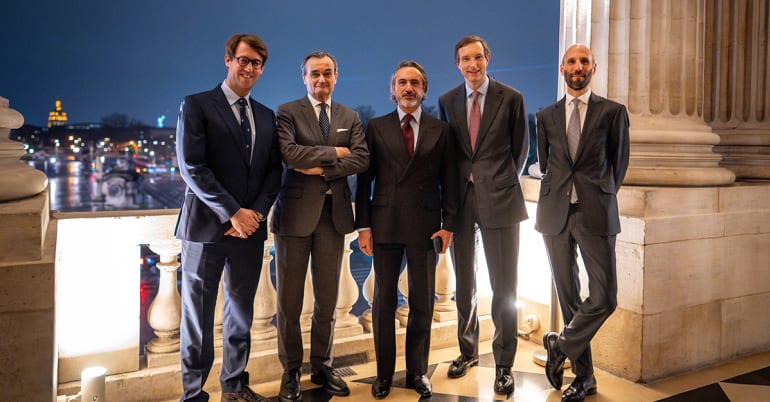
In early February 2026, Lombard Odier France hosted the latest edition of its flagship “Rethink Perspectives” events, a chance for investors to take a step back from the relentless news cycle, to reflect, and explore our latest strategic analysis. Opening the evening, Edouard de Saint Pierre, Chief Executive Officer of Lombard Odier France, explained, “The objective is straightforward – to take the time to gain perspective and share our outlook with you.”
In a world characterised by “profound transitions,” he underscored the importance of long-term thinking and reaffirmed Lombard Odier’s promise of continuity and stability. “Amid the turbulence and the noise, be assured that we stand alongside you with rigour, with conviction, and with a long-term vision,” he said.
Sign up for our newsletter
Frédéric Rochat, Managing Partner of the Lombard Odier Group, noted that today’s turbulence has created “a world of paradoxes – one that fosters innovation, optimism, and opportunity; yet remains highly volatile and uncertain.” In the face of these tensions, he told delegates that Lombard Odier’s mission remains as it has always been: to stay close to its clients, supporting them through uncertainty and helping them rethink the world around us.
As the evening unfolded, three key questions emerged. Is US–China technological rivalry a durable engine of growth, or a vector of fragmentation? What does “the end of Western dominance” mean for Europe and investment portfolios? And how can investors stay invested when the rules of the game – industrial, fiscal, and commercial – have fundamentally changed?
Samy Chaar, Partner, Chief Economist and CIO Switzerland at Lombard Odier, offered a clear analytical framework – technological competition as the structure for our current economic cycle. “The most visible dimension of this competition is between China and the United States, two powers determined to lead and dominate the field of artificial intelligence [AI],” he explained. Drawing a historical parallel with the Cold War, he noted that strategic rivalry fuels investment and, by extension, economic activity: “Investment in economics is like training for an athlete – one trains in order to win.”
Today, this competition is “multidimensional,” he added. It begins with innovation, where the United States retains leadership, particularly in semiconductors and computing capacity. It then extends to industrial adoption – the ability to transform breakthrough technologies into standardised, scalable solutions integrated into global value chains. In this domain, China enjoys a structural advantage through its mastery of large-scale industrialisation. Finally, there are spillover effects – each technological breakthrough accelerates investment momentum, particularly in AI, where the race hinges not only on performance but also on speed of diffusion.
The United States continues to dominate advanced computing capacity, while China controls many critical inputs – including the processing of nearly 90% of global rare earth supply – granting it substantial leverage across advanced technology value chains
Geoeconomic bottlenecks: rare earths, computing power, energy
The conference highlighted a defining feature of today’s global economy – political and economic power is increasingly concentrated in strategic bottlenecks. According to Samy Chaar, the United States continues to dominate advanced computing capacity, while China controls many critical inputs – including the processing of nearly 90% of global rare earth supply – granting it substantial leverage across advanced technology value chains.
This dynamic creates a constrained interdependence. “The Americans possess what China needs – computing power – but China equally holds what the Americans require – rare earths.” This symmetry is central to risk management, Samy Chaar explained. It sustains geopolitical tension, yet also reduces the probability of full decoupling between nations, as the economic cost of a “pure” separation would be prohibitive. For markets, this translates into recurring cycles of political announcements, targeted restrictions, and industrial adaptation – in other words, volatility that is structural rather than episodic.
In the background, a “genuine transformation” is taking place, with the logic of efficiency and interdependence giving way to the logic of security. “Securing value chains, securing energy supply, securing technology” – this has become the new triptych, Samy Chaar explained.
Sovereignty-driven expenditure – in energy, defence, digital infrastructure, and networks – can support economic activity, even if it entails higher short-term costs
This transition requires substantial investment in infrastructure, energy systems, and industrial capacity, elevating industrial policy, subsidies, and domestic market protection to a central role in achieving national security.
For long-term wealth investors, this shift is not only a source of risk, it may also underpin durable investment cycles. Sovereignty-driven expenditure – in energy, defence, digital infrastructure, and networks – can support economic activity, even if it entails higher short-term costs. The challenge lies in distinguishing emotional responses from clear investment signals – geopolitical fragmentation may weigh on margins and potential growth, but it also triggers capital expenditure, reshoring, and investments in domestic resilience, which have the potential to offer investable long-term themes.
Europe: fiscal reawakening and strategic autonomy
On Europe, delegates heard that the continent must strengthen its autonomy in a world increasingly shaped by economic sovereignty. Encouragingly, Samy Chaar noted early signs of political movement – “Germany is gradually beginning to wake up,” he said.
This reawakening is reflected in fiscal recalibration. Berlin has relaxed its debt brake – the structural deficit ceiling set at 0.35% of GDP – by exempting certain defence expenditures above 1% of GDP and deploying an EUR 100 billion special fund for the Bundeswehr (the armed forces of the German Republic). In parallel, it has established an investment fund that could reach up to EUR 500 billion for infrastructure development.
If Europe invests more decisively, it may strengthen domestic demand, accelerate its energy transition, and reduce strategic dependencies
Though technical in appearance, this development carries macroeconomic significance for Europe, signalling that security imperatives can shift long-standing fiscal taboos, even in countries traditionally committed to budgetary orthodoxy.
For investors, this raises the prospect of a re-pricing of European risk. If Europe invests more decisively, it may strengthen domestic demand, accelerate its energy transition, and reduce strategic dependencies. For this to happen, however, fiscal expansion must translate into increased productive capacity and must be coordinated across member states.
A deeply weakened transatlantic alliance: Gérard Araud’s geopolitical thesis
Joining Samy Chaar on stage, Gérard Araud, former French Ambassador to the United States, delivered a stark and forthright assessment – “Geopolitically, we are alone and can no longer rely on the Americans,” he said. He noted that awareness of this fact is uneven across the continent, with some countries – particularly in Northern and Eastern Europe – remaining “viscerally attached to the American alliance.”
Nevertheless, he added, the shift away from the old order is structural, and is linked to the relative erosion of Western power. Though precise figures vary depending on methodology, the trajectory is well documented – the G7’s share of global GDP has declined over recent decades, while emerging economies have gained weight.
The strategic implication is clear – “The West no longer dominates.” Europe must therefore “relearn the grammar of international relations” and accept that it operates in a more force-based environment, where security once again becomes a central language and where Europe must reassert its visibility.
Markets: remaining invested and structuring resilience
In this context, Samy Chaar articulated a pragmatic investment stance. “We remain invested,” he said, because “the risks remain contained for now,” and the global economy continues to expand. The cornerstone for investors is disciplined portfolio construction – regional diversification, selective opportunity capture, and the maintenance of stabilising assets.
The cornerstone for investors is disciplined portfolio construction – regional diversification, selective opportunity capture, and the maintenance of stabilising assets
Two examples were highlighted – gold, notwithstanding its volatility, and the Swiss franc, perceived as a safe-haven currency during periods of stress. The objective is not to remain permanently defensive, but to combine performance drivers with ‘shock absorbers’. In a world where shocks are often political in nature before they translate into financial shocks, such portfolio architecture becomes as critical as asset selection itself.
Investors should also consider public debt and, in particular, the purpose it serves, Samy Chaar explained. Rather than fixating on debt thresholds, “we must consider what the debt finances.” Debt that finances infrastructure development, new energy systems, and domestic resilience – in other words, productive or strategic assets – can be considered “useful” debt provided it safeguards growth potential and reduces vulnerabilities.
Public debt – and the uses to which it is put – shapes interest rate trajectories, term premia, and the capacity of sovereign nations to balance growth and fiscal discipline
For investors, this debate is far from theoretical. Public debt – and the uses to which it is put – shapes interest rate trajectories, term premia, and the capacity of sovereign nations to balance growth and fiscal discipline. In a more fragmented world, public investment needs are likely to remain elevated – the key question for investors becomes the credibility of fiscal trajectories rather than the immediate level of debt or deficit.
European demand, trade contradictions, and changing rules
As the Paris event came to a close, the audience was invited to join the speakers with further thoughts or questions. Asked about Europe’s future in the face of US reindustrialisation and Chinese self-sufficiency, Samy Chaar advocated a demand-led rebalancing. “Why couldn’t Europe generate some demand?” he asked, noting that “we have a vast potential market of 500 million people.”
The vision is clear, he said – “A Europe that invests, creates jobs and stimulates domestic demand to reinforce its autonomy and sovereignty,” recalibrating partnerships and reducing reliance on US demand.
On the apparent contradiction between protectionism and ongoing trade flows, Samy Chaar pointed out that US–China trade remains substantial, with US goods imports from China reaching USD 438.7 billion in 2024, according to official US statistics.
Finally, addressing the temptation to downplay current disruptions, Gérard Araud and Samy Chaar reiterated their belief that we are not witnessing mere short-term noise, but a fundamental redrawing of the global order. “Trump is the symptom – he is not the disease,” Gérard Araud said, while Samy Chaar concluded, “The rules of the game have changed,” particularly with respect to industrial policy, subsidies, and protectionism.
For investors, the message is twofold – the world is becoming more volatile, yet it is also generating durable investment cycles. The challenge is to remain exposed to growth potential while structurally embedding resilience within portfolios
Turning uncertainty into investment strategy
The Paris edition of “Rethink Perspectives” offered a valuable bridge between geopolitical analysis and portfolio allocation, with an exploration of technological rivalries, strategic bottlenecks, the return of security imperatives, European fiscal rearmament, and the persistence of commercial interdependence in spite of political fragmentation.
For investors, the message is twofold – the world is becoming more volatile, yet it is also generating durable investment cycles. The challenge is to remain exposed to growth potential while structurally embedding resilience within portfolios.
In periods of structural disruption – such as we are experiencing today – Lombard Odier offers a simple solution built on more than two centuries of experience: to step back from the noise, continuously rethink the world around us, and support clients over the long term with consistency, stability, and an independent vision.
This is a marketing communication issued by Bank Lombard Odier & Co Ltd (hereinafter “Lombard Odier”).
It is not intended for distribution, publication, or use in any jurisdiction where such distribution, publication, or use would be unlawful, nor is it aimed at any person or entity to whom it would be unlawful to address such a marketing communication.





share.