Article published in Forbes Luxembourg, 14 April 2026
From Geneva to Luxembourg, Lombard Odier has turned to art as a way of engaging with social change. Its collection gives form to ideas such as sustainability, innovation and democracy, inviting audiences to reflect beyond the codes of finance.
Bringing visual language into private banking
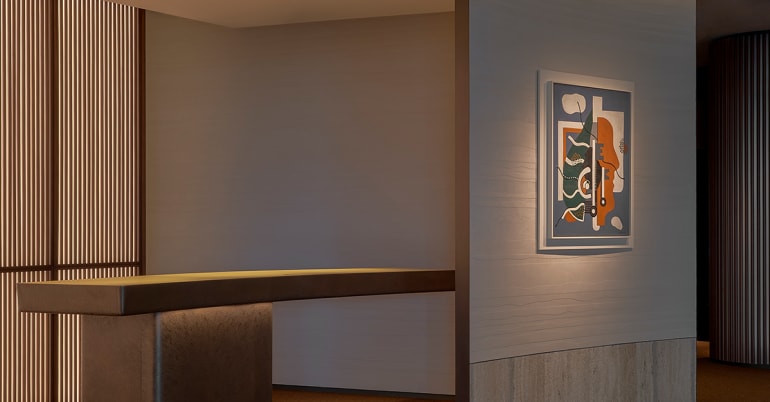
Private banks rarely communicate through culture. Their messages are usually framed in numbers, performance indicators and forecasts. At Lombard Odier, which is expanding its current Luxembourg team of roughly 300 people, visual language has entered the conversation. Contemporary artworks are integrated into everyday professional environments, accompanying staff and visitors through corridors, offices, and meeting rooms.
The result is not a gallery transplanted into a corporate setting, but a working sector shaped by images and forms. Art becomes part of the daily rhythm of decision-making. It softens the rigidity of financial architecture and introduces a slower tempo, one that allows space for interpretation. In doing so, Lombard Odier extends its long-term philosophy beyond investment horizons into cultural presence.
Read also: Fondation Philanthropia named "Grand Mécène de la Culture française"
Culture as long-term commitment
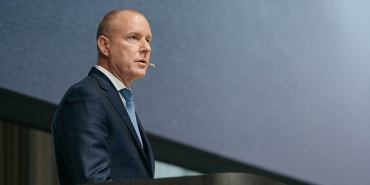
“Through its foundations and its philanthropic advisory services, the Lombard Odier Group supports cultural and artistic actors with a long-term vision focused on continuity and resilience, backing specific projects that enable them to continue enriching our collective life. As part of a bespoke initiative created to honour a client’s wishes, Foundation Philanthropia was awarded the distinction of “Grand Mécène de la Culture française” for its support of key restoration works at Versailles, including the Royal Chapel. Supporting culture means contributing to an essential ecosystem from which everyone can benefit”., said Maximilian Martin, Group Head of Philanthropy at Lombard Odier.
Supporting culture means contributing to an essential ecosystem from which everyone can benefit
Visualising sustainability as a systemic transition
The Group’s sustainability strategy positions environmental transition as a deep economic shift rather than a peripheral concern. Within the art collection, this systemic vision is echoed visually. The works do not offer slogans about climate or nature. Instead, they evoke fragmentation, circulation and imbalance, visual cues that mirror the complexity of ecological transformation. Some pieces hint at altered landscapes, while others trace hidden infrastructures or material flows. Together, they encourage viewers to reflect on the interdependence of systems, natural, social, and economic. This indirect approach avoids didacticism. Sustainability is not presented as a fixed narrative, but as an open question that unfolds over time, much like the transition itself.
Innovation under scrutiny
Technological progress is another theme running through the collection. The artworks that engage with data, urban life and digital environments resist easy celebrations of innovation. They register acceleration, saturation, and the pressures of constant change.
Placed within a financial institution, these works create a productive tension. They ask how innovation reshapes not only markets, but social relations, work, and public spaces. In this setting, innovation is no longer a purely strategic objective; it becomes a subject of reflection. The collection suggests that progress must be examined as carefully as it is pursued.
Read also: Lombard Odier partners with Belgium’s Van Buuren Museum
Art, democracy, and European identity
By foregrounding European creators, Lombard Odier situates its cultural engagement within the political and social realities of the continent. Several works engage with themes of displacement, memory, borders and collective identity. These are not abstract concerns. They resonate with contemporary debates about democratic cohesion and participation.
The artworks carry civic questions into spaces shaped by private capital
Inviting these perspectives into a private banking environment subtly alters the terms of dialogue. The artworks carry civic questions into spaces shaped by private capital. In doing so, they underline the idea that economic systems are inseparable from the social frameworks in which they operate.
Philanthropy as a framework for stewardship
The cultural dimension of Lombard Odier’s engagement aligns with its philanthropic structures. The Fondation Lombard Odier anchors the Group’s and Managing Partners’ long-term commitments across humanitarian, social and environmental causes. Alongside it, the Philanthropia Foundation enables clients to design and implement their own philanthropic initiatives, from cultural projects to education and social impact programmes.
Art is not used to project certainty, but to host complexity
This architecture reinforces a model of stewardship that extends beyond wealth preservation. Art, philanthropy, and finance converge around a shared notion of responsibility: that private resources can, and should, contribute to public value.
Read also: Lombard Odier Luxembourg to move to new headquarters in 2027
Looking ahead: culture within Luxembourg’s financial ecosystem
In 2027, Lombard Odier will move to new headquarters in Luxembourg’s Cloche d’Or district, signalling the Group’s deepening engagement with one of Europe’s key financial centres. Already active through Lombard Odier (Europe) S.A., the firm brings together private banking, asset management and technology teams in the Grand Duchy.
As Luxembourg continues to position itself at the intersection of finance, sustainability, and culture, Lombard Odier’s arrival adds a new layer to the local ecosystem. While the cultural dimension of this presence is still taking shape, it opens possibilities for new dialogues between financial institutions and the public sphere.
Hosting complexity in an age of certainty
What defines Lombard Odier’s approach is less the scale of its collection than the intention behind it. Art is not used to project certainty, but to host complexity. It introduces nuance into environments oriented toward efficiency and control.
At a moment when institutions face growing scrutiny, this openness carries symbolic weight. It suggests that finance can engage with doubt, contradiction and long-term uncertainty without losing its sense of purpose.
share.