When you visit our website, information may be stored or recovered on your device, mainly in the form of cookies. We use essential cookies to ensure the website works as it should, and statistical and marketing cookies for audience measurement and content customisation purposes. We rely on Google for statistical and marketing cookies in order to measure website performance and display relevant advertising. For more information on this, please also refer to the Google policy on Business Data Responsibility.
From the Cookie Management Centre, you can set your preferences with respect to the use of cookies: accept or reject certain categories, accept all, or reject all. For detailed information on all cookies used across these three categories, please refer to our Cookie Policy.
Please note that blocking certain cookies may affect your experience and the services offered.
Essential cookies Always active
Essential cookies help the website to work as it should by enabling necessary functionalities, such as navigating between pages and accessing secure areas. These cannot be disabled in our systems.
Statistical cookies
Statistical cookies help us understand how visitors interact with our site by collecting and communicating browsing information. They make it possible to identify the most and least visited pages and to improve the overall performance of the site.
Marketing cookies
Marketing cookies are used to display relevant advertising and measure the performance of campaigns. If you choose not to allow these cookies, you will continue to see ads, but they will be less relevant to your interests.
Choose the purposes for which we may use Google products to collect and use your data:
User storage: to technically permit advertising functionality.
User data for advertising: to optimise our advertising campaigns.
Ad customisation: to tailor advertising to your interests.
US tariffs will raise import duties to levels not seen in decades, raising inflation and recession risks for the US and global economies
While the US President’s announcements did not mention room for negotiation, we expect efforts to mitigate effective rates
The Federal Reserve has additional economic risks to manage, and its interest rate could fall as low as 2% if the US falls into recession
We expect a period of risk-aversion in financial markets. US Treasury Inflation Protected Securities (TIPS), the Swiss franc, Japanese yen and gold should offer opportunities.
President Donald Trump announced trade tariffs higher than markets anticipated. New import duties bring the US’s effective tariff rate to levels not seen in decades, and raise the risk of a US recession. Risk assets, including equities, are likely to see further declines while select fixed income, the Swiss franc, Japanese yen, and gold should outperform.
Sign up for our newsletter
President Trump’s announcement on 2 April will take effective US tariff rates from 2% in 2024 to around 20%, according to our preliminary estimate. The consequences will surely lead to lower US and global growth, and rising inflation as goods trade suffers a supply-side shock. We expect the US economy will face significant damage, with the odds of a recession rising. Eventually, these negative effects on the US economy may be partly mitigated by the planned tax cuts that the tariffs are supposed to pay for, and further measures such as deregulation which may be announced in the coming weeks.
The tariff announcement added some detail but offered little of the certainty that markets sought. Delivered as a ‘national emergency’, how long the tariffs stay in place depends only on President Trump deciding that “the US trade deficit and underlying nonreciprocal treatment is satisfied, resolved, or mitigated,” said the White House statement.
How long the tariffs stay in place depends only on President Trump
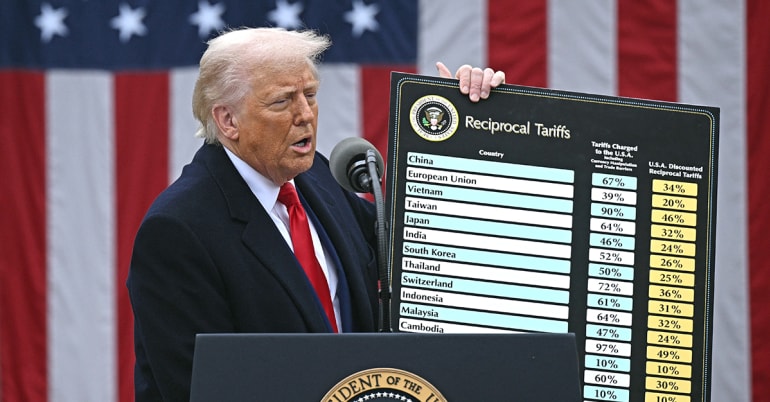
The US will impose at least a 10% tariff on all US trading partners starting 5 April, and add varying “reciprocal” tariffs on those judged to have high non-tariff barriers or manipulate their currency.
In this context, “tariffs charged to the US” are simple ratios of the US’s bilateral trade deficit in goods as a share of total bilateral goods imports. The US’s reciprocal tariffs are half of these estimates.
China is especially targeted. Tariffs on China should rise to 54%, consisting of a 20% tariff imposed since February, plus 34% of “reciprocal” tariffs announced 2 April. It is not clear yet whether these tariffs will be in addition to Section 301 tariffs imposed under the first Trump administration. If combined, the resulting tariffs on Chinese goods would slightly exceed 60%, roughly the level pledged by the Trump administration during the presidential campaign. Canada and Mexico have been spared additional restrictions, for now, as all goods compliant with a North American (USMCA) free trade accord will avoid tariffs. Non-USMCA compliant goods still face a 25% tariff rate (with an exception for energy and potash which are subject to a 10% rate).
Switzerland and talks
Switzerland’s small and open economy, which will attract a 31% tariff, looks challenged by the duties. We do not yet know how pharmaceutical exports, which account for 30% of Switzerland’s shipments to the US, will be treated. Pharmaceuticals were explicitly excluded by reciprocal tariffs, alongside copper, semiconductors and lumber, as well as steel, aluminium and auto parts that are already subject to tariffs.
Switzerland’s small and open economy… looks to be challenged by the duties
Both China and the European Union have threatened to retaliate with their own measures. US Treasury Secretary Scott Bessent urged governments to “wait and see” rather than retaliate. President Trump did not raise the possibility of negotiation in his remarks. We believe that talks in the coming months can eventually lower effective tariff rates to around 15%, taking US inflation to around 3.5% in 2025, along with higher recession risk.
We also note that this announcement should mark a peak in tariff-related uncertainty, and that some sudden exemptions are possible, as we have seen for Mexico and Canada in recent months, that would lower effective tariff rates.
The immediate threat to the US economy is inflationary, and that is triggering fears about growth and recession. With economic risk rising, the Federal Reserve will need to manage risks to both the labour market and inflation. In the case of a recession, the Fed funds rate could go as low as 2%.
In the case of a recession, the Fed funds rate could go as low as 2%
We continue to watch real wage trends, business sentiment surveys, the US dollar, and corporate inventory-to-order ratios, as US importers have anticipated tariffs by placing early orders.
Investment implications
The macroeconomic environment points to a period of risk aversion in financial markets. The length of this period will largely depend on how long the new tariffs are in place, and whether their impact can be offset by more positive news on US deregulation and tax cuts. Given higher US and global recession risks, and higher inflation, we anticipate volatility in equity markets. Defensive sectors and styles, such as utilities, stand to outperform. In fixed income, we now see 10-year US Treasury bonds falling to 3.5%-to-4% over the next 3 months, as the Fed takes its policy rate lower. With investors averse to risk, we see US Treasury Inflation Protected Securities (TIPS) outperforming.
We still see potential for Indian stocks to outperform within emerging markets. Emerging market government bonds should outperform corporate bonds. In currency markets, we anticipate a stable-to-stronger US dollar versus the euro and sterling. Haven currencies such as the Swiss franc and Japanese yen should strengthen further. Asian currencies, and the Chinese yuan in particular, should all experience further weakness. Gold retains its useful role as a portfolio diversifier. However, some near-term consolidation is possible if US gold imports slow due to a tariff exemption. Our Investment Committee is assessing the implications.
This is a marketing communication issued by Bank Lombard Odier & Co Ltd (hereinafter “Lombard Odier”).
It is not intended for distribution, publication, or use in any jurisdiction where such distribution, publication, or use would be unlawful, nor is it aimed at any person or entity to whom it would be unlawful to address such a marketing communication.






share.