When you visit our website, information may be stored or recovered on your device, mainly in the form of cookies. We use essential cookies to ensure the website works as it should, and statistical and marketing cookies for audience measurement and content customisation purposes. We rely on Google for statistical and marketing cookies in order to measure website performance and display relevant advertising. For more information on this, please also refer to the Google policy on Business Data Responsibility.
From the Cookie Management Centre, you can set your preferences with respect to the use of cookies: accept or reject certain categories, accept all, or reject all. For detailed information on all cookies used across these three categories, please refer to our Cookie Policy.
Please note that blocking certain cookies may affect your experience and the services offered.
Essential cookies Always active
Essential cookies help the website to work as it should by enabling necessary functionalities, such as navigating between pages and accessing secure areas. These cannot be disabled in our systems.
Statistical cookies
Statistical cookies help us understand how visitors interact with our site by collecting and communicating browsing information. They make it possible to identify the most and least visited pages and to improve the overall performance of the site.
Marketing cookies
Marketing cookies are used to display relevant advertising and measure the performance of campaigns. If you choose not to allow these cookies, you will continue to see ads, but they will be less relevant to your interests.
Choose the purposes for which we may use Google products to collect and use your data:
User storage: to technically permit advertising functionality.
User data for advertising: to optimise our advertising campaigns.
Ad customisation: to tailor advertising to your interests.
Today’s food systems are a major contributor to biodiversity loss and climate change – more than one third of all greenhouse gas emissions come from food production1, while agriculture alone is the identified threat to 24,000 out of the 28,000 species at risk of extinction2. But could a shift to regenerative agriculture turn our food systems from environmental villain to hero?
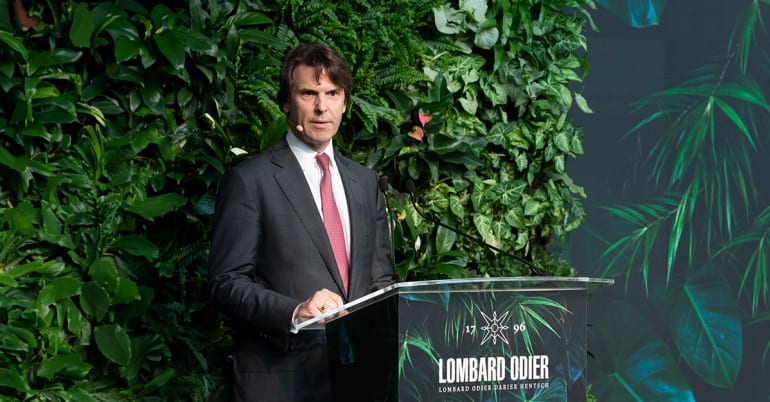
Speaking at the recent World Forum 2024, hosted by the Smith School of Enterprise and the Environment at the University of Oxford, Hubert Keller, Lombard Odier Senior Managing Partner, shared his conviction that today’s food systems could be transformed into a force for environmental and social good, while creating a new opportunity for retailers to build brand loyalty and for investors to unearth new sources of value.
Taking coffee as an example, he highlighted that while today’s conventional, monoculture production methods are responsible for 200 million tonnes of CO₂ emissions annually3 – 20 tonnes for every tonne of coffee consumed – a shift to regenerative production could turn this paradigm on its head, creating net carbon sequestration of 100 million tonnes each year4. In effect, consumers could be storing carbon with every sip. However, he warned, to implement this shift, we must first reimagine today’s highly fragmented and socially unequal coffee value chain.
Sharing the stage with leading thinkers from the food and climate sectors – including Agnes Kalibata, President of the Alliance for a Green Revolution in Africa, and Henry Dimbleby, author of the UK Food Strategy – Hubert Keller outlined how the coffee sector could serve as an example for the rest of today’s food system to follow.
For tea brands, at least 20% of all supply chain emissions come from fertilisers, with most countries applying excessive fertiliser to their crops
Defining the problem – and the solution
Opening the event, Henry Dimbleby outlined how today’s food system has come into being. In the 1950s, he explained, governments around the world targeted increased crop yields to ensure national food security and feed a growing population. Farming mechanisation, monoculture crop practices and the increased use of pesticides and fertilisers created an industrial farming system, allowing us to produce more food than ever before.
Near miraculously, this now means we are producing enough to feed 8 billion people, despite almost one third of all food going to waste. However, he noted, this industrialisation has come at a cost. By targeting production, government subsidies have, historically, encouraged the widespread use of farming chemicals with little thought for the health of soils and natural ecosystems. While bumper crops have followed, so have poor quality food, ill health, biodiversity loss and carbon emissions.
Key among these negative impacts is our overuse of fertiliser, Dr. Helen Saini, Head of R&D Sustainable Agriculture at Lipton Teas, explained. For tea brands, at least 20% of all supply chain emissions come from fertilisers, with most countries applying excessive fertiliser to their crops. However, in a system made up of millions of smallholder farmers, many of whom lack the knowledge or financial means to invest in regenerative practices, change is hard to achieve.
Agnes Kalibata agreed, pointing to the on-the-ground perspective of farmers in Africa, many of whom are already experiencing the impacts of climate change. However, she noted, where farmers are able to implement regenerative practices, they are seeing the benefits.
Sign up for our newsletter
In drier areas in Kenya, for instance, farmers are discovering that regenerative farming practices – where synthetic inputs such as pesticides are replaced with natural alternatives, and crops are grown in diverse ecosystems in place of monocultures – can generate 100% higher yields than conventional farming. To drive change across the board, governments must understand that food production, nutrition and the environment are inextricably linked, she said. And, above all, we must get more value to the farmers themselves.
Transitioning from monoculture to organic agroforestry for coffee has been proven to improve both environmental and economic outcomes
Re-imagining value chains
Hubert Keller picked up on this theme, highlighting the need to shift value upstream to the point of production.
“Most coffee today is grown in monoculture systems, leading to environmental harm. Transitioning from monoculture to organic agroforestry for coffee has been proven to improve both environmental and economic outcomes,” he said. However, “The economics of coffee production are challenging. It costs about USD 3.50 to produce a kilogram of green beans, which are sold at around USD 4 on fluctuating markets, leaving farmers with thin margins.”
There are significant inefficiencies in the coffee value chain, with 15 to 20 intermediaries involved, making it socially unfair
To enable investment in new, nature-positive ways of farming, we must upend this value chain, he explained, ensuring that greater value sits at the point of production, rather than being concentrated downstream.
“Coffee farming is a fragmented industry with around 12 million growers, 95% of whom live on less than USD 350 annually, well below the poverty line,” he said. “There are significant inefficiencies in the coffee value chain, with 15 to 20 intermediaries involved, making it socially unfair.”
However, he continued, by “[reducing] the number of intermediaries, this would connect coffee growers more directly with sellers, improving cash flow at the farm level and allowing for a more equitable distribution of margins.”
By cutting out the middlemen, he continued, farm-level returns can rise, “creating investment opportunities for private capital…[and making] a compelling case for private-sector involvement.”
As corporations come under regulatory and consumer pressure to reduce their emissions and environmental impact, regeneratively grown coffee will increasingly sell at a premium, offering greater value for farmers and private investment
In a global coffee market worth USD 450 billion, in which 3 billion cups of coffee are consumed daily, the opportunity for private investment is large – and growing. As corporations come under regulatory and consumer pressure to reduce their emissions and environmental impact, regeneratively grown coffee will increasingly sell at a premium, offering greater value for farmers and private investment.
For the major coffee brands, regenerative farming – in which food crops and commodities sequester more carbon then they emit – offer a way to cut their emissions via “carbon in-setting”. Unlike carbon offsets, Hubert Keller explained, in which external offsets are purchased to counterbalance emissions, “in-setting refers to carbon sequestration that occurs within a company’s value chain.” By integrating in-setting directly into consumer value chains, brands can create real, tangible emissions cuts, while building brand reputation and consumer loyalty.
Hubert Keller concluded by re-echoing Agnes Kalibata’s call for greater value to reach the farmers themselves. Where coffee is leading, he said, numerous other crops can follow, creating fresh appeal for investors and discerning consumers, while restoring damaged ecosystems, sequestering carbon and boosting incomes for farmers and their communities.
Watch the full session from the World Forum on Economies and the Environment with Henry Dimbleby, Co-founder of Leon & Bramble Partners, Dr Agnes Kalibata, President, AGRA, Dr Helen Saini, Head of R&D Sustainable Agriculture, Lipton Teas and Infusions and Hubert Keller, our Senior Managing Partner, here: Feeding the future: Food solutions for climate and biodiversity | World Forum 2024.
This is a marketing communication issued by Bank Lombard Odier & Co Ltd (hereinafter “Lombard Odier”).
It is not intended for distribution, publication, or use in any jurisdiction where such distribution, publication, or use would be unlawful, nor is it aimed at any person or entity to whom it would be unlawful to address such a marketing communication.




share.