When you visit our website, information may be stored or recovered on your device, mainly in the form of cookies. We use essential cookies to ensure the website works as it should, and statistical and marketing cookies for audience measurement and content customisation purposes. We rely on Google for statistical and marketing cookies in order to measure website performance and display relevant advertising. For more information on this, please also refer to the Google policy on Business Data Responsibility.
From the Cookie Management Centre, you can set your preferences with respect to the use of cookies: accept or reject certain categories, accept all, or reject all. For detailed information on all cookies used across these three categories, please refer to our Cookie Policy.
Please note that blocking certain cookies may affect your experience and the services offered.
Essential cookies Always active
Essential cookies help the website to work as it should by enabling necessary functionalities, such as navigating between pages and accessing secure areas. These cannot be disabled in our systems.
Statistical cookies
Statistical cookies help us understand how visitors interact with our site by collecting and communicating browsing information. They make it possible to identify the most and least visited pages and to improve the overall performance of the site.
Marketing cookies
Marketing cookies are used to display relevant advertising and measure the performance of campaigns. If you choose not to allow these cookies, you will continue to see ads, but they will be less relevant to your interests.
Choose the purposes for which we may use Google products to collect and use your data:
User storage: to technically permit advertising functionality.
User data for advertising: to optimise our advertising campaigns.
Ad customisation: to tailor advertising to your interests.
Security, sovereignty, and fragmentation: the new forces set to reshape the economy and portfolios in 2026
key takeaways.
The global economy is shifting from a linear path to a more fragmented landscape, where security, sovereignty, and trade tensions are reshaping the rules of the game
Despite the slowdown, three safety nets – a resilient private sector, fiscal support, and monetary easing – are keeping recession risks at bay
In this environment, staying invested, diversifying more broadly, and stabilising portfolios with high-quality assets remain essential choices
The return of power politics in a world without an arbiter is reshaping geopolitics, offering Europe a potential role with ‘intermediate powers’, provided it fully embraces this new reality.
The global order is changing before our eyes: a slowdown in the US economic cycle after years of outperformance, a tariff offensive by Washington, fragmentation of economic blocs, and a return of military and political power relationships. For investors, the landscape is becoming more complex: growth is leaving the motorway and taking to more windy mountain roads, visibility is decreasing, and the economic and geopolitical risks are more interwoven than before.
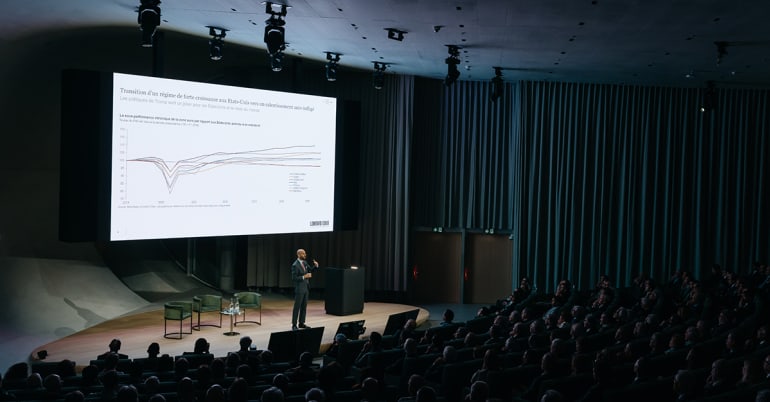
The latest edition of our signature event “Rethink Perspectives” – held recently at 1Roof, our new headquarters, for the first time – was dedicated to these fault lines. In our new auditorium – which was filled with over 500 people for the occasion, including clients and partners of the firm – Frédéric Rochat, Managing Partner of Lombard Odier, noted that investors today must navigate “a ridgeline” in a world where technological innovation and investment opportunities exist alongside a more volatile geopolitical, commercial, and monetary environment. He also underlined how “changing international power relationships, commercial tensions, and the rise of political uncertainties are redefining the investment landscape more than ever before.”
For attendees, the event highlighted numerous essential questions. How should we interpret today’s economic slowdown? What investment perspectives are emerging in the wake of an unprecedented tariff shock – and what are the consequences for portfolios? Can Europe afford its sovereignty in a world where multilateralism is giving way to the pursuit of independence and security? And finally, given the gradual withdrawal of the United States, what role can Europe play on the international geopolitical stage?
Sign up for our newsletter
To answer these questions and unpick the challenges facing investors today, Samy Chaar, Chief Economist and CIO Switzerland at Lombard Odier, and Gérard Araud, senior diplomat and former French ambassador to the United States, shared their insights.
Ever since the energy crisis of 2022, and the subsequent accumulation of political shocks, the priority has been on security: securing supply chains, energy, critical technologies, and infrastructure
A global economy on the ridgeline
Samy Chaar began with a clear diagnosis – the global economy, he explained, is facing two major disruptions. The first is economic, linked to the deterioration in business conditions fuelled by political uncertainty in the US and an unprecedented wave of tariffs.
The second, more profound, is structural: the shift from multilateralism to an environment where priority is given to independence and economic security, strategic autonomy, and robust value chains. “Ever since the energy crisis of 2022 and the subsequent accumulation of political shocks, the priority has been on security: securing supply chains, energy, critical technologies, and infrastructure,” he said.
This shift comes at a massive budgetary cost, but it also redefines the boundary between “good” and “bad” debt. The former funds the energy transition, defence, physical and digital infrastructure, and strategic branches of industry. The latter fuels operating expenses or poorly calibrated tax cuts, which do not enhance productivity or resilience.
For Samy Chaar, Europe has the means to finance this “good debt.” Looking at the combination of public finances and private savings (households, banks, businesses), he noted, “at present, many countries on the continent have current accounts that are in balance or show a surplus,” such as Spain or Portugal. Similarly, despite a persistent public deficit, France has significant stock of private savings and a solid banking sector, enabling it to further mobilise the markets to finance productive investments. The real challenge is therefore not a lack of financial capacity but the ordering of priorities: to accept more debt to invest in energy independence, defence, infrastructure, and technology.
We have now left the motorway and turned onto a mountain road: persistent political uncertainty in the United States and a tense trade environment. But a slowdown does not mean recession
Recent years have seen many investors asking the same question – are we heading for a recession? Samy Chaar explained why he believes this is unlikely.
“After Covid, for two years we cruised on the growth motorway. Now we have exited it. The question is, what are the risks?” 2023–2024, he explained, were marked by a linear recovery of the major economies, heightened visibility for businesses, resilient employment, and continued strong post-pandemic support plans. By contrast, we have now left the motorway and turned onto a mountain road: persistent political uncertainty in the United States and a tense trade environment.
However, Samy Chaar outlined his belief that a slowdown does not mean recession, and that three “safety nets” will safeguard against an economic crash.
The first is the solid position enjoyed by the private sector. Businesses are not announcing outsized layoffs, households are maintaining good levels of both savings and consumer spending, and the US labour market remains resilient, notwithstanding the signs of a slowdown. “Employment is the key variable. As long as employment holds up, consumer spending will hold up, even if it slows.”
The second safety net, Samy Chaar explained, is budgetary. In the United States, a deficit totalling between 6–7% of GDP is acting as a direct support for the economy. In Europe, the unused funds of the NextGenerationEU plan will need to be mobilised by 2027, injecting between 1.5–2% of GDP in some countries. Germany, for its part, has announced a vast programme unleashing EUR 500 billion of investment in the energy transition, defence, and infrastructure, equivalent to around 1.5–2% of GDP.
Three safety nets are preventing a slide into recession: the solid position of the private sector, budget measures, and central banks
The third safety net is provided by the central banks. The Swiss National Bank has reduced its key rate to 0%, the European Central Bank has already lowered its rates eight times consecutively to 2%, and the Federal Reserve and Bank of England are expected to continue their easing cycles.
What this means for portfolios: stay invested and diversify
This observation led Samy Chaar to outline three strategic choices when it comes to positioning portfolios. “It is important to stay invested,” he said. In an environment where growth is slowing down but remains positive, it is essential for investors to stay invested, otherwise they risk missing the rebound.”
He continued, “Then, diversify. While North America is no longer cruising at high speed, other regions are becoming attractive again: Switzerland, Europe and, above all, emerging markets as they benefit from a weaker US dollar and structural investment momentum.”
“Finally, stabilise the portfolio, in particular with high-quality bonds, gold, and Swiss francs, and also unlisted assets such as private equity. These tools help reduce volatility in portfolios without missing out on opportunities,” he concluded.
Gérard Araud, former French Ambassador to the United States
Power politics in a world without an arbiter
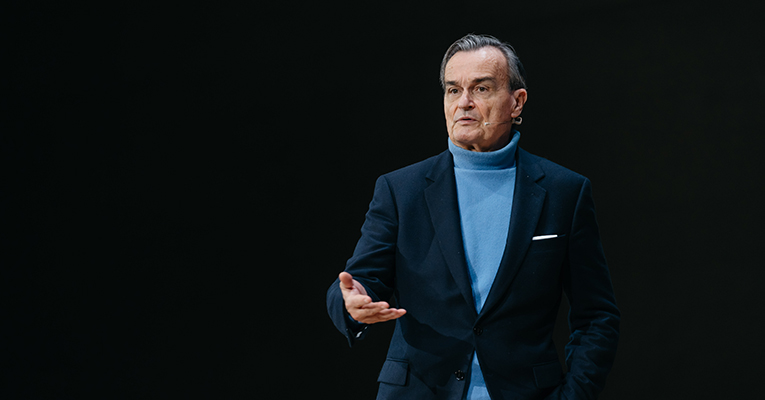
Samy Chaar handed over to Gérard Araud, who turned attention to the geopolitical landscape. He began with a stark warning: “We Europeans have experienced the longest period of peace, prosperity, and freedom since the fall of the Roman Empire. This period is coming to an end, and we are undoubtedly the ones least able to grasp it.” According to the former ambassador, “Europeans have unlearnt history,” too convinced that “law, procedures, and compromise would be enough to conjure up a return to strength.”
Russia’s invasion of Ukraine, he explained, brutally dispelled this illusion. Since then, he said, there has been “no judge and no police” in international relations, nor any shared universal morality. “Donald Trump is the symptom of this, not the disease,” he insisted. “His presidency has not created the crisis in the West. It is merely the loudest expression of it.” The disease runs deeper, he added, with public opinion increasingly questioning the value of liberal democracy; populism rising in both Europe and the United States; strategic fatigue on the part of the Americans; and non-western states such as China, India, and Brazil flexing their muscles.
For Washington, Europe is becoming increasingly peripheral – growth is happening elsewhere. The major technological innovations are increasingly taking place in Silicon Valley or Asia rather than Brussels, and the main strategic threat is perceived as coming from Beijing, not Moscow
In this context, he continued, “The West has lost its status as the centre of gravity of the international system. For Washington, Europe is becoming increasingly peripheral.” Growth is happening elsewhere, he noted. The major technological innovations are increasingly taking place in Silicon Valley or Asia rather than Brussels, and the main strategic threat is perceived as coming from Beijing, not Moscow.
Even before Donald Trump, Gérard Araud reminded the audience, “Barack Obama already demonstrated a lack of interest in the Old Continent. The war in Ukraine has, for the time being, brought the United States and Europe together, but, for America, the priority is clear: to disengage from this conflict and focus resources on the US-China rivalry.”
Moreover, Gérard Araud explained that Europe’s geographical and historical diversity make joint decisions difficult, even as the rise of the far right in several Member States undermines the balance within the EU.
Despite this, the ambassador struck a positive note. Non-Western powers have not formed an “anti-Western front,” he said. Emerging markets like India, Indonesia, Mexico, and Brazil do not want to be caught in a vice between Washington and Beijing, but “aspire to an order where the rules are more balanced.” Here, Europe could occupy an important role, talking to these “intermediate powers” as equals, and putting forward a model of regulation, climate cooperation, and sustainable finance. However, Gérard Araud emphasised that Europe must be “willing to come out of denial and draw the political and budgetary consequences of this new state of affairs.”
Europe could occupy an important role, talking to these “intermediate powers” as equals, and putting forward a model of regulation, climate cooperation, and sustainable finance
Gold, fragmentation, and allocation
In a Q&A session moderated by Serge Fehr, Head of the Swiss Domestic Region for Private Clients, Samy Chaar took a deeper dive into portfolio allocation decisions. Asked about the role of gold, he outlined why the precious metal currently enjoys support. “China exports around USD 450 billion to the United States every year. Previously, China reinvested these US dollars in US assets, particularly Treasury bonds. However, relations with the United States have now hardened, and China is worried about sanctions. Nor can these flows be put into assets denominated in renminbi without strengthening the currency. For China, this leaves commodities as an option, with gold in first place.”
In this context, a lasting drop in the price of gold would require either a strategic reconciliation between Washington and Beijing, or the appearance of a huge new market for gold that would allow China to recycle its surplus in another currency – neither scenario is very likely in the short term. In our strategic allocations, an exposure “of the order of 3–5%” constitutes a line of portfolio defence when faced with extreme shocks.
More broadly, the audience Q&A highlighted the fact that geopolitical fragmentation does not lead to a generalised market retreat, but instead imposes a more detailed and refined hierarchy of risks broken down by region and sector. It also demands that particular attention be paid to sovereign balance sheets and microeconomic fundamentals.
At the end of the first edition of “Rethink Perspectives” to be held at our new headquarters, a strong conviction emerged – we have left the comfortable motorway of linear globalisation and entered a steeper landscape where geopolitics, trade policies, and the energy transition are profoundly reconfiguring growth trajectories and risk premiums.
However, it also became clear that, though we are now on a mountain road, we are not at the edge of a precipice. The resilience of the private sector, the capacity of the United States to finance investments, and the gradual easing of monetary policies still offer points of solid support for long-term investors ready to adapt and adjust their strategies.
At Lombard Odier, our ability to take a step back, combine macroeconomic, geopolitical, and financial perspectives, and translate these analyses into concrete investment strategies, remains at the heart of our philosophy. We are committed to helping our clients navigate this more fragmented world – one which is rich in opportunity for those willing to rethink their perspectives.
important information
This is a marketing communication issued by Bank Lombard Odier & Co Ltd (hereinafter “Lombard Odier”).
It is not intended for distribution, publication, or use in any jurisdiction where such distribution, publication, or use would be unlawful, nor is it aimed at any person or entity to whom it would be unlawful to address such a marketing communication.






share.