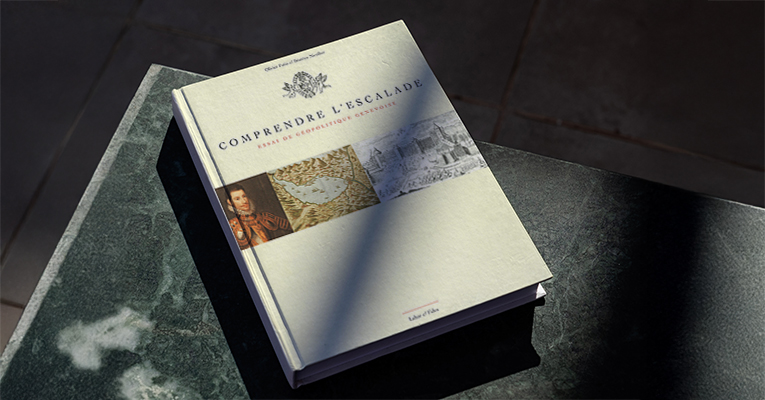
To mark the 400th anniversary of L’Escalade at the turn of this millennium, Lombard Odier financed and contributed to the publication of two books dedicated to this defining moment in Geneva’s history.
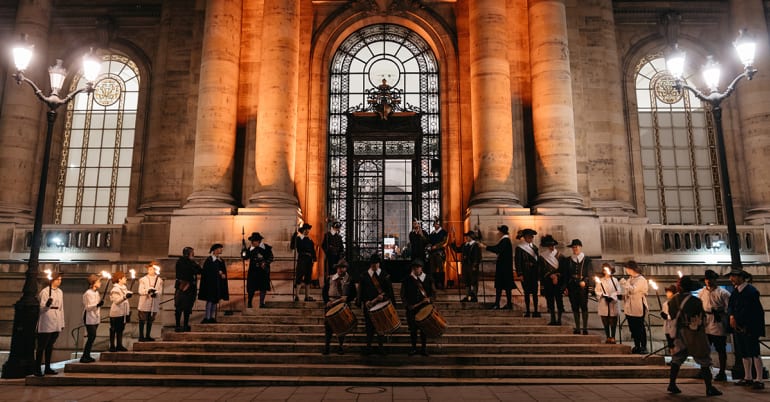
For decades, the Escalade festival has been celebrated in our Geneva offices, becoming a cherished tradition. Over the years, we have shared this uniquely Genevan custom with international colleagues and clients, including those as far afield as Canada. This year, once again, Laurent Pellet, our Global Head of External Asset Managers and Limited Partner, brought together more than 200 participants to celebrate a shared heritage rooted in independence, resilience and community, taking part in the symbolic “breaking of the marmite” (a chocolate cauldron).
Watch our celebratory video as we strengthen ties with our EAM partners at Geneva’s Musée d’Art et d’Histoire.
Between pride and legend
Today, celebrated throughout the Canton of Geneva as a moment of joy and togetherness, the Escalade remains deeply rooted in a historic act of resistance that shaped the city’s identity.
Since the late 19th century, the central ritual of the Escalade has been to break a chocolate marmite, accompanied by the words: “Ainsi périssent les ennemis de la République”, which translates to, “Thus perish the enemies of the Republic.”
This warning pays tribute to one of the key figures of the Escalade. Legend has it that on the night of 11–12 December 1602, Dame Royaume was preparing a pot of vegetable soup when Savoyard forces launched an assault on Geneva’s ramparts. On discovering the attack, Dame Royaume is said to have hurled the boiling contents of the pot from her window onto the head of a Savoyard soldier below. This decisive act entered Genevan folklore and, centuries later, inspired the tradition of the chocolate marmite filled with marzipan vegetables that is broken each year.
Over time, the historic event became a founding myth of Geneva and a powerful marker of Genevan identity. The song that commemorates it, “Cé qu’è lainô” – written in Franco-Provençal Arpitan and loosely meaning, “He who is above”, a reference to God as protector of Geneva – has since taken on special significance. In 2024, following a popular vote, it was formally enshrined in the cantonal constitution as the official anthem of the Republic and Canton of Geneva.
Today, celebrated throughout the Canton of Geneva as a moment of joy and togetherness, the Escalade remains deeply rooted in a historic act of resistance that shaped the city’s identity
After the Escalade, the Restoration of the Republic
Another defining moment in Geneva’s history is commemorated each December on the 31st – a public holiday in the Canton, marking a further act of resistance. When Lombard Odier was founded in Geneva in 1796, the city was not yet Swiss. Until 1798, Geneva was a sovereign city-state. But that year, its annexation by Napoleon made it the capital of the Département du Léman.
Geneva regained control of its territory on 31 December 1813, a date now celebrated as the “Restoration of the Republic of Geneva”. The following year, fearing renewed subjugation, Geneva sought he protection of the Swiss Confederation. It was accepted as the 22nd canton, and officially joined the Confederation in 1815, cementing its place within Switzerland while preserving the spirit of independence that continues to define its identity today.
Despite political upheaval: fruitful economic ties with France
Although Geneva’s territory experienced periods of tension with neighbouring countries before it entered into the Swiss Confederation, these challenges did not hinder the development of economic and financial ties with France in the 19th century, supported by a more stable geopolitical climate.
In Lombard Odier’s history, the Hentsch and Odier families, firmly established in Paris since the Empire, seized the opportunity to finance the first canals and railway lines linking coal deposits and steel production in the North to industrial centres in Paris and Lyon. They also forged close partnerships with a new generation of investment bankers and held leadership positions at the Banque de France. A branch of the Hentsch family went on to become the co-founder of BNP Paribas, Banque Indosuez, Société Générale and several savings banks.
Lombard Odier became an active participant in the Industrial Revolution, investing notably in France and French-speaking Switzerland
While Lombard Odier’s French branch prospered in Paris, the association of Jean Eloi Lombard with Charles Odier in Geneva in 1830 marked a decisive transformation of the Bank’s more traditional business model. From that point forward, Lombard Odier became an active participant in the Industrial Revolution, investing notably in France and French-speaking Switzerland.
Within a few years, Lombard Odier established itself as an enterprising investment bank, with its reputation extending well beyond national borders. In 1850, it helped create the Geneva Stock Exchange and subsequently formed a syndicate distributing shares and bonds internationally. By the end of the 19th century, Lombard Odier underwrote the majority of American debt securities placed in Europe – underscoring its early role as a truly international financial institution.



share.