When you visit our website, information may be stored or recovered on your device, mainly in the form of cookies. We use essential cookies to ensure the website works as it should, and statistical and marketing cookies for audience measurement and content customisation purposes. We rely on Google for statistical and marketing cookies in order to measure website performance and display relevant advertising. For more information on this, please also refer to the Google policy on Business Data Responsibility.
From the Cookie Management Centre, you can set your preferences with respect to the use of cookies: accept or reject certain categories, accept all, or reject all. For detailed information on all cookies used across these three categories, please refer to our Cookie Policy.
Please note that blocking certain cookies may affect your experience and the services offered.
Essential cookies Always active
Essential cookies help the website to work as it should by enabling necessary functionalities, such as navigating between pages and accessing secure areas. These cannot be disabled in our systems.
Statistical cookies
Statistical cookies help us understand how visitors interact with our site by collecting and communicating browsing information. They make it possible to identify the most and least visited pages and to improve the overall performance of the site.
Marketing cookies
Marketing cookies are used to display relevant advertising and measure the performance of campaigns. If you choose not to allow these cookies, you will continue to see ads, but they will be less relevant to your interests.
Choose the purposes for which we may use Google products to collect and use your data:
User storage: to technically permit advertising functionality.
User data for advertising: to optimise our advertising campaigns.
Ad customisation: to tailor advertising to your interests.
The US election looks set to deliver a Republican clean sweep, promising ‘America first’ policies of lower taxes, less regulation, tighter immigration and widespread import tariffs
We anticipate an inflationary impact from most of Trump’s policies which should also deliver a small boost to growth. The Federal Reserve is likely to limit its interest rate cuts in response
The election result supports US financial assets, especially equities and the dollar. Treasury yields, particularly longer maturities should rise. We maintain our preference for Bunds and Gilts. Gold remains a useful portfolio exposure
Market volatility will persist and a well-diversified portfolio remains the most appropriate response.
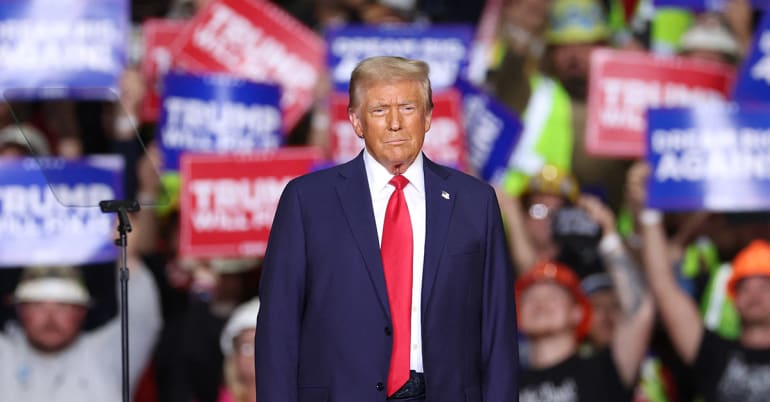
Donald Trump will become the next US president. Crucially, Republicans are poised to win both chambers of Congress, giving the Trump White House room to implement “America First” fiscal, trade and immigration policies. This has far-reaching implications for the US and global economies, and consequently for international investors.
Polling pointed to a tight race. In the event, the election delivered a clear Republican victory. When Mr Trump takes office in January he will become only the second president in US history to serve non-consecutive terms, after Grover Cleveland in the late 1800s. Turnout in 2020 was the highest in more than a century, and in 2024 that record may have been broken.
‘America first’ policies should translate into higher US nominal growth with lower taxes, more spending and looser regulation. Increased import tariffs, as pledged by Mr Trump, along with tighter immigration policies, would have a direct impact on prices and likely lead to a moderate resurgence in inflation. Their absolute level remains the key uncertainty – and we think tariffs are likely to be used as a transactional tool to extract deals on buying American goods – rather than simply implementing the levels pledged in campaign rhetoric.
Sign up for our newsletter
We expect the Federal Reserve (Fed) to deliver another 25 basis point cut to interest rates on 7 November. However, given the longer-term outlook, we expect the Fed to maintain policy rates at restrictive levels, with its interest rate cutting cycle likely ending in the first quarter of 2025 around 4%. This reflects more limited rate cuts compared with our pre-election expectations, as the central bank is likely to respond to the renewed risk of inflation.
While a Republican clean sweep could mean higher US rates than markets are currently pricing in, they could lead to lower-than-expected rates in the rest of the world, notably in Europe. This is because we anticipate tariffs would end up putting more downward pressure on European growth than upward pressure on its inflation.
A Republican clean sweep could lead to lower-than-expected interest rates in the rest of the world, notably in Europe
Stock and bond market impacts
US financial assets, especially equities and the US dollar, should experience a boost, on expectations that the Trump administration lowers taxes and loosens the corporate regulatory environment, albeit some of this optimism was already priced in pre-election. Global stocks should also gain, with technology, banks and defence names all performing in an environment of higher military spending and lighter regulation. The energy sector may also see some surprises. If efforts to boost US oil production weigh on global prices, the traditional energy sector would suffer.
Small capitalisation stocks and growth names should rally on strong risk appetite. Healthcare may remain under pressure, given a bipartisan push to lower domestic drug prices, but this is probably lower on Republicans’ than Democrats’ agenda. For Chinese equities, US tariffs would add to headwinds, and so their outlook is very much dependent on local support measures. President Trump’s tone on tariffs in the coming weeks will set the tone for equities of other regions.
For Chinese equities, US tariffs would add to headwinds, and so their outlook is very much dependent on local support measures
In fixed income, we expect higher inflation and less Fed easing to push up US Treasury yields, particularly long-dated ones. Longer-dated yields should rise slightly faster than those of shorter maturities. We expect US inflation-linked bonds to perform broadly in line with nominal bonds. We would tactically prefer 3–5-year Treasuries within the asset class and maintain our preference for Bunds and Gilts over Treasuries within portfolios, given more pronounced interest rate cutting cycles ahead in Europe and the UK than in the US.
Credit spreads will remain tight; we see high yield credit outperforming government debt, while investment grade credit should initially prove more sensitive to slightly higher interest rates.
Dollar, gold and oil
For the dollar, the clean-sweep offers support over the next few months as US interest rates should remain high. Over the longer term we would expect more investor focus on fiscal risks and the impact of import tariffs. That would then be more positive for haven currencies, such as the Swiss franc and Japanese yen, compared with more cyclical currencies such as the euro and sterling.
The outlook for gold remains positive
The outlook for gold remains positive, although higher US rates and a slightly stronger dollar could initially limit gains. We retain our 12-month price target of USD 2,900 per ounce. Increased US shale production could put more supply-side pressure on oil, and we see risks that crude prices could fall below USD 70 per barrel a year from now.
The US election result is clearly supportive for US financial assets, but will not bring market volatility to a close. In the longer term, markets tend to prefer government with some checks and balances in place. There is no room for complacency for investors and a well-diversified portfolio is vital. Maintaining a flexible, well-diversified approach remains key to managing risks and capturing opportunities in this complex environment.
CIO Office Viewpoint
Trump’s clean sweep sets up an ‘America first’ second term
This is a marketing communication issued by Bank Lombard Odier & Co Ltd (hereinafter “Lombard Odier”).
It is not intended for distribution, publication, or use in any jurisdiction where such distribution, publication, or use would be unlawful, nor is it aimed at any person or entity to whom it would be unlawful to address such a marketing communication.







share.