When you visit our website, information may be stored or recovered on your device, mainly in the form of cookies. We use essential cookies to ensure the website works as it should, and statistical and marketing cookies for audience measurement and content customisation purposes. We rely on Google for statistical and marketing cookies in order to measure website performance and display relevant advertising. For more information on this, please also refer to the Google policy on Business Data Responsibility.
From the Cookie Management Centre, you can set your preferences with respect to the use of cookies: accept or reject certain categories, accept all, or reject all. For detailed information on all cookies used across these three categories, please refer to our Cookie Policy.
Please note that blocking certain cookies may affect your experience and the services offered.
Essential cookies Always active
Essential cookies help the website to work as it should by enabling necessary functionalities, such as navigating between pages and accessing secure areas. These cannot be disabled in our systems.
Statistical cookies
Statistical cookies help us understand how visitors interact with our site by collecting and communicating browsing information. They make it possible to identify the most and least visited pages and to improve the overall performance of the site.
Marketing cookies
Marketing cookies are used to display relevant advertising and measure the performance of campaigns. If you choose not to allow these cookies, you will continue to see ads, but they will be less relevant to your interests.
Choose the purposes for which we may use Google products to collect and use your data:
User storage: to technically permit advertising functionality.
User data for advertising: to optimise our advertising campaigns.
Ad customisation: to tailor advertising to your interests.
The US budget worsens the country’s fiscal outlook, raising deficits by USD 4 trillion over a decade – and even more if temporary tax cuts become permanent
Tariff revenues will soften the bill's effect on US debt, but we still project publicly-held debt to climb to 119% of GDP by 2034
The legislation pairs major tax breaks focused on wealthy households with steep cuts to Medicaid, food stamps, and student loans
Despite its scale, the legislation offers limited macroeconomic stimulus. We keep our US growth and inflation forecasts unchanged.
The US’s ‘One Big Beautiful Bill’ has been approved by Congress, meeting a 4 July deadline, but comes at the cost of even higher deficits. The legislation extends tax cuts, slashes social spending, and increases US deficits by USD 4 trillion over a decade. With little macroeconomic upside and a worsening fiscal outlook, we struggle to see anything beautiful about this budget.
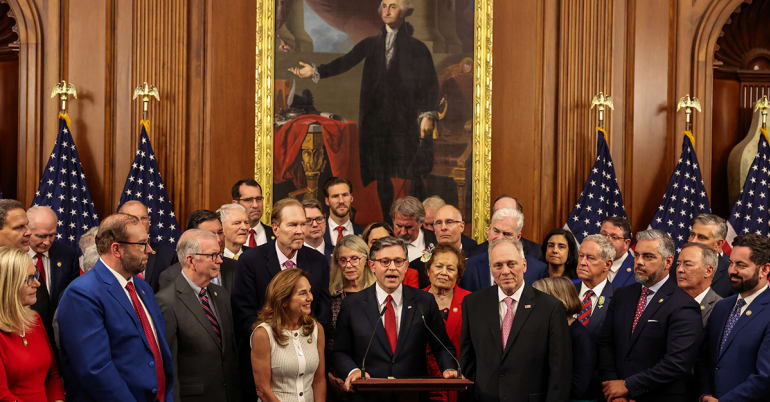
After marathon sittings in the US Congress, reflecting widespread concerns with the bill among Republicans and some obstruction from Democrats, President Donald Trump’s “One Big Beautiful Bill” was passed, meeting a self-imposed 4 July deadline.
The final legislation is similar to the version of the bill passed by the House of Representatives in May (see A big, but not beautiful, US budget bill), but implies even larger deficits – increasing from USD 3 trillion to USD 4 trillion over a decade. The Congressional Budget Office (CBO) has estimated that the legislation will increase the US deficit by USD 3.4 trillion over ten years, but that calculation excludes interest. If the ‘temporary’ tax cuts contained in the bill became permanent, the total deficit over a decade would rise by almost USD 5.5 trillion. This is higher than the combined deficit impact of much of the legislative stimulus passed in recent years: CHIPS and Science Act in 2022, the Bipartisan Infrastructure Law of 2021, the American Rescue Plan Act in 2021 and the 2020 CARES Act.
Sign up for our newsletter
Overall, we reiterate our initial assessment that this budget worsens the US fiscal outlook, while failing to provide positive macroeconomic benefits. We therefore maintain our forecasts for US growth of 1.3% in 2025 and 1.4% in 2026, and inflation of 2.8% and 2.7% respectively.
This budget worsens the US fiscal outlook, while failing to provide positive macroeconomic benefits
While the legislation alone would push US deficit-to-GDP above 7%, peaking around 7.5% in 2028, US tariff revenues should help to keep the deficit within a range of 6% to 7%. Under the budget and including tariff revenues, the ratio of US debt held by the public to GDP is set to increase from today’s 100% to 119% within a decade, while under previous policies it would have reached 114%. Without tariff revenues, the budget would raise that ratio to 126% by 2034.
The legislation extends 2017’s Tax Cuts and Jobs Act (TCJA), excludes tips and overtime from taxes up to USD 25,000 until 2028, and increases the state and local taxes (‘SALT’) deductions from USD 10,000 to USD 40,000, again only until 2028. The law also reinstates business investment incentives for equipment and research and development that began a phase out in 2022-2023, as well as allowing the full expensing of factory investments - until 2028.
Most of these tax cuts will not stimulate consumption. That is because an extended TCJA does not change current household cash flows, and the tips and overtime provision only affects a small fraction of the population. Further, SALT deductions only impact households earning more than USD 200,000 per year – these consumers represent a large fraction of US spending but are typically slower than lower income brackets to spend any additional income.
The largest spending cuts, worth approximately USD 900 billion, are to the Medicaid healthcare programme, essentially by imposing work requirements. Another USD 150 billion will be cut from SNAP, or “food stamps”, and a further estimated USD 350 billion of cuts to student loans through caps and phasing-out subsidised and income-driven repayment plans. Estimates indicate that several million people will lose their healthcare and/or assistance in affording groceries over the next few years. While these provisions worried some US senators seeking re-election in November 2026’s midterm votes, from an economic perspective the transmission of these spending cuts to aggregate consumption will also be limited. That is because the impacted households make up a small share of US consumption, and some provisions for student loans are delayed over time.
Most of these tax cuts will not stimulate consumption
The legislation also contains very substantial cuts to the Inflation Reduction Act (IRA) of 2022. However, the final version carries last-minute amendments including a provision to protect tax credits for some projects if at least 5% of the capital is spent by 30 June 2026.
Other provisions aim to fulfil Trump campaign promises. The 940-page document, for example, provides around USD 150 billion for immigration controls including detention facilities, deportation operations, additional personnel and border installations. It also includes some small giveaways, for example by making interest on loans deductible for American-made car purchases, and additional deductions for seniors.
Finally, the legislation extends the debt limit by USD 5 trillion compared to the May draft’s USD 4 trillion. This debt limit will become binding again, likely in 2027, as it is the US’s overall public deficit that matters for the country’s debt ceiling, rather than the marginal figure implied by this legislation.
This is a marketing communication issued by Bank Lombard Odier & Co Ltd (hereinafter “Lombard Odier”).
It is not intended for distribution, publication, or use in any jurisdiction where such distribution, publication, or use would be unlawful, nor is it aimed at any person or entity to whom it would be unlawful to address such a marketing communication.





share.