When you visit our website, information may be stored or recovered on your device, mainly in the form of cookies. We use essential cookies to ensure the website works as it should, and statistical and marketing cookies for audience measurement and content customisation purposes. We rely on Google for statistical and marketing cookies in order to measure website performance and display relevant advertising. For more information on this, please also refer to the Google policy on Business Data Responsibility.
From the Cookie Management Centre, you can set your preferences with respect to the use of cookies: accept or reject certain categories, accept all, or reject all. For detailed information on all cookies used across these three categories, please refer to our Cookie Policy.
Please note that blocking certain cookies may affect your experience and the services offered.
Essential cookies Always active
Essential cookies help the website to work as it should by enabling necessary functionalities, such as navigating between pages and accessing secure areas. These cannot be disabled in our systems.
Statistical cookies
Statistical cookies help us understand how visitors interact with our site by collecting and communicating browsing information. They make it possible to identify the most and least visited pages and to improve the overall performance of the site.
Marketing cookies
Marketing cookies are used to display relevant advertising and measure the performance of campaigns. If you choose not to allow these cookies, you will continue to see ads, but they will be less relevant to your interests.
Choose the purposes for which we may use Google products to collect and use your data:
User storage: to technically permit advertising functionality.
User data for advertising: to optimise our advertising campaigns.
Ad customisation: to tailor advertising to your interests.
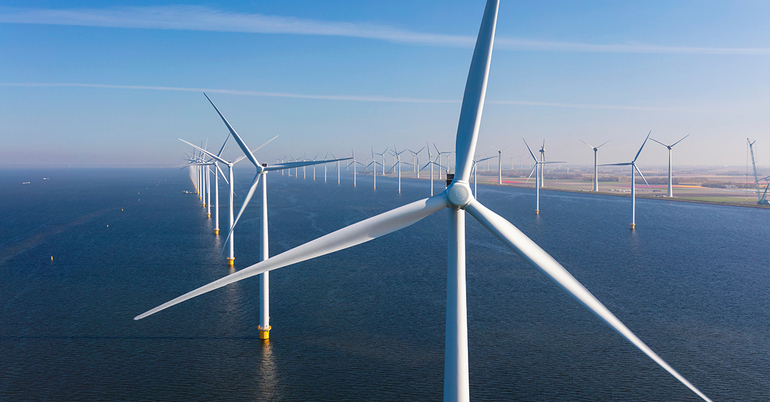
Japan’s wind power sector is facing some turbulence as soaring material prices and construction costs are jeopardising the development of the industry amid complaints of regulatory and policy bottlenecks.
In response, there are reports the government is engaging with companies to ‘sweeten’ the terms for building offshore wind farms1 to increase momentum. This is a much-needed move by the government as Japan’s wind industry has a long way to go in order to be a significant contributor to its renewable energy generation targets.
Japan recently stepped up its plans for renewable energy, announcing that it wants renewables to account for 40% - 50% of electricity generation by 2040. Offshore wind is projected to contribute 4% - 8% of that overall total2.
However, although the government targets 45 gigawatts (GW) of electricity from offshore wind sources by 2040, installed offshore wind capacity was only 153.5 MW in 2023, a slight increase from 135 MW in 20223. Meanwhile, the Japan Wind Power Association has set a mid-century goal to increase total wind power capacity to 140 GW, from less than 5GW currently4.
The road ahead is challenging, but the rewards for Japan will be significant. We at Lombard Odier believe that the world’s energy system is changing, moving firmly away from fossil fuels toward an electrified economy. Renewables have moved from niche to mainstream, as efficiency gains and cost decreases make zero-emissions electricity more attractive to both energy producers and consumers5.
The government is taking positive steps, with Parliament recently passing a bill, long in gestation, that effectively opens the country’s Exclusive Economic Zone (EEZ) for offshore wind farm development6. This should unlock about 4 million square kilometres for use by wind farms.
The EEZ has the potential to offer up to 552 GW of offshore wind capacity, mainly through deep-water floating turbines7.
We at Lombard Odier believe that the world’s energy system is changing, moving firmly away from fossil fuels toward an electrified economy. Renewables have moved from niche to mainstream, as efficiency gains and cost decreases make zero-emissions electricity more attractive to both energy producers and consumers
Learn more about China’s clean tech role in APAC here.
Sector must be made more palatable
The sector is clearly making progress, but key complexities remain and would-be developers need confidence that there is a viable pathway to profitability.
Some companies have suffered cost overruns, delays and other supply chain issues. There have also been complaints about the slow auction process for awarding contracts and other administration bottlenecks.
Mitsubishi is a high-profile example of a company rethinking the sector’s potential. It recently said it is re-assessing its investments in Japan’s offshore wind sector because of ‘inflation, the depreciation of the yen, tight supply chains, and rising interest rates’8. This could change, of course.
Japan is not alone in facing macroeconomic or sectoral problems in offshore wind. However, not every country has Japan’s potential for offshore wind power generation, with the country offering a large coastline and strong winds. The International Energy Agency (IEA) estimates that Japan’s total technical potential for offshore wind generation is over 9,000 TWh/year. This is more than nine times its projected electricity demand in 2050 (922 TWh/yr)9.
It is in the government’s interest to make the industry more palatable for investors, whether domestic or foreign, to ensure it fulfils its potential.
Lombard Odier estimate that, by 2050, the world will reach approximately 50% economy-wide electrification, up from around 20% today, as industries transition from fossil fuels to renewably generated electricity
Companies and government need more visibility
Longer contract tenors, for example, would provide greater visibility on profitability. The government could also encourage longer purchase power agreements by offering tax incentives, which would give itself longer-term confidence and clarity of the flow of energy10.
The government could also consider clarifying or adjusting its cabotage laws, which restrict foreign vessels in Japan’s territorial waters11. Easing restrictions is essential if Japan fully takes advantage of foreign equipment and expertise. Meanwhile, some companies are asking the government for tax exemptions.
As part of the bill opening the EEZ, Japan streamlined its assessment process to determine the environmental impact of projects12, which should help facilitate investment and give greater visibility for developers.
Commercial interest remains strong, with industry players reportedly talking to the government13 pushing for some of the measures mentioned above and other incentives. These include subsidies and further changes to the auction process, to encourage their participation in developing the country’s offshore wind sector.
Lombard Odier estimate that, by 2050, the world will reach approximately 50% economy-wide electrification, up from around 20% today, as industries transition from fossil fuels to renewably generated electricity. While the energy transition won’t be completed by mid-century, the long-term trajectory points toward over 70% electrification. Technological advances and the falling costs of renewables and batteries are key to the transition, but unprecedented policy support will continue to play a crucial role. For offshore wind development, building turbines in deep waters and harsh weather areas adds complexity and cost. Japan’s government must find the right balance between encouraging commercial interest and safeguarding coastal communities and the fisheries industry. It may not be an easy balance, but the targets are set and the rewards clear.
Discover our conviction about the transition to net zero here.
view sources.
+
[1]Japan poised to sweeten offshore wind rules as players get cold feet. Available here. [2] Japan’s exclusive economic zone (EEZ) unleashes massive offshore wind potential. Available here.
[3] Japan’s offshore wind sector – Facing headwinds, seeking lifelines. Available here. [4] Wind industry aims to provide a third of Japan’s power by 2050. Available here. [5] Electrifying the economy. Available here. [6] Japan passes law allowing offshore wind development in the EEZ. Available here.
[7[ Japan's exclusive economic zone (EEZ) unleashes massive offshore wind potential. Available here. [8] Mitsubishi Corporation reviews its Japanese offshore wind power generation projects. Available here. [9] Offshore wind in Japan: The untapped potential. Available here. [10] Japan’s offshore wind sector – Facing headwinds, seeking lifelines. Available here. 11] Japan ‘faces important decisions’ regarding cabotage rules and offshore wind. Available here. [12] Japan’s exclusive economic zone (EEZ) unleashes massive offshore wind potential. Available here.
[13] Japan poised to sweeten offshore wind rules as players get cold feet. Available here.



share.