When you visit our website, information may be stored or recovered on your device, mainly in the form of cookies. We use essential cookies to ensure the website works as it should, and statistical and marketing cookies for audience measurement and content customisation purposes. We rely on Google for statistical and marketing cookies in order to measure website performance and display relevant advertising. For more information on this, please also refer to the Google policy on Business Data Responsibility.
From the Cookie Management Centre, you can set your preferences with respect to the use of cookies: accept or reject certain categories, accept all, or reject all. For detailed information on all cookies used across these three categories, please refer to our Cookie Policy.
Please note that blocking certain cookies may affect your experience and the services offered.
Essential cookies Always active
Essential cookies help the website to work as it should by enabling necessary functionalities, such as navigating between pages and accessing secure areas. These cannot be disabled in our systems.
Statistical cookies
Statistical cookies help us understand how visitors interact with our site by collecting and communicating browsing information. They make it possible to identify the most and least visited pages and to improve the overall performance of the site.
Marketing cookies
Marketing cookies are used to display relevant advertising and measure the performance of campaigns. If you choose not to allow these cookies, you will continue to see ads, but they will be less relevant to your interests.
Choose the purposes for which we may use Google products to collect and use your data:
User storage: to technically permit advertising functionality.
User data for advertising: to optimise our advertising campaigns.
Ad customisation: to tailor advertising to your interests.
Can AI make essential minerals greener? Rethinking rare earths for the energy transition
key takeaways.
Critical minerals are becoming increasingly strategic to the energy transition, but supply chains remain concentrated, and extraction carries high environmental and social costs
AI is helping miners identify higher-quality deposits more precisely, potentially reducing unnecessary drilling, waste and the physical footprint of exploration
Beyond the mines, AI could unlock value from existing waste streams and accelerate the discovery of alternative materials, including rare-earth-free magnets
Better data will be critical. AI is enabling decades of geological and scientific information to be analysed at unprecedented speed, narrowing the gap between virtual discovery and physical experimentation
For investors, the opportunity extends beyond mining to the technologies enabling efficient exploration, material discovery, processing and substitution.
This summer's record-breaking heat has put electricity systems under pressure around the world, exposing both the vulnerabilities and the growing importance of modern energy infrastructure. As demand for cooling surges and grids face mounting strain, the technologies underpinning the energy transition are moving into sharper focus. Renewable power, battery storage and electrification are central to building a more resilient, low-carbon energy system. Yet all depend on something far less visible: a growing supply of critical minerals.
Lithium, cobalt, nickel and rare earth elements are essential to technologies ranging from batteries and wind turbines to electric motors and power infrastructure. Securing enough of them is becoming a strategic priority. According to the International Energy Agency (IEA), demand for rare earth elements is expected to rise by around 50-60% by 2040 under current policy settings, driven in part by growing demand for permanent magnets used in electric vehicles and wind power.1
Lithium, cobalt, nickel and rare earth elements are essential to technologies ranging from batteries and wind turbines to electric motors and power infrastructure. Securing enough of them is becoming a strategic priority
The challenge is not simply to increase supply; it is to do so while reducing the environmental and social costs of extracting and processing these materials. With mounting worries over supplies, the race is on to discover new sources or alternatives to the minerals essential for the green transition. But is there a more sustainable way to find and extract these materials — or even replace them altogether?
AI could help change that equation.
Sign up for our newsletter
A supply challenge and an environmental one
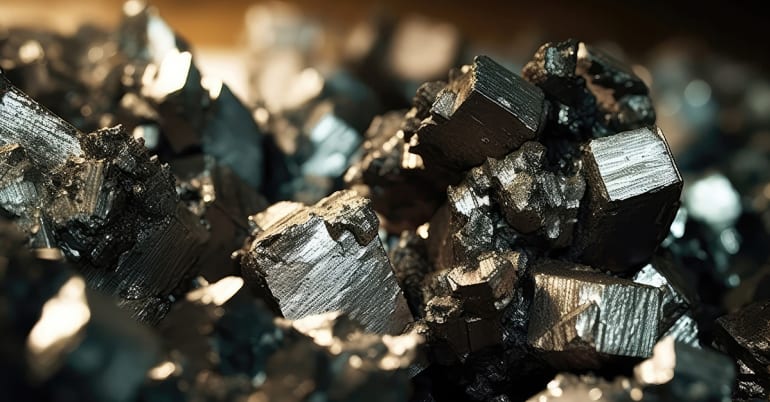
Rare earths are not as rare as the name suggests, at least in geological terms. The difficulty lies in finding deposits with sufficiently high concentrations and then separating and refining the elements economically. However, mining and processing also carry high environmental costs, from land disturbance and waste to water use and pollution. The search for alternatives is becoming more urgent. New mining projects face growing scrutiny from local communities, NGOs and regulators over their environmental and community impact, including legal challenges. The concentration of rare earth processing in China has added a geopolitical dimension to the efforts to find alternative supplies. China account for around 60% of mined magnet rare earths in 2024, but as much as 91% of refining, according to the IEA.2
At the same time, decades of access to relatively abundant rare earths and other critical minerals meant there was little incentive to radically rethink how the mining industry explored for new resources. As a result, innovation in the sector has lagged.
“These things were easy to find,” says Mfikeyi Makayi, Chief Executive of the African arm of mining start-up KoBold Metals Africa. “It was sitting there, so why should you invent some tool to go deeper?”
From prospecting to predictive discovery
Backed by investors including Bill Gates and Jeff Bezos and operating in the Democratic Republic of Congo, KoBold is among a new generation of companies using AI and advanced data analysis to identify untapped deposits that can increase supply while minimising the environmental impact of production.3
AI is also helping scientists revisit material that has already been dug out of the ground
Makayi explains that AI can identify areas with higher percentages of materials such as lithium, cobalt and nickel per tonne of rock, allowing exploration teams to focus drilling more precisely. “You’re not just digging up holes to find poor-quality material,” Makayi says. “So we’re using AI to turn the art of finding great rocks into a repeatable science.”
That distinction would prove important. If miners can extract more useful material from less rock, they may be able to lower costs and reduce some of the physical footprint associated with exploration and production.
AI is also helping scientists revisit material that has already been dug out of the ground. Julie Bryce, Professor of Earth Sciences at the University of New Hampshire, points to mining waste as one example. Materials discarded when commodity prices were lower may contain concentrations of rare earths or other materials that are increasingly valuable today. “Rare earths are present in lots of materials,” she explains. “But now that they’re so valuable, it’s becoming more economically feasible to go after them.
This creates a second opportunity: extracting greater value from existing resources rather than relying solely on new mines.
What if we could design out of rare earths?
Perhaps a more disruptive possibility lies beyond mining altogether. Companies are using AI to find out how new combinations of materials might produce “rare earth free” versions of the magnets and other components needed in clean energy infrastructure.
For example, some materials have magnetic properties but cannot retain them in the same way as a rare-earth-based magnet. “A regular magnetic element like iron by itself doesn’t keep the same magnetisation, so you have to coax it into that state,” explains Kathy Christofidou, Chair in Digital and Sustainable Metallurgy at the University of Sheffield.
From the periodic table’s vast range of possibilities, finding the right combination of elements traditionally requires scientists to work through an enormous number of possibilities, creating and testing physical samples one by one. AI can narrow that search dramatically, identifying promising combinations far faster than humans. “It would take multiple days to create just one sample to test, and the testing takes a while,” says Christofidou, who is part of a team working with trade association UK AI and materials science company MatNex to develop rare-earth-free materials.
Data to AI is like fuel to a machine
AI, however, is only as powerful as the data behind it. That has drawn attention to the world’s geological and materials records, much of which remains fragmented across digital databases, government archives, paper files and historic maps. Efforts are now underway to bring these sources together and make them more accessible for analysis.
“There’s a collective challenge as an industry where we’re not bringing these bodies together,” says Makayi, who adds that KoBold is working with the governments of Zambia and Congo to organise their national geological databases and make it easier to use for exploration.
“Data to AI is like fuel to a machine,” says Jiadong Zang, Professor of Materials Science at the University of New Hampshire, where he helped build a database of more than 67,000 magnetic materials, including 25 previously unrecognised compounds whose magnetic properties remain constant even at high temperatures. Because structured data on magnetic materials was limited, Zang and his colleagues used large language models to analyse tens of thousands of scientific papers and extract information on their structure, chemistry, and magnetic properties.
The ability to turn decades of scientific material into machine-readable data could become one of AI’s most valuable contributions to materials research. Armed with this “fuel”, AI can combine large numbers of materials at speed, enabling humans to conduct fewer but better physical tests. “You can do experiments in the virtual world before going to the lab,” says Jonathan Bean, Co-founder and Chief Executive of MatNex.
We don’t want to lose human creativity…But the places where we’ve seen moments of superhuman intelligence are when AI makes those decisions
When AI sees what scientists might miss
With sufficient data, AI can do more than accelerate the search for promising materials. It can also explore combinations that human researchers might overlook. Rafael Gómez-Bombarelli, an MIT professor and Co-founder of materials design company Lila Sciences, is developing AI systems that can learn from successive experiments and generate new hypotheses. In work on alternatives to ruthenium and iridium, metals used in green hydrogen production, one such system came up with a viable idea that the company’s in-house experts would not have pursued. “We don’t want to lose human creativity,” he says. “But the places where we’ve seen moments of superhuman intelligence are when AI makes those decisions.”
The potential comes with its own environmental trade-off. AI depends on energy-intensive data centres, but Gómez-Bombarelli believes that the potential for scientists to accelerate the transition to clean energy should outweigh their relatively modest AI use in this kind of research. “Given the amount of energy that is going into science, it will be a net positive,” he says.
Beyond the mine
The critical-minerals challenge is unlikely to be solved by simply extracting more out of the ground. The more durable answer may lie in using technology to find better deposits, recover more from existing materials, reduce waste and ultimately design alternatives to some of the most constrained resources altogether. AI is beginning to widen the range of possibilities. From finding richer deposits to designing new materials, AI is helping reduce the environmental footprint of rare earths needed for the energy transition.
For investors, this points to an opportunity extending beyond traditional mining. Value may increasingly be created across the enabling technologies around critical minerals: geological intelligence, advanced exploration, materials discovery, recycling, processing efficiency and substitution. These are areas where innovations can help reconcile two objectives that often appeared in tension: securing the materials required for the energy transition while reducing the impact of obtaining them.
* Any reference to a specific company or security does not constitute a recommendation to buy, sell, hold or directly invest in the company or securities.
This is a marketing communication issued by Bank Lombard Odier & Co Ltd (hereinafter “Lombard Odier”).
It is not intended for distribution, publication, or use in any jurisdiction where such distribution, publication, or use would be unlawful, nor is it aimed at any person or entity to whom it would be unlawful to address such a marketing communication.




share.