When you visit our website, information may be stored or recovered on your device, mainly in the form of cookies. We use essential cookies to ensure the website works as it should, and statistical and marketing cookies for audience measurement and content customisation purposes. We rely on Google for statistical and marketing cookies in order to measure website performance and display relevant advertising. For more information on this, please also refer to the Google policy on Business Data Responsibility.
From the Cookie Management Centre, you can set your preferences with respect to the use of cookies: accept or reject certain categories, accept all, or reject all. For detailed information on all cookies used across these three categories, please refer to our Cookie Policy.
Please note that blocking certain cookies may affect your experience and the services offered.
Essential cookies Always active
Essential cookies help the website to work as it should by enabling necessary functionalities, such as navigating between pages and accessing secure areas. These cannot be disabled in our systems.
Statistical cookies
Statistical cookies help us understand how visitors interact with our site by collecting and communicating browsing information. They make it possible to identify the most and least visited pages and to improve the overall performance of the site.
Marketing cookies
Marketing cookies are used to display relevant advertising and measure the performance of campaigns. If you choose not to allow these cookies, you will continue to see ads, but they will be less relevant to your interests.
Choose the purposes for which we may use Google products to collect and use your data:
User storage: to technically permit advertising functionality.
User data for advertising: to optimise our advertising campaigns.
Ad customisation: to tailor advertising to your interests.
Staying cautious on European risk assets after Germany’s election
Bill Papadakis
Senior Macro Strategist
Dr. Luca Bindelli
Head of Investment Strategy
key takeaways.
As expected, the centre-right Christian Democratic Union/Christian Social Union (CDU/CSU) came first in yesterday’s elections and, with the SPD (Social Democratic Party), they hold a Parliamentary majority
With centrist parties in favour of reforming the ‘debt brake’, we expect somewhat more expansionary fiscal policy ahead for Germany. Change will not be immediate and the scale of the boost is likely to be modest
Initial market reactions were positive, with the euro and European equity futures rising slightly, likely pricing out some of the more extreme pre-election scenarios
Given weak German economic growth, the absence of major fiscal stimulus and widening interest rates between the euro and dollar, we retain our cautious view on European equities and continue to prefer European sovereign debt.
Germany’s election results provide a degree of policy predictability, although talks to form a coalition government are likely to take time. However, with little hope for a material change in fiscal policy at a time of geopolitical challenges, key issues for the German economy remain. We keep our cautious outlook for European risk assets, and maintain our preference for fixed income in the region.
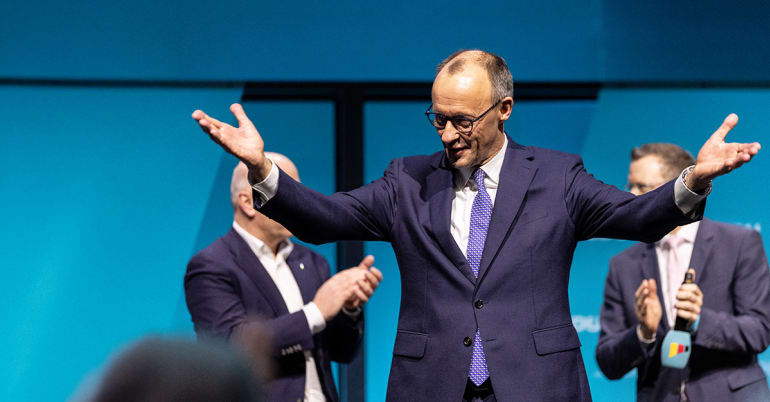
The conservative Christian Democratic Union/Christian Social Union (CDU/CSU) won 28.5% of the national vote. Far-right Alternative für Deutschland (AfD) rose strongly to 20.8%, while the Social Democratic Party (SPD) came third with 16.4%. CDU leader Friedrich Merz is set to become the next Chancellor, although with CDU/CSU short of an absolute majority, a coalition will be necessary.
A key point of uncertainty ahead of the election was whether a two-party ‘grand coalition’ by CDU/CSU and SPD would be possible, or whether a third party would be needed to clear the hurdle of 315 seats. In the event, benefiting from the failure of two smaller parties (liberal Free Democratic Party and left-wing Sahra Wagenknecht Alliance or BSW) to clear the 5% threshold needed to enter parliament, the two centrist parties jointly reached 328 seats, creating a slim but functional majority.
These results … should provide greater government stability and policy predictability
Political timeline
This leaves a likely baseline scenario of a centrist coalition CDU/CSU and SPD in the next government. The three-party coalition government that was in power until November 2024 proved particularly dysfunctional, and so we see these results as positive given that they should provide greater government stability and policy predictability.
Mr Merz’s call for a government in place by Easter (18-20 April) sounds ambitious, as negotiations have historically taken around two months on average, and as long as six months in 2018. But with two parties now commanding enough parliamentary seats for an absolute majority, and a recognition that the stakes are high, the coalition formation process should prove more expeditious.
Economic implications
This was a high-stakes election, and saw the highest voter turnout since German reunification. The three-party coalition government that had been in power since 2021 created significant discontent. The rise of far-right and euro-sceptic AfD to second place in parliament is a concern both in Germany and elsewhere in Europe. The geopolitical context is particularly complex, especially for Germany’s export-dependent economy, which has contracted in the last two years and faces additional risks from President Trump’s tariff agenda.
Sign up for our newsletter
The economic circumstances are particularly notable, following two years of economic contraction and significant downside risks. Chronic under-investment has taken a toll, leaving serious infrastructure needs in areas including defence, digitalisation, and public transport. With the German economy underperforming its peers since the global pandemic and an increasing recognition of the need for additional funds, especially for defence spending, the political debate had recently shifted in favour of reforming the constitutional debt brake that has acted as a strict constraint on German fiscal policy.
The three parties in favour of a debt brake reform have failed to reach the majority necessary
Such a development could have led to a meaningful change in Germany’s macroeconomic policy. However, the three parties in favour of a debt brake reform (CDU/CSU, SPD, Greens) have failed to reach the two-thirds majority necessary to change the country’s constitution.
This makes for a more challenging fiscal outlook, as support from left-wing parties who are opposed to higher defence spending, or from the AfD, which is opposed to debt brake reform, is unlikely. While there is some potential for fiscal easing going forward, the absence of a strong majority in favour of reforming the debt brake means any such change will be of limited nature and possibly take longer to negotiate, meaning that ultimately any resulting near-term growth boost would only be modest.
Investment implications
The euro strengthened in the immediate aftermath of the German election. We believe currency markets had anticipated a two-party coalition, including expectations for a reform of the debt brake. Therefore, if there is any indication that reform is threatened, we would not expect the euro to maintain its recent resilience. The single currency faces significant macroeconomic headwinds, as the European Central Bank (ECB) delivers successive rate cuts in the face of tepid economic growth in core European countries. We still see the euro weakening against the US dollar and Swiss franc over the next twelve months and so reiterate our EURUSD targets of 1.02 on a 3-month basis and 0.98 on a 12-month horizon, and EURCHF at 0.93 in three-months and 0.86 a year from now. Overall, we expect the impact of Federal Reserve and Trump administration policies, as well as China’s growth momentum, to matter more for the European currency.
It is high time to lock in higher yields while possible
Yields on 10-year German Bunds remained largely unmoved following the election. However, with interest rates in the euro area still falling as the ECB eases policy, we see European sovereign bond yields falling, and believe that it is high time to lock in higher yields while possible.
European stocks have recorded a strong start to the year. The STOXX Europe 600 index has gained 8.24% year-to-date. Under-owned by investors, European stocks have benefited from expectations that they would gain from an end to the Ukraine war. The ECB’s rate-cutting cycle has supported valuations. Immediately following the election, European stocks declined, with the exceptions of the German DAX and the Spanish IBEX.
In coming weeks, we expect some consolidation. The French stock market may outperform in the short term, given that German stocks look overbought. In addition to the ECB’s monetary easing, which supports valuations, a possible decline in global energy prices would restore some competitiveness to Europe’s industrial sectors.
From a geopolitical perspective, Mr Merz’s comment that Germany and Europe need to gain independence from the US risks putting the country on an economic collision course with the US. Trump administration tariffs on German goods, most likely on the auto sector, are possible. Meanwhile the banking sector, which has driven most of the European stock market performance this year, may slow in response to the ECB’s easing cycle. For these reasons, we keep a cautious view on the outlook for European stocks. We will closely monitor the evolution of the Ukraine war negotiations and discussions on the future of Germany’s debt brake.
CIO Office Viewpoint
Staying cautious on European risk assets after Germany's election
This is a marketing communication issued by Bank Lombard Odier & Co Ltd (hereinafter “Lombard Odier”).
It is not intended for distribution, publication, or use in any jurisdiction where such distribution, publication, or use would be unlawful, nor is it aimed at any person or entity to whom it would be unlawful to address such a marketing communication.






share.